

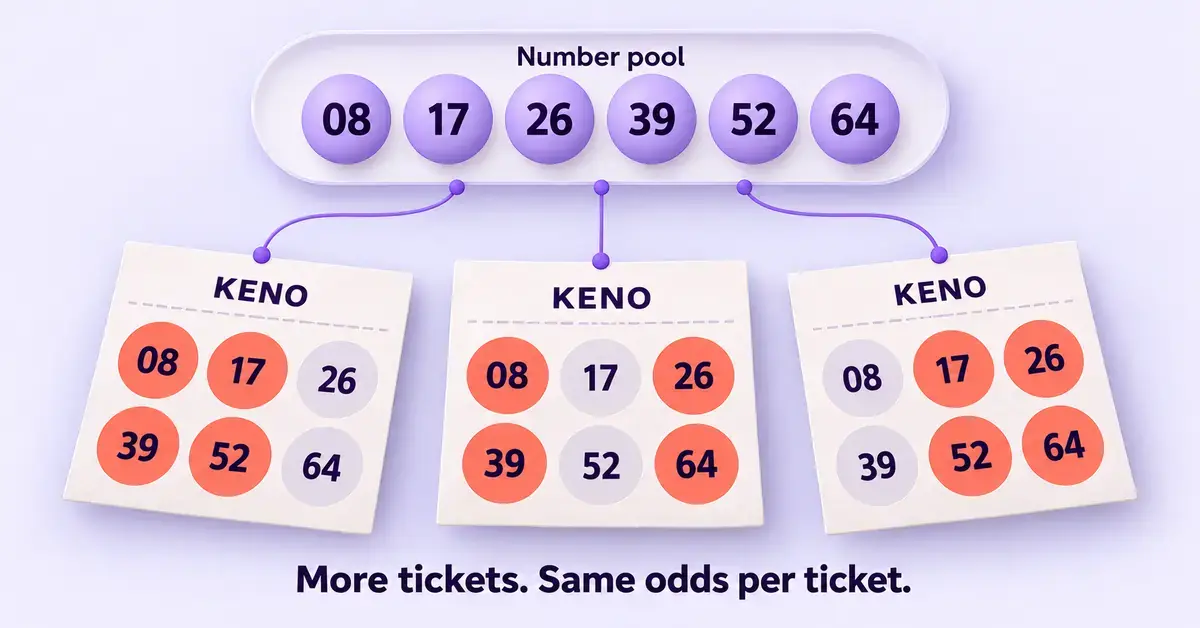
A keno wheeling system is a way of spreading a larger group of chosen numbers across several tickets so that, if enough of your numbers are drawn, at least one ticket is guaranteed to hit a set minimum. It is borrowed directly from lottery “wheeling,” and it does exactly one useful thing: it turns a single pick into a structured batch of bets. What it does not do is change the odds on any ticket or shift the long-run maths in your favour. This guide explains how wheeling works, what its guarantee really means, what it costs, and whether it is worth doing in Canadian keno.
Key Points
- A keno wheeling system splits a larger pool of your numbers across many overlapping tickets, so a single draw can land on several at once.
- Buying every ticket in the wheel guarantees a minimum catch level — but only if a set number of your pool numbers are actually drawn.
- Wheeling never changes the odds on an individual ticket or the game’s house edge; it only means you are holding more bets.
- Cost scales with the number of combinations: a full 4-spot wheel on six numbers is 15 tickets, so $15 per draw at $1 each.
- In Canadian keno, wheeling is done through combination and way tickets. It suits players who already buy multiple tickets, not anyone trying to beat the game.
What is a keno wheeling system?
A keno wheeling system is a method for arranging more numbers than you would normally play into a planned set of tickets, so that certain draw outcomes are guaranteed to produce a win. In keno you pick a few numbers (your “spots”) from a pool — 1 to 70 in OLG Daily Keno, 1 to 80 in most other Canadian and casino keno games — and 20 numbers are drawn. A “catch” is one of your spots that matches a drawn number.
Wheeling starts one step earlier. Instead of picking, say, four numbers and playing them on one ticket, you choose a bigger pool — maybe six, eight or ten numbers you want to cover — and then split that pool into multiple smaller tickets. Because the tickets overlap, a single lucky draw can land across several of them at once. The whole arrangement is called a “wheel,” and buying every ticket in it is what creates the guarantee.
The term comes from lottery play, where it is also called the “lottery wheel problem.” The maths is identical for keno: it is a covering problem, where you want a group of tickets arranged so that every winning combination you are hoping for appears on at least one of them.
How does a keno wheeling system work?
A wheel works by covering combinations of your chosen pool across many tickets, and the guarantee is written as “X if Y” — meaning you are guaranteed an X-number catch on at least one ticket whenever Y of your pool numbers are drawn. There are three common wheel types, from most complete (and most expensive) to most compact.
Full wheels
A full wheel plays every possible combination of your pool at the spot size you have chosen. If you like six numbers and want to play them as 4-spot tickets, a full wheel is every group of four you can make from those six. That is 15 tickets (written mathematically as “6 choose 4”). Buy all 15 and you have the strongest possible guarantee for that pool: if any four of your six numbers are among the 20 drawn, one of your tickets will show a full 4-catch.
Full wheels get expensive fast. A pool of 10 numbers played as 5-spot tickets is 252 separate tickets. That is why most people who wheel use a cut-down version.
Abbreviated or reduced wheels
An abbreviated wheel plays a carefully chosen subset of combinations that still guarantees a smaller prize for less money. You give up the strongest guarantee in exchange for far fewer tickets. For example, a reduced wheel on 10 numbers might promise “a 4-catch if 4 of your numbers are drawn” using around 20 tickets instead of the hundreds a full wheel would need. The trade-off is simple: fewer tickets, a weaker or narrower guarantee.
Key-number wheels
A key-number wheel puts one or more “key” numbers on every ticket in the wheel, then rotates the rest of your pool around them. Players use this when they have a number they want on all their tickets. It does not make that number more likely to be drawn — every number in the pool has the same chance on every draw — it simply changes how your tickets are structured around it.
What a keno wheel looks like on a real ticket
In Canadian keno you rarely fill out 15 separate slips by hand. The same effect is built into the game through way, combination and king tickets, which let you group numbers on one slip and have the terminal treat each group — and each combination of groups — as its own bet. A combination ticket that plays every 4-number group from your six numbers is, in practice, a full 4-spot wheel.
The crucial detail is the cost. Each combination on the ticket is a separate wager at the full stake. A 15-combination wheel at $1 a bet costs $15 per draw, not $1. The terminal is not giving you 15 plays for the price of one; it is selling you 15 plays and arranging them for you.
Does a keno wheeling system improve your odds?
No — a keno wheeling system does not improve the odds on any individual ticket, and it does not change the game’s house edge. This is the single most important point, and it is where wheeling is most often misunderstood.
Every keno draw is independent and random, so each ticket in your wheel has exactly the same chance of hitting as it would if you played it on its own. Arranging 15 tickets into a clever pattern does not make the drawn numbers any more likely to fall inside your pool. What changes is only how your money is spread: you now hold 15 bets instead of one, so your chance of winning something on at least one ticket goes up — purely because you bought more tickets.
That extra coverage is not free value. Keno carries one of the highest house edges in gambling, and every ticket in the wheel carries that same edge. Spreading your stake across 15 negative-expectation bets gives you 15 negative-expectation bets. The long-run expected return of the whole wheel is just the sum of its tickets, which stays below what you paid. A wheel can raise your chance of a small win while leaving your expected result negative — and the same maths that governs a single ticket, explained in our guide to keno probability, governs the wheel.
What Wheeling Changes
| Factor | Does wheeling change it? |
|---|---|
| Odds on any single ticket | No — each ticket keeps the same independent chance |
| House edge / long-run expected return | No — every ticket carries the same edge |
| Jackpot or top-prize odds | No — a keno wheel guarantees only a modest catch level |
| Chance of winning something on a draw | Yes — higher, simply because you hold more tickets |
| Frequency of small wins | Yes — more frequent, but spread across many paid bets |
| Amount you stake per draw | Yes — multiplied by the number of combinations |
What a wheel actually changes: cost and hit frequency
A wheel changes two things you can measure — how often you win and how much you stake — and nothing about the odds behind them. Think of it as a volume control, not an edge.
Because you are holding more tickets, you will see winning tickets more often. That feels like progress, but the wins are usually small and spread across many paid bets, so a run of “wins” can still leave you behind for the session. The flip side is cost: a full wheel multiplies your spend by the number of combinations, which can be a dozen times your normal stake or more.
A worked example
Say you choose six numbers and play them as a full 4-spot wheel. That is 15 tickets. At $1 each you stake $15 on a single draw.
- If four of your six numbers are drawn: the guarantee kicks in — exactly one of your 15 tickets shows all four, so you collect one 4-spot prize. The other 14 tickets each catch two or three of the four at best.
- If only three of your six are drawn: several tickets catch three numbers, so you may collect multiple small prizes — but you still staked $15 to get there.
- If none or one of your numbers is drawn: the whole $15 is lost, just as a single $1 ticket would have lost its stake.
Compare that with one plain 6-spot ticket for $1: fewer winning outcomes, but one-fifteenth of the cost. Neither approach is “better” in expected value — the wheel simply buys more coverage for more money. Deciding how much coverage you can afford is really a question of bankroll management, not strategy.
Keno wheels versus lottery wheels: why keno is different
Wheeling was designed for pick-style lotteries, and keno differs from them in ways that make wheeling less appealing. In a Lotto 6/49-style draw, a full wheel of 10 numbers can genuinely guarantee the jackpot if all the drawn numbers sit in your pool, because only six numbers are drawn from a fixed field.
Keno is the opposite shape. Twenty numbers are drawn, not six, and you are usually trying to catch a handful of your own spots among them. A “full wheel” in keno guarantees only a modest catch level, never the top prize, unless your pool is enormous — and a pool that large would cost far more than any prize it could win. Keno also pays fixed amounts per catch in most Canadian games, so there is no growing jackpot pool to chase. The result: wheeling in keno is really just structured multi-ticket betting, and it bumps into the same wall every system does. As our look at whether keno is rigged explains, regulated draws are random and audited, so no arrangement of numbers can beat them over time.
Common mistakes with keno wheeling systems
Most wheeling disappointment comes from a few predictable errors rather than bad luck. Watch for these.
- Believing the guarantee means profit. “Guaranteed win” only means a guaranteed catch level if a specific number of your spots are drawn. It does not guarantee the prize covers what you spent on the wheel, and it does not guarantee that enough of your numbers come up at all.
- Underestimating the cost. Players often focus on the per-ticket price and forget it is multiplied by every combination. A 4-spot wheel on eight numbers is 70 tickets — $70 per draw at $1 a bet.
- Treating “hot” and “cold” numbers as a system. Picking a pool from recent frequent numbers adds nothing; every number has equal odds every draw, as covered in our guide to the best keno numbers.
- Paying for a wheeling “system.” Covering charts are basic combinatorics and are freely available; paid systems that promise an edge are selling maths you can get for nothing, often wrapped in the gambler’s fallacy.
- Chasing losses with a bigger wheel. Expanding the pool after a losing run only increases the amount exposed to the house edge.
Who might a wheeling system suit?
A wheeling system suits a player who already plans to buy multiple keno tickets and simply wants them organised, not someone looking to beat the game. If you enjoy covering a wider set of numbers, like the steadier trickle of small wins, and treat the extra outlay as entertainment spending you can afford to lose, a reduced wheel is a tidy way to structure that play.
It is a poor fit for anyone on a tight budget, anyone expecting it to turn keno profitable, or anyone who would be tempted to keep enlarging the wheel to recover losses. For most players, understanding the odds trade-offs and setting firm limits — the heart of sensible keno strategy — delivers more than any wheeling chart.
Responsible gambling
Keno is a game of chance with a built-in house edge, and a wheeling system does not change that. No arrangement of numbers improves your long-run odds, and playing more tickets means staking more money at the same negative expectation. Treat any amount you spend as the cost of entertainment, never as an investment or a way to make money. You must be of legal age to play — 19 in most provinces, 18 in Alberta, Manitoba and Quebec. If gambling is no longer fun or feels hard to control, free, confidential help is available; in Ontario you can reach ConnexOntario at 1-866-531-2600, and every province has its own support service. See our responsible gambling resources for help lines and self-exclusion options across Canada.
Sources
Frequently Asked Questions (FAQ)
Does a keno wheeling system increase my chances of winning?
It increases your chance of winning something only because you are buying more tickets, not because the odds on any ticket improve. Each ticket keeps the same independent chance it always had, and the overall expected return stays negative.
What does “4 if 5” mean in a wheel?
It is the wheel’s guarantee: you are guaranteed at least a 4-number catch on one ticket whenever 5 of your chosen pool numbers are among the 20 drawn. The first number is the catch level you are promised; the second is the condition that triggers it.
How much does a keno wheel cost?
Each combination in the wheel is a separate bet at the full stake, so cost equals the number of combinations times your per-ticket price. A full 4-spot wheel on six numbers is 15 tickets, which is $15 per draw at $1 each.
Can I wheel numbers on Canadian keno games?
Yes, in effect, through combination and way tickets, which group your numbers and play each combination as its own priced bet. The number pool and prize tables differ by province, so check the rules for your specific game before building a wheel.
Are paid keno wheeling systems worth buying?
No. Wheeling charts are standard combinatorics that cost nothing to work out, and any product promising an edge over a random, audited draw is making a claim the maths does not support.
