

Independent guide · no tickets, no casinos
Keno Canada: Rules, Odds, Payouts and Provincial Games Explained
Keno is run by provincial lottery corporations, not private companies. This independent guide explains how the game works, what the odds and payouts really are, and how it differs from one province to the next.
Find your province: BC · Prairies · Ontario · Quebec · Atlantic · Territories
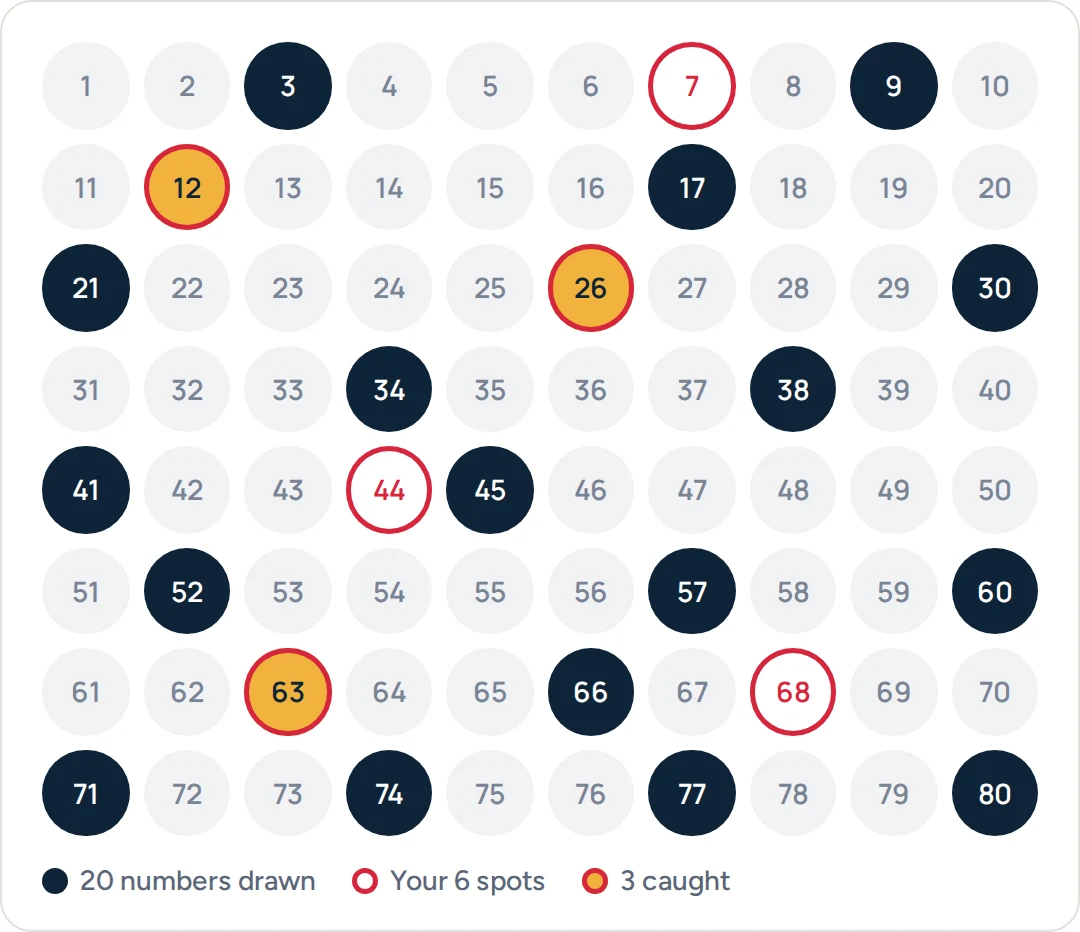
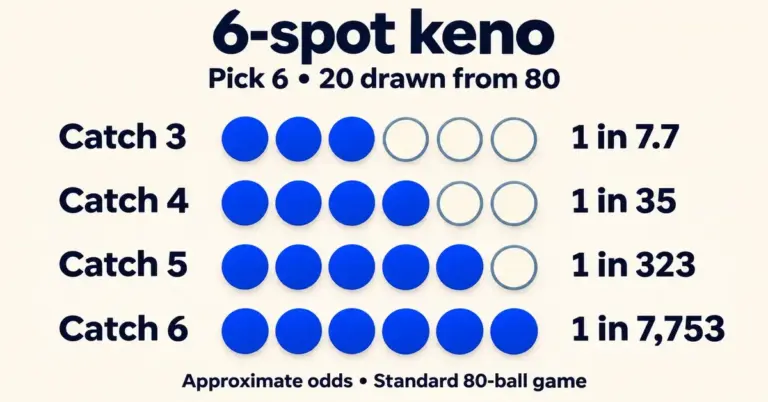
One draw on an 80-number board: you pick 6 spots, 20 numbers are drawn, you catch 3. Your chances →
Keno where you live
Atlantic Canada
Keno Atlantic · NB, NS, PEI, NL
- Number pool 1–70
- You pick 2 to 10
- Draws Nightly, 11:29 p.m. AT
Most read guides


Latest
- OLG Daily Keno in Ontario: How to Play, Prizes and Odds
- 6-Spot Keno Odds: Your Chances of Catching 3, 4, 5 and 6
- Keno in Canada’s Territories: Yukon, Northwest Territories and Nunavut
- How Much Does It Cost to Play Keno in Canada? Wagers and Minimums
- How to Play Keno for Multiple Draws: Advance Play in Canada
18/19+
Play for fun, not for income. Set a limit before you play. Free, confidential help is available in every province. Responsible gambling →
Odds at a glance
10-spot ticket, 80-ball game
| Catch | Odds |
|---|---|
| 8 of 10 | 1 in 7,384 |
| 9 of 10 | 1 in 163,381 |
| 10 of 10 | 1 in 8.9 million |
The complete guide to keno in Canada
Keno is a lottery-style numbers game, and in Canada it is run by provincial and regional lottery corporations rather than by private companies. This site is an independent, neutral reference that explains how keno works across the country: how you choose your numbers, how the draw decides winners, what the odds and payouts actually are, and how the game changes from one province to the next. Nothing here sells tickets or steers you toward a place to play. It exists so you can understand the game clearly before you decide whether it is for you.
Key Points
- Keno in Canada is run only by government lottery corporations — there is no privately licensed national keno.
- Every version works the same way: you pick “spots” (numbers), the lottery draws 20 numbers, and you win based on how many you match.
- The number pool is 1–70 in Ontario, Quebec and Atlantic Canada, and 1–80 in British Columbia and the Western provinces.
- Wagers are typically $1, $2, $5 or $10; a larger wager multiplies the prize, not your chances.
- Choosing more numbers raises the top prize but lengthens the odds of matching them all.
- You must be 19 to play in most provinces, or 18 in Alberta, Manitoba, Quebec and for lottery products in Ontario and Saskatchewan.
What is keno?
Keno is a draw game in which you pick a short list of numbers and hope they appear among a larger set of numbers the lottery draws at random. It descends from a centuries-old Chinese numbers game and reached North America with Chinese immigrants in the 1800s, which is why older names for it sometimes mention a lottery of “characters” or “spots.” Today it is a standard product offered by regulated lotteries worldwide.
The appeal is its simplicity and flexibility. You decide how many numbers to play and how much to wager, and prizes scale with both. Keno is pure chance: no skill, pattern or past result changes what the next draw produces, because every draw is independent.
How does keno work in Canada?
Every Canadian keno game follows the same three steps: you choose your numbers, the lottery draws 20 numbers, and you are paid based on how many of your numbers match. The details — the size of the number pool, how many numbers you may pick and how often draws happen — vary by province, but the core mechanic is identical everywhere.
Picking your spots
Your chosen numbers are called “spots.” Depending on the game you can play as few as one or two spots and as many as ten. A game where you pick four numbers is often written as a “4 Pick” or “4 spot.” You either mark the numbers yourself on a paper selection slip or let the terminal pick them at random for you; the odds are exactly the same either way.
The draw and your “catch”
In every draw the lottery selects 20 numbers at random from the game’s pool — that pool is 1 to 70 in some provinces and 1 to 80 in others. The numbers of yours that appear among those 20 are your “catch.” If you played a 4 spot and three of your four numbers are drawn, you caught three. How many you need to catch to win depends on how many spots you played.
How payouts are decided
Your prize depends on two things: how many spots you played and how many you caught, read from the game’s published prize table, and the size of your wager. Prize tables are quoted on a $1 basis, and a larger wager simply multiplies the listed prize. A $10 play that would pay $100 on a $1 basis pays $1,000, for example. A bigger wager never improves your odds of matching — it only scales the money.
Which keno games can you play in each province?
Keno is legal and available across Canada, but it is not a single national game. Each lottery corporation runs its own keno-style product with its own number pool, draw schedule and prize table. The table below compares the main ones, and the sections beneath it describe each in turn. Wagers of $1, $2, $5 or $10 are standard across all of them.
Provincial Keno Games at a Glance
| Game | Lottery corporation | Region | Number pool | Numbers you pick | Draw frequency |
|---|---|---|---|---|---|
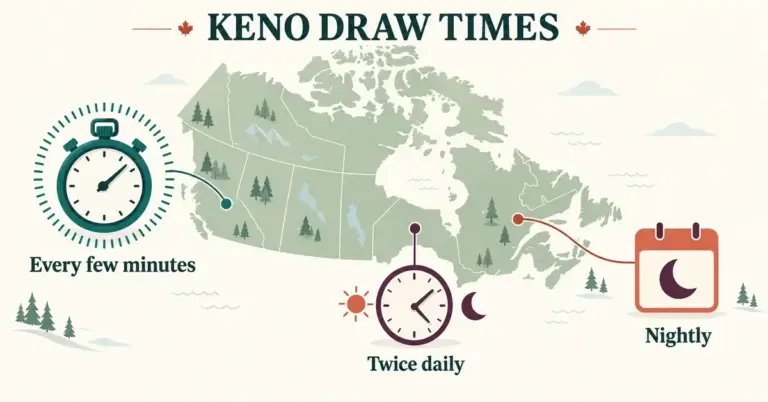
| Daily Keno | OLG | Ontario | 1–70 | 2 to 10 | Twice daily (2:00 p.m. & 10:30 p.m. ET) |
| Keno | BCLC | British Columbia | 1–80 | 1 to 10 | Roughly every 3.5 minutes during the gaming day |
| Keno | WCLC | Alberta, Saskatchewan, Manitoba & the territories | 1–80 | 1 to 10 | About every 5 minutes |
| Keno Atlantic | Atlantic Lottery | New Brunswick, Nova Scotia, PEI, Newfoundland & Labrador | 1–70 | 2 to 10 | Nightly (11:29 p.m. AT) |
| Banco | Loto-Québec | Quebec | 1–70 | 2 to 10 | Nightly (wager deadline 10:30 p.m.) |
Ontario: Daily Keno
In Ontario, keno is sold as Daily Keno by the Ontario Lottery and Gaming Corporation. You pick 2 to 10 numbers from a pool of 1 to 70, and 20 numbers are drawn twice a day — a midday draw at 2:00 p.m. Eastern and an evening draw at 10:30 p.m. Eastern. The top prize reaches up to $2,500,000 on a maximum wager, and an optional add-on called Encore can be attached to the ticket.
British Columbia: Keno
British Columbia Lottery Corporation offers a fast-paced Keno in which you pick 1 to 10 numbers from a pool of 1 to 80. A fresh draw of 20 numbers happens roughly every three and a half minutes throughout the gaming day, so results come far more often than in a once- or twice-daily game. Optional multiplier features such as Keno Bonus are available in this region.
Alberta, Saskatchewan and Manitoba: Keno
Across the Prairie provinces and the territories, the Western Canada Lottery Corporation runs a Keno that also draws 20 numbers from a pool of 1 to 80, with players choosing 1 to 10 numbers. Draws are held about every five minutes, and a single selection can be entered for anywhere from 1 up to 99 consecutive draws.
Atlantic Canada: Keno Atlantic
In New Brunswick, Nova Scotia, Prince Edward Island and Newfoundland and Labrador, Atlantic Lottery runs Keno Atlantic. You choose 2 to 10 numbers from a pool of 1 to 70, and 20 numbers are drawn once each night at 11:29 p.m. Atlantic Time. The top prize reaches up to $2,500,000 on the largest wager, and an optional add-on called TAG can be added for an extra $1 per selection.
Quebec: Banco
Quebec’s keno-style draw game, run by Loto-Québec, is Banco. It works on the same principle: you pick 2 to 10 numbers from a pool of 1 to 70, and 20 numbers are drawn, with the nightly wager deadline at 10:30 p.m. A Turbo option lets you double your wager, and selections can be entered for several draws at once.
What are the odds and payouts in keno?
Keno odds depend entirely on how many spots you play and how many you need to catch. The more numbers you choose, the larger the advertised top prize, but the harder it becomes to match them all — so bigger potential wins come with longer odds. Smaller plays win more often for smaller amounts.
Ontario’s Daily Keno illustrates the pattern with published figures. On a $1 wager, matching 2 of your numbers pays about $7 at odds of roughly 1 in 13; matching 3 pays about $25 at roughly 1 in 48; matching 4 pays about $100 at roughly 1 in 189. At the other extreme, matching all 10 numbers on a 10 Pick carries odds of about 1 in 2.1 million and pays $250,000 for every $1 wagered — which is how a maximum $10 wager reaches the $2.5 million top prize.
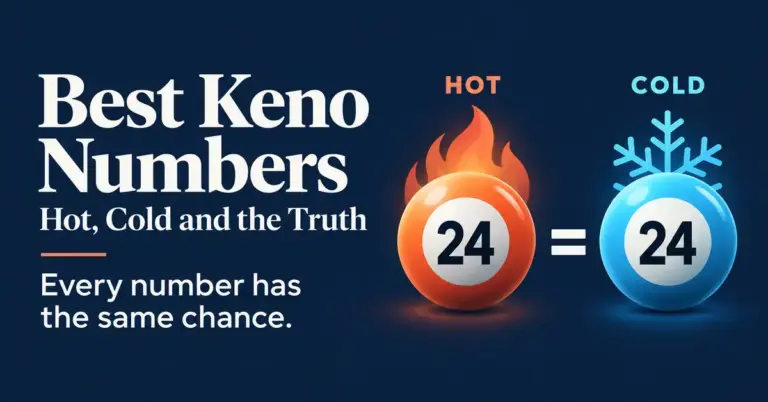
Two things are worth keeping in mind. First, prize tables and exact odds differ between the 1-to-70 games and the 1-to-80 games, so always read the specific game’s table. Second, because each draw is independent, there is no such thing as a “due” number or a hot streak that improves your next ticket.
What keno variants and add-ons exist?
Beyond the base game, several Canadian lotteries sell optional add-ons that change the price and the way prizes are calculated. They do not improve your odds of matching numbers; they adjust the payout. The main ones you will encounter include:
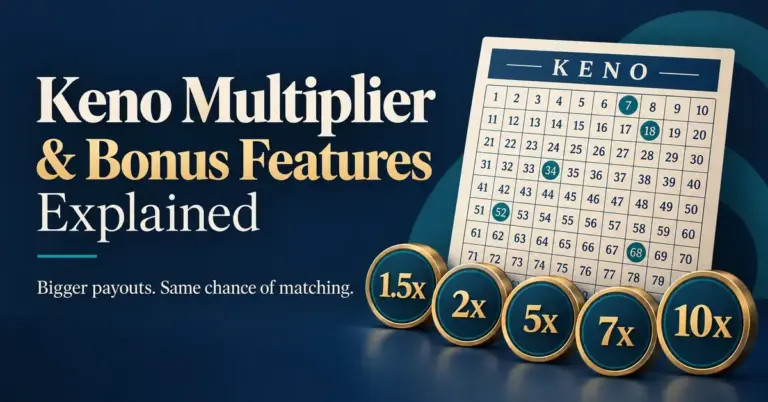
- Keno Bonus — offered in Western and British Columbia keno; you pay an extra amount equal to your base wager, and a multiplier drawn at random (for example 1.5×, 2×, 5×, 7× or 10×) is applied to any prize you win.
- Keno Doubler and Keno Tripler — optional multiplier features available in some western regions; see the current game conditions for exact pricing and mechanics.
- Keno Pattern Play — lets you build your selections using a pattern on the play grid rather than marking each number individually.
- TAG — an Atlantic add-on costing an extra $1 per selection, playable multiple times on one ticket.
- Encore — an Ontario add-on attached to a lottery purchase, drawn separately from keno itself.
Exact rules, prices and multiplier values change from time to time, so the official game conditions for your province are the final word on any add-on.
What are the most common keno mistakes?
Most keno misunderstandings come from treating a game of pure chance as if it could be outguessed. The errors below are the ones that most often lead players astray:
- Chasing “due” numbers. Frequency charts show what has happened, not what will happen. Every draw is independent, so a number that has not appeared recently is no more likely to be drawn next.
- Assuming more spots is always better. Playing 10 numbers raises the headline prize but makes catching them all extraordinarily unlikely. Fewer spots win smaller amounts far more often.
- Confusing wager size with odds. Raising your wager multiplies the prize, not your chance of matching. A $10 ticket has the same matching odds as a $1 ticket.
- Ignoring the specific game’s rules. A 1-to-70 game and a 1-to-80 game have different odds and prize tables; a payout you saw for one does not transfer to the other.
- Buying add-ons expecting better odds. Multipliers like Keno Bonus change payouts only; they never make your numbers more likely to be drawn.
Is keno legal in Canada, and who can play?
Keno is legal everywhere in Canada when it is offered by the province’s own lottery corporation. Under Canadian law, lottery schemes are conducted and managed by the provinces, which is why there is no single national keno and why each region runs its own version through OLG, BCLC, the Western Canada Lottery Corporation, Atlantic Lottery or Loto-Québec. Keno marketed by private or offshore operators is not part of this provincial framework.
You must meet the minimum age to buy a ticket. In most provinces that age is 19; in Alberta, Manitoba and Quebec it is 18; and in Ontario and Saskatchewan the minimum for lottery products such as keno is 18. Retailers and lottery terminals are required to verify age, and prizes are only paid to eligible players.
What you will find on this site
This homepage is the starting point for a set of focused guides. Each one goes deeper than the overview above, and together they cover the game from first ticket to responsible limits. The planned sections are:
- How to play keno — a step-by-step walkthrough of filling in a selection slip, choosing spots and reading your ticket.
- Keno odds and payouts — the full prize tables and match probabilities for the main Canadian games, side by side.
- Keno in Canada — a province-by-province breakdown of every regulated keno game and where it is sold.
- Keno strategy — an honest look at what bankroll and spot-count choices do, and why no system changes the odds.
- Keno variants — the add-ons and alternative formats, from multipliers to fast-draw games.
- Responsible gambling and about this site — our limits-first guidance and who stands behind the information here.
As each guide is published it will be linked directly from this page so you can move between them easily.
Responsible play and disclaimer
This website is an informational reference only. It is not affiliated with any lottery corporation, does not sell tickets and does not offer gambling advice or encouragement. Keno is a game of chance with a built-in house margin, which means that over time players lose more than they win; it should be treated as paid entertainment, never as a way to make money or recover losses.
You must be of legal age to play — 19 in most provinces, and 18 in Alberta, Manitoba, Quebec and for lottery products in Ontario and Saskatchewan. If gambling is causing you or someone you know harm, free and confidential help is available across Canada. In Ontario you can reach ConnexOntario 24/7 at 1-866-531-2600, and the Responsible Gambling Council and your provincial lottery’s safer-play resources list the helpline for every region.
Sources
Frequently Asked Questions (FAQ)
Is keno the same in every Canadian province?
No. The core idea is identical — pick numbers, 20 are drawn, match to win — but the details differ. Ontario, Quebec and Atlantic Canada use a 1-to-70 pool, while British Columbia and the Western provinces use 1-to-80. Draw frequency ranges from twice daily to every few minutes, and prize tables are not interchangeable.
How many numbers should I pick in keno?
There is no “right” number of spots; it is a trade-off. Playing fewer numbers wins smaller prizes more frequently, while playing more numbers raises the top prize but makes matching them all far less likely. The odds of matching are set by the game, not by which numbers you choose.
Can a strategy or system improve my keno odds?
No. Keno is pure chance and every draw is independent, so no betting system, number pattern or frequency chart changes the probability of the next result. Choosing numbers yourself and letting the terminal choose randomly give exactly the same odds.
What is the most you can win playing keno in Canada?
Top prizes depend on the game and your wager. In Ontario’s Daily Keno and Atlantic Canada’s Keno Atlantic, matching all 10 numbers on a maximum $10 wager can pay up to $2,500,000. Other provincial games publish their own top prizes, which you should confirm on the game’s prize table.
How old do I have to be to play keno in Canada?
You must be 19 in most provinces. The minimum is 18 in Alberta, Manitoba and Quebec, and 18 for lottery products such as keno in Ontario and Saskatchewan. Retailers verify age at purchase, and only eligible players can claim prizes.