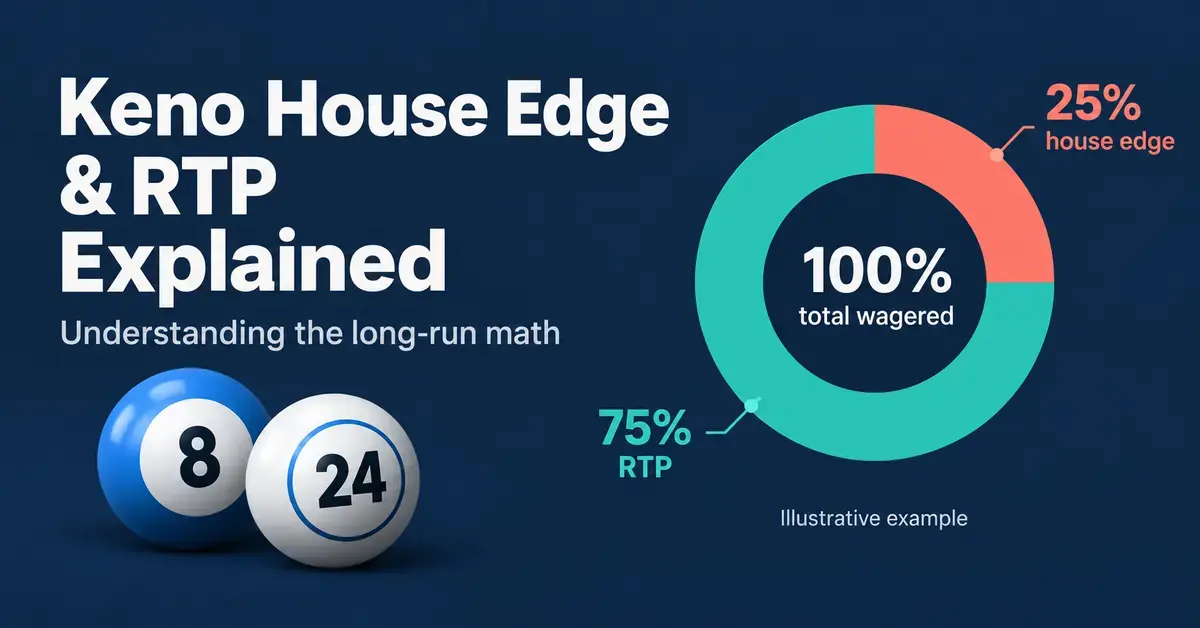
Keno has one of the highest house edges of any widely available gambling game. On a typical lottery or live keno ticket the operator keeps roughly 20 to 35 cents of every dollar wagered over the long run — far more than games such as blackjack, craps or roulette. This guide explains what the keno house edge and return to player (RTP) actually mean, why keno’s edge is so steep, the numbers you can realistically expect, and how the game compares to the alternatives. It does so honestly, with no suggestion that any pattern, lucky number or betting system can overcome the underlying math.
Key Points
- Keno has one of the highest house edges in gambling. Lottery and live keno typically keep about 20%–35% of every dollar wagered over the long run.
- RTP is the mirror of the house edge. A 25% house edge means an RTP of about 75% — and the two always add up to 100%.
- Video keno is usually better than lottery or live keno, often returning around 84%–95%, but it is still worse value than most table games.
- The edge is built into the fixed paytable. No lucky number, pattern, spot count or betting system removes it.
- Keno is negative-expectation entertainment. Over time the average player loses money; treat it as paid fun with a set budget, not a way to earn.
What is the house edge in keno?
The house edge in keno is the share of every wager the operator keeps on average over time. It is the built-in mathematical advantage that makes keno profitable for the lottery or casino and a long-run loss for players. If a keno game has a 30% house edge, then for every $100 wagered across many tickets the operator expects to keep about $30 and pay back about $70 in prizes.
Importantly, the house edge is a long-run average, not a prediction for any single ticket. On one draw you might win a large prize or nothing at all. The edge describes what happens across thousands or millions of tickets, which is exactly the scale an operator plays at. Over that horizon the result is extremely consistent, and it always favours the house.
What does RTP (return to player) mean in keno?
Return to player (RTP) is the mirror image of the house edge: it is the percentage of total wagers a game pays back as prizes over the long run. House edge and RTP always add up to 100%. A keno game with a 25% house edge has an RTP of about 75%, meaning roughly 75 cents of every wagered dollar is returned to players as a group, and 25 cents is kept by the operator.
Three points matter when reading an RTP figure:
- It is theoretical and long-run. A 75% RTP does not mean you get $75 back from a $100 session. It is a statistical average measured over an enormous number of plays.
- It is pooled across all players. Most of the returned money goes to a small number of winners, not evenly to everyone.
- It is set by the paytable. RTP comes directly from how much the game pays for each possible match, so it varies between games and operators.
Because the two figures are just two ways of stating the same thing, you can convert instantly: RTP = 100% − house edge, and house edge = 100% − RTP.
Why does keno have such a high house edge?
Keno’s house edge is high because the fixed prizes are set well below the true odds of the outcomes they pay for. In a fair bet, a result with a 1-in-10 chance would pay 10-to-1. Keno paytables deliberately pay less than that gap on every tier, and the accumulated shortfall across all tiers is the edge.
Several features of the game compound this:
- Large number pool, few draws. Twenty numbers are drawn from a pool of 70 or 80. Matching many of your picks is very unlikely, so the headline prizes look large but are rarely paid.
- Rounded, capped payouts. Prizes are set in tidy fixed amounts and are capped, which keeps the operator’s cost below the mathematically fair payout.
- Independent, random draws. Each draw is independent, so past results tell you nothing about future ones. There is no mechanism a player can exploit.
This is why keno is best described as negative-expectation entertainment: the expected value of every ticket is less than its cost. You are paying for the experience and the small chance of a prize, not making an investment with a positive long-run return. For the full picture of how odds and fixed prizes interact, see our guide to keno odds and payouts.
What is the typical keno house edge and RTP?
For lottery-style and live keno, the house edge is commonly in the 20% to 35% range, which corresponds to an RTP of roughly 65% to 80%. Gaming mathematician Michael Shackleford’s Wizard of Odds surveys of live keno found returns between about 65% and 80%, and a representative paytable figure of roughly 25% to 29% house edge. Video keno machines are usually more generous, with house edges often between about 5% and 16% (RTP around 84% to 95%), because their paytables are tuned more like other electronic games.
The exact number always depends on the specific paytable and the number of spots played. Two games labelled “keno” can have very different edges. The safe takeaway is directional rather than precise: lottery and live keno sit among the worst-value bets in a gambling venue, while video keno is somewhat better but still worse than most table games.
How does keno compare to other gambling games?
Keno has a far higher house edge than almost every common casino game. The table below places the typical keno figures alongside other games so the scale of the difference is clear. Lower house edge (and higher RTP) means better value for the player over the long run.
House Edge Comparison
| Game | Typical house edge | Typical RTP |
|---|---|---|
| Keno (lottery / live) | 20%–35% | 65%–80% |
| Video keno | 5%–16% | 84%–95% |
| Slot machines | 2%–15% | 85%–98% |
| Roulette (double zero) | 5.26% | 94.74% |
| Roulette (single zero) | 2.70% | 97.30% |
| Craps (pass line) | 1.41% | 98.59% |
| Baccarat (banker bet) | 1.06% | 98.94% |
| Blackjack (basic strategy) | ~0.3%–0.5% | ~99.5%–99.7% |
Figures are typical long-run averages and vary by paytable, rules and operator. House edge and RTP always add up to 100%.
Put plainly: a 25% keno edge is roughly 90 times the house edge of blackjack played with basic strategy, and about five times that of double-zero roulette. That gap is why keno is often singled out as the game to avoid if your goal is to make your money last. If you enjoy the format, video keno and the differences between game styles are covered in our overview of the main types of keno.
Does the house edge change with the number of spots you play?
Yes — the house edge can differ from one spot count to another, because each spot count (a 2-spot, 4-spot, 10-spot and so on) has its own paytable. One paytable might return slightly more of your money than another, so a 6-spot and a 10-spot on the same game can carry different edges.
Two cautions keep this in perspective:
- Every spot count still carries a large negative edge. Choosing a “better” spot count narrows the gap slightly; it never flips the game in your favour.
- The draw itself is unaffected. How many numbers you pick does not change the odds of any individual number being drawn. It only changes which paytable applies.
So picking the spot count with the best RTP is the one modest, legitimate lever a player has, and it is far smaller than marketing or myth suggests. It is a question of how fast you lose on average, not whether you win. For how spot count interacts with prize tiers, see how to play keno.
Is keno a good bet?
Purely as a wager, keno is a poor bet: it has one of the highest house edges and lowest RTPs you will find, so the average player loses money faster than at nearly any other game. If value — getting the most playing time or the best odds for your money — is your only measure, keno ranks at the bottom.
Whether it is a worthwhile way to spend money is a different, personal question. Some players value keno’s simplicity, its relaxed pace, the low $1 minimum on many provincial games, and the small chance of a large fixed prize. Viewed as paid entertainment with a strict, pre-set budget, that can be a reasonable choice. Viewed as a way to make money, it is not, and no approach changes that. Our honest look at keno strategy explains why no system beats the edge and what you can actually control.
The keno house edge in Canadian provincial games
Canadian provincial lotteries do not publish a single official RTP for their keno products, but the same principles apply, and the fixed paytables place these games firmly in the high-edge category. Keno in Canada is run province by province by regulated operators such as OLG in Ontario, BCLC in British Columbia, WCLC in the Prairies, ALC in Atlantic Canada and Loto-Québec.
Two examples show how the structure works in practice:
- OLG Daily Keno (Ontario) draws 20 numbers from a pool of 1 to 70. Players pick between 2 and 10 numbers and wager $1, $2, $5 or $10 per play.
- BCLC Keno (British Columbia), on PlayNow, draws 20 numbers from a pool of 1 to 80, lets players choose up to 10 numbers, runs a new draw roughly every 3.5 minutes, and has a top prize of $200,000 — or up to $2,000,000 with the optional Keno Bonus multiplier.
Because paytables and pool sizes differ between provinces, the precise house edge varies too. The reliable way to judge a specific game is to read its official game conditions and compare the prize for each match against the true odds. A wider province-by-province comparison is available in our guide to keno in Canada.
Common mistakes people make about keno odds and RTP
The biggest mistake is believing the house edge can be beaten. It cannot, and several related misconceptions lead players to spend more than they intended:
- Thinking “due” or “hot” numbers matter. Draws are independent and random. A number that has not appeared recently is no more likely to be drawn next.
- Confusing a big top prize with good odds. A large advertised jackpot usually comes with a very small chance of winning it, which is part of what keeps the RTP low.
- Assuming more spots means better odds. Picking 10 numbers does not improve your chances; it simply applies a different paytable with its own tiers.
- Treating free plays or demo modes as an edge. They let you learn the interface but do not change the odds or RTP of real-money play.
- Chasing losses. Increasing your wager to recover a loss does not change the negative expectation; it only increases how much you can lose.
Understanding these points will not make keno a winning game, but it will stop you from paying for strategies and systems that cannot work.
Responsible gambling and disclaimer
This article is informational only and is not betting, financial or legal advice. Keno is a game of chance with a negative long-run expectation: over time, players as a group lose more than they win, and no system, pattern or spot selection changes the built-in house edge. In Canada you must be of legal age to play — 18 or 19 depending on your province — and you should only wager money you can afford to lose, within limits you set in advance.
If gambling is causing stress or financial harm for you or someone you know, free, confidential help is available. See our responsible gambling help and support page for verified national and provincial resources, including helplines and self-exclusion options.
Sources
Frequently Asked Questions (FAQ)
What is the house edge on keno?
Lottery and live keno typically carry a house edge of about 20% to 35%, meaning the operator keeps roughly 20 to 35 cents of every wagered dollar over the long run. Video keno is usually lower, often around 5% to 16%. The exact figure depends on the specific paytable.
What is a good RTP for keno?
Keno RTP is generally low compared with other games. Lottery and live keno often return about 65% to 80%, while video keno can reach roughly 84% to 95%. Even the higher end is below the RTP of most table games, so a “good” keno RTP is still worse value than blackjack, craps or roulette.
Is keno a good bet compared with other games?
No. Keno has one of the highest house edges and lowest RTPs of common gambling games, so on value alone it ranks near the bottom. It can be reasonable as budgeted entertainment, but it is a poor choice if your aim is to make your money last or to win over time.
Can any strategy reduce the keno house edge?
No betting system, lucky number or pattern reduces the house edge. The only modest lever is choosing the spot count with the best paytable RTP on a given game, which narrows the loss slightly but never removes the negative expectation. Draws are random and independent.
Why is keno’s house edge higher than slots or roulette?
Keno pays fixed prizes that are set well below the true odds of each match, and the large pool of 70 or 80 numbers makes high matches very rare. Slots and roulette use paytables tuned to much smaller edges, so they return a larger share of wagers to players.
