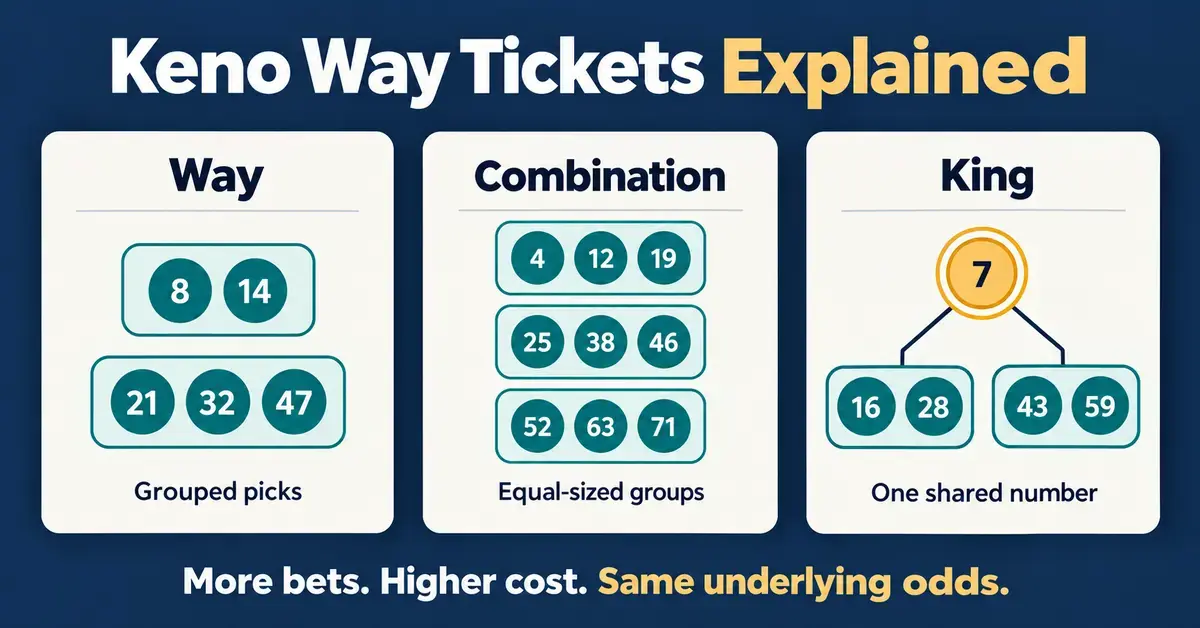
A keno way ticket lets you split your chosen numbers into groups and play several bets on a single slip, so one ticket can win in more than one way at the same time. Combination tickets and king tickets are close relatives that use the same idea — grouping numbers to create extra bets from the spots you have already marked. This guide explains what each ticket type is, how the grouping is marked and counted, and walks through a simple worked example. Keep one point clear from the start: grouping multiplies how many bets you place, and therefore what you pay, but it never changes the underlying odds of the game.
Key Points
- A way ticket splits your picks into groups and plays several bets at once; each “way” is scored on its own paytable.
- A combination ticket is a way ticket where every group is the same size (for example a 3×3×3 nine-spot).
- A king ticket adds a single circled number that joins every group to create more ways.
- The number of ways — and the total cost — climbs quickly as you add groups or a king.
- Grouping changes how you bet, not the odds: keno keeps the same built-in house edge however you mark the slip.
- Provincial daily keno in Canada is a straight pick-per-board game; true way, combination and king slips are a casino, club and video-keno feature.
What is a keno way ticket?
A keno way ticket is a single ticket on which your numbers are divided into groups, and each combination of those groups is played as its own separate bet. Instead of one wager on one set of numbers, you place several smaller wagers at once. Each separate bet is called a “way,” which is where the name comes from.
On a plain or “straight” ticket you mark one set of spots — say six numbers — and you win only if enough of those six match the draw. On a way ticket you might split the same six numbers into two groups of three. Now the ticket can win if either group of three comes in on its own, as well as if all six hit together. The appeal is frequency: smaller groups land more often than one large set, so a way ticket pays back in smaller amounts more regularly, even though the big combined bet pays less often. If you are new to the mechanic of picking spots and matching the 20 drawn numbers, start with the basics in our guide to how to play keno before layering groups on top.
How do you group and mark the numbers?
You create groups by circling or bracketing sets of numbers on the keno slip so the terminal or writer can tell which spots belong together. Each circled set is one group. The groups can be the same size or different sizes, depending on the ticket type you are building.
- Circle each group. Draw a ring around the numbers that form one group, then a separate ring around the next group. A six-number ticket split into two threes shows two rings of three.
- State the ways. You tell the writer (or select on the terminal) which group-combinations you want to play and how much to wager on each. This is sometimes called “conditioning” the ticket.
- Set a wager per way. Every way carries its own stake. Some venues let you bet below the usual minimum when you play several ways; others require the full minimum on each one. Always check the posted minimum before you commit.
Because the slip now carries several bets, it also pays on several schedules. Each way is scored independently on the paytable for its own spot size, and more than one way on the same ticket can win in a single draw.
How are the “ways” counted? A simple worked example
The number of ways equals the number of group-combinations you choose to play, and the simplest version uses just two groups. Here is a worked example you can follow line by line.
Say you like six numbers and split them into two groups of three:
- Group A: 7, 12, 23
- Group B: 44, 58, 69
From those two groups you can build three distinct bets:
- Group A on its own — a 3-spot bet (7, 12, 23)
- Group B on its own — a 3-spot bet (44, 58, 69)
- Group A + Group B together — a 6-spot bet (all six numbers)
That is a “3-way” ticket: two 3-spot ways plus one 6-spot way. At a stake of $1 per way, the ticket costs $3. Each way is settled on its own paytable: if only Group A comes in, you still collect on the 3-spot way; if all six hit, the 6-spot way and both 3-spot ways can pay at once. Compare that with a straight 6-spot for $1, which pays nothing unless enough of all six match together.
Add a third group and the count rises quickly. Three groups of two — a “2-2-2” ticket — produces seven ways: the three 2-spots on their own, the three different 4-spot pairs, and one 6-spot with all three groups combined. At $1 per way that single slip is a $7 play.
What is a combination ticket?
A combination ticket is a way ticket in which every group holds the same number of spots, and you play every possible combination of those groups. The equal group sizes make the ticket symmetrical and easy to price, which is why “combination” and “way” are often used loosely to mean the same thing.
The classic example is a 3×3×3 nine-spot: you mark three groups of three numbers, usually labelled A, B and C. From those three equal groups you can play the three single 3-spots, the three different 6-spot pairs, and the one 9-spot that uses all nine numbers — seven ways in total. Every way is scored separately, so the ticket can return on several of them in the same draw. The difference from a general way ticket is only the rule that each group is the same size; the counting and settlement work the same way.
What is a king ticket?
A king ticket adds a “king” — a single number circled entirely on its own — that joins into every other group to create extra ways. A king is never a group of two or three; it is one number set apart, and its job is to swing into each of your other groups and the combinations between them.
Take the two-group example above, Group A (7, 12, 23) and Group B (44, 58, 69), and add the number 31 as a king. The king multiplies the ticket into more ways, for example:
- Group A + king — a 4-spot (7, 12, 23, 31)
- Group B + king — a 4-spot (44, 58, 69, 31)
- Group A + Group B + king — a 7-spot (all seven numbers)
Those sit on top of the original three ways, so one king can noticeably expand a ticket. Exactly how a king is allowed to combine, and whether it can ever be played alone, varies between venues, so read the house rules or the terminal’s help screen before you build a king ticket. The takeaway is the same as for every grouping tool: a king adds bets, not an advantage.
How grouping multiplies your bet — and your cost
Grouping multiplies your total stake because you pay for every way on the ticket, not just one bet. The cost of a way, combination or king ticket is simply the price per way multiplied by the number of ways, plus any separate bet you place on the full set of spots.
- Two groups of three (3-way) at $1 per way = $3.
- Three groups of two (2-2-2, 7 ways) at $1 per way = $7.
- Add a king or a fourth group and the number of ways can climb into the dozens, so a slip that looks like “a few numbers” can become a double-digit wager.
Some venues lower the per-way minimum once you play several ways — for instance allowing 50 cents a way instead of a $1 minimum — while others charge the full minimum on every way. Either way, the house only ever pays back against the amount you actually staked on each way; grouping does not buy you extra prize money for free. Budgeting for the total number of ways, not the headline “per way” figure, is the single most useful habit with these tickets. For how stakes translate into prizes across spot sizes, see our overview of keno odds and payouts.
Ticket Types Compared
| Ticket type | What you mark | Number of bets | Example | Changes the odds? |
|---|---|---|---|---|
| Straight ticket | One set of spots | 1 | A single 6-spot | No (baseline) |
| Way ticket | Two or more groups (any sizes) | One per group-combination played | Two 3-spot groups → 3 ways (two 3-spots + one 6-spot) | No |
| Combination ticket | Several groups of equal size | Every combination of the groups | Three 3-spot groups (3×3×3) → 7 ways | No |
| King ticket | A single circled “king” plus other groups | King joins each group and combination to add ways | Two 3-spot groups + 1 king → extra 4-spot and 7-spot ways | No |
Do way, combination or king tickets improve your odds?
No — way, combination and king tickets do not improve your odds or your expected return. They are a way of placing many bets on one slip, nothing more. Each way is settled exactly as if you had bought that bet on its own straight ticket, so the maths is identical whether you spread the bets across several slips or bundle them into one.
Keno keeps a fixed, built-in house edge no matter how you mark the ticket. On land-based keno that edge is high — commonly cited in the region of 20% to 35%, depending entirely on the operator’s paytable — and grouping numbers does not shrink it. What grouping changes is the shape of your results: more frequent small returns from the little groups, and a larger, rarer prize from the combined bet, at the price of a bigger total stake. Treat these tickets as a betting style you enjoy, not an edge. Our honest guide to keno strategy explains why no ticket structure beats a random draw with a fixed margin.
Can you play way tickets in Canada?
Way, combination and king tickets are mainly a casino, club and video-keno feature, so where you meet them in Canada depends on the venue rather than on a provincial lottery slip. The traditional grouped ticket comes from parlor and casino keno, and the same idea appears on video keno terminals and some online random-number-generator keno games.
Canada’s provincial daily draws work differently. OLG’s Daily Keno in Ontario, for example, is a straight pick-per-board game: you pick 2 to 10 numbers from 1 to 70, choose a wager per board, and match the 20 drawn — there is no circling of groups into ways. To play several bets you simply fill in several boards. The other provincial products run on the same per-board principle. So in practice a Canadian player who wants true way or king tickets is usually looking at casino keno or a video/online keno game, while a Daily Keno player reproduces the same “spread” by buying multiple boards. For which operator offers what across the country, see keno in Canada, and for how video and casino keno differ from the lottery draw, see our guide to types of keno.
Common mistakes with way tickets
The most common mistake is assuming the grouping improves your chances; the rest are usually about cost and how the ticket is read.
- Believing ways beat the odds. They do not. Each way pays exactly as its own straight bet would, against the same house edge.
- Underestimating the total stake. Ways multiply fast. Three or four groups, or an added king, can turn a “small” ticket into a large one. Count the ways before you pay.
- Forgetting the per-way minimum. Every way needs a valid stake. If the venue requires the full minimum on each way, the total can be far higher than you expected.
- Misreading which ways are in play. If you only want certain combinations, confirm the ticket is conditioned for exactly those ways — not every possible one.
- Expecting way tickets on a Daily Keno slip. Provincial draw keno is pick-per-board; you cannot circle groups into ways on it.
- Chasing losses by adding ways. Stacking more ways after a losing draw raises your stake without changing the odds. Set a budget first.
Who are way tickets for?
Way, combination and king tickets suit players who want more frequent small results and enjoy building a ticket, and who can comfortably afford the larger total stake that grouping creates. If you like the idea of one slip paying on several bets at once, and you understand that the trade-off is cost rather than better odds, these formats add variety to how you play.
They are a poor fit for anyone on a tight budget, anyone hoping to improve their chances of winning, or anyone who finds the cost hard to track — a straight single ticket is cheaper and easier to follow. Whichever style you choose, the money you stake is the money at risk, and the house keeps its margin either way.
Responsible gambling and disclaimer
This article is for information only and is not betting advice or a system for winning. Keno is a game of chance with a fixed house edge, and way, combination and king tickets change only how you bet — they do not improve your odds or your long-term return. You should expect to lose money over time, and grouping numbers can increase how much you stake per ticket.
The legal age to play lottery and casino games in Canada is 18 or 19 depending on the province. Only ever wager money you can afford to lose, set a budget before you start, and never chase losses by adding bets or ways. If gambling is causing you or someone you know harm, free and confidential help, self-exclusion options and provincial helplines are available — see our responsible gambling help in Canada page for verified resources and numbers.
Sources
Frequently Asked Questions (FAQ)
What is a keno way ticket in simple terms?
It is one ticket on which your numbers are split into groups, and each combination of those groups is played as a separate bet called a “way.” The ticket can win on more than one way at a time, but you pay for every way you play.
How many ways does a two-group ticket have?
Three. Two groups give you each group on its own plus the two groups combined — for example two groups of three make two 3-spot ways and one 6-spot way, a “3-way” ticket.
Do way tickets give better odds than a straight ticket?
No. Each way is settled exactly as the same bet would be on its own ticket, against the same fixed house edge. Grouping changes the pattern and cost of your bets, not the odds.
What is a king number in keno?
A king is a single number circled on its own that joins into every other group on the ticket to create extra ways. It adds more bets, and therefore more cost, but no mathematical advantage. Exactly how a king combines can vary by venue.
Can I play way tickets on Canada’s Daily Keno?
Not as grouped ways. Provincial daily keno, such as OLG Daily Keno, is a straight pick-per-board game, so you place multiple bets by filling in multiple boards. True way, combination and king tickets are a casino, club and video-keno feature.
