

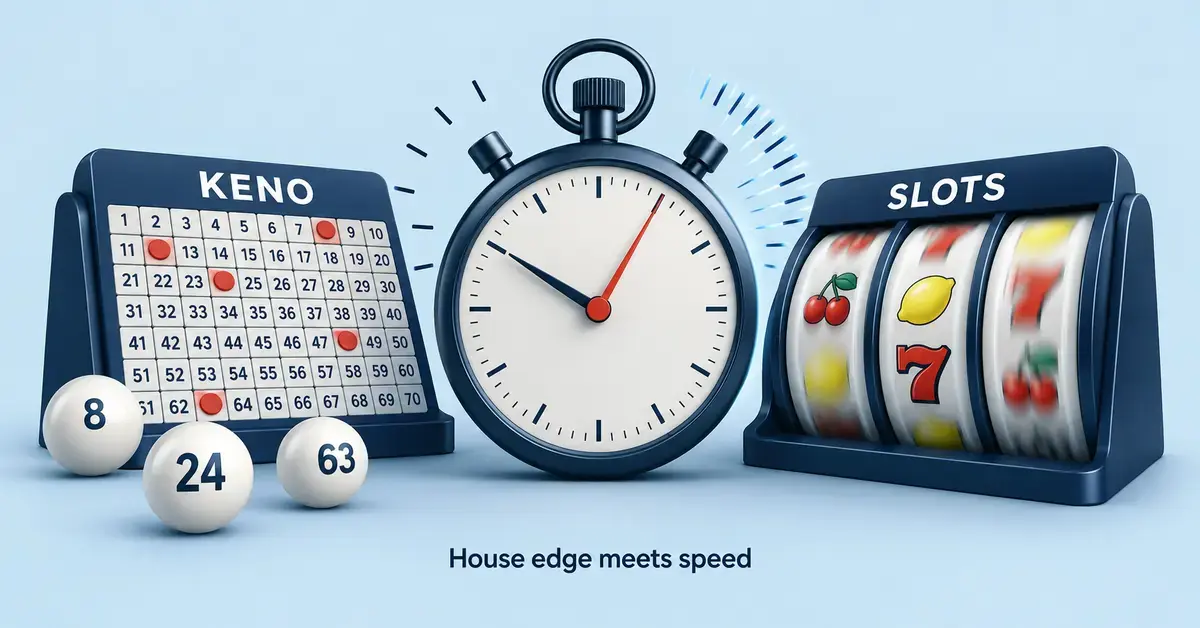
Keno and slot machines are both pure games of chance with a built-in advantage for the house, but they are not equally expensive to play. The short answer: keno usually carries a far higher house edge (often 20%–35% for lottery and live keno), while slots typically take 2%–15% — yet slots play so much faster that they can empty a bankroll just as quickly. “Which is better” is not about which one wins more, because neither can be beaten over time. It is about pace, prize type, how much say you have, and what you actually enjoy. This guide compares the two on the numbers that matter.
Key Points
- Both are games of chance with a house edge — neither keno nor slots can be beaten over the long run.
- Keno’s edge is usually much higher: about 20%–35% for lottery and live keno, versus roughly 2%–15% for slots.
- Slots return more but play faster: RTP of ~85%–98% means little when you can spin several hundred times an hour.
- Expected loss = edge × total wagered — pace, not just the edge, decides what a session really costs.
- Control is limited either way: keno lets you pick numbers and spots; slots only let you pick the game and bet size. Neither changes the odds.
What are keno and slots?
Keno and slots are both lottery-style games of chance, but the mechanics are very different. In keno you pick a small set of numbers (usually 2 to 10, called “spots”) from a larger pool, then 20 numbers are drawn at random; the more of your picks that match the draw, the more you win, following a fixed pay table. A slot machine shows spinning reels of symbols, and a round pays when matching symbols land on an active line or trigger a bonus feature. A spot is simply one of the numbers you choose on a keno ticket.
Both outcomes are decided by chance. Modern keno draws and every electronic slot use a random number generator (RNG) — a computer process that produces unpredictable results — or, for drawn keno, a physical ball draw. Each round is independent of the last, so nothing you did on a previous spin or draw changes the next one.
Keno vs slots: the odds and house edge compared
On raw house edge, slots are the cheaper game per bet — often by a wide margin. The house edge is the share of every dollar wagered that the game keeps on average over the long run; its mirror image is the return to player (RTP), the share paid back. A game with a 10% house edge has a 90% RTP. Neither figure tells you what happens in one session — luck dominates the short term — but over thousands of rounds the edge is what decides the outcome.
What is the house edge in keno?
Keno has one of the highest house edges in gambling, typically 20%–35% for lottery and live-casino keno. That corresponds to an RTP of roughly 65%–80%, meaning the game keeps 20 to 35 cents of an average dollar. Video and online keno are usually kinder, with edges often in the 5%–16% range, because electronic pay tables can be set more generously. The exact figure depends on the operator’s pay table, not on which numbers or how many spots you choose — changing your picks never changes the edge. For the full breakdown, see our guide to the keno house edge and RTP.
What is the house edge and RTP in slots?
Slots generally return far more of your money than keno, with a house edge usually between 2% and 15% and an RTP around 85%–98%. Online slots often sit near the top of that band, commonly 94%–97%. Regulated Canadian machines also have a legal floor: the Alcohol and Gaming Commission of Ontario (AGCO), for example, requires slots in Ontario gaming sites to pay out at least 85% of wagers over each machine’s life. The headline RTP is only an average, though: a high-volatility slot can run cold for a long stretch and then pay in one large hit, while a low-volatility slot pays small amounts more often. Volatility describes how choppy the wins are, not how much the game returns overall.
Which has the better odds?
Slots have the better odds per bet, because their house edge is usually several times lower than keno’s. A rough comparison: risking a dollar on lottery keno gives up about 20–35 cents of expected value, while the same dollar on a typical slot gives up only about 2–15 cents. On that measure alone, slots are the less costly game. But “per bet” is the catch — how often you bet matters just as much, which is where slots claw back the difference.
Comparison
| Feature | Keno | Slots |
|---|---|---|
| Typical house edge | 20%–35% (lottery / live); ~5%–16% (video keno) | ~2%–15% (online often 4%–6%) |
| Typical RTP | ~65%–80% (live); ~84%–95% (video) | ~85%–98% |
| You choose the numbers? | Yes — pick 2 to 10 spots | No — reels are automatic |
| Round speed | Slow to fast (twice daily up to every ~3.5 min) | Very fast — hundreds of spins per hour |
| Prize type | Fixed pay table per match | Variable: symbol combos, features, jackpots |
| Top prize | Fixed maximum (hundreds of thousands) | Up to progressive jackpots (can reach millions) |
| What you control | Spot count, numbers, stake | Game choice, bet size |
| Outcome | RNG or ball draw; each draw independent | RNG; each spin independent |
How fast you lose: the pace factor most players ignore
Pace is the hidden reason slots can cost as much as keno despite the lower edge, because your expected loss is the house edge multiplied by everything you wager — and faster play means far more wagers. Expected loss per hour is roughly: bet size × rounds per hour × house edge.
Slots are among the fastest games in any casino. A player can complete several hundred spins an hour, so even a small edge is applied over and over. As Wizard of Odds puts it, between a high house edge and a fast rate of play “there is no quicker way to lose your money in a casino.” Keno’s pace swings enormously by format: provincial lottery keno such as Ontario’s Daily Keno draws only once or twice a day, Western and British Columbia keno draws roughly every 3.5 minutes, and the fast monitor keno found in bars runs every few minutes.
A worked example shows why the edge alone is misleading. Bet $1 per round at a 30% keno edge, but play just 10 slow draws in an hour, and your expected loss is about $3. Bet $1 per spin on a slot with a 6% edge but spin 500 times in that hour, and your expected loss is about $30 — ten times more, despite the far lower edge. The slower the game, the less the house edge can bite.
Prizes and jackpots: what can you actually win?
The two games pay in fundamentally different ways. Keno uses a fixed pay table: match a set number of your spots and you win a set amount (or a set multiple of your stake), known in advance. The top prizes on Canadian lottery keno reach into the hundreds of thousands of dollars for a maximum catch, but the odds of hitting the top tier are extremely long. Slots pay variable amounts based on symbol combinations and bonus features, and many are linked to progressive jackpots — a pooled prize that grows with play and can climb into the millions before someone wins it. Neither prize structure improves your overall odds; a bigger possible jackpot is funded by a lower chance of hitting it.
How much control do you have?
Keno gives you slightly more to decide, but neither game lets you influence the result. In keno you choose how many spots to play and which numbers, plus your stake — decisions that change the shape of the pay table (hit frequency versus top prize) but not the house edge. In slots you choose only the game and the bet size; the reels are entirely automatic. Importantly, no betting system, number pattern or “hot” machine tilts the math in either game, because every round is independent and random. If you want the full picture on what a player can and cannot control, see our honest look at keno strategy and what actually works.
Which is better for you?
Neither game is “better” at making money — both are negative-expectation entertainment — so the right choice depends on what you value. The comparison below frames it by preference, not by any promise of winning.
Keno may suit you if…
- You like picking your own numbers and a slower, lottery-style rhythm.
- You prefer fixed, known prizes over surprise bonus features.
- You are playing drawn lottery keno once or twice a day, where the slow pace limits how much the high edge can cost you.
- You enjoy the social, low-key feel of a ticket game.
Slots may suit you if…
- You want a lower house edge per bet and generally higher RTP.
- You enjoy animations, bonus rounds and the chance at a large progressive jackpot.
- You will set a firm time or money limit — because the fast pace is what makes slots risky, not the edge.
For comparisons with other number games, our guides on keno vs the lottery and keno vs bingo cover how keno stacks up elsewhere.
Common mistakes players make
The biggest mistake is judging the two games on house edge alone and ignoring pace. A slot’s low edge feels safe, but at several hundred spins an hour it can out-lose slow keno many times over. Other frequent errors include:
- Believing a game is “due” to pay. Each keno draw and each slot spin is independent; a long cold streak does not raise the next round’s odds.
- Thinking high RTP means you will win. RTP is a long-run average across all players; it does not protect any individual session.
- Chasing progressive jackpots. The bigger the top prize, the longer the odds against hitting it.
- Confusing video keno with lottery keno. Video keno is faster and usually lower-edge, so its risk profile is closer to slots. See how machine keno differs in our guide to video keno and Power Keno.
- Playing without a limit. On any fast game, a budget and a stop-loss matter more than picking the “right” game.
Responsible Gambling Disclaimer
This article is for information only and is not betting advice or a recommendation to play. Keno and slots are both games of chance with a permanent house edge, which means that over time the games are designed to return less than players wager; no system, number choice or machine improves your long-term odds. You must be of legal gambling age in your province — 19 in most of Canada, 18 in Alberta, Manitoba and Quebec. If gambling stops being fun or starts causing harm, free, confidential help is available. In Ontario you can reach ConnexOntario any time at 1-866-531-2600, and every province has its own support line. See our responsible gambling help and support page for the full list of verified resources.
Sources
Frequently Asked Questions (FAQ)
Does keno or slots have the better odds?
Slots have the better odds per bet. A typical slot house edge is about 2%–15%, while lottery and live keno usually run 20%–35%. However, slots play far faster, so a lower edge does not automatically mean a smaller loss over an hour.
Why is keno’s house edge so high?
Keno’s pay tables are set to keep a large share of wagers — often 20 to 35 cents per dollar on lottery and live keno — in exchange for the chance at a large fixed prize from a small stake. The edge comes from the pay table, not from the numbers you pick.
Can you win more consistently on slots than keno?
No game pays out consistently, because both are random and negative-expectation. Slots return more of your money on average (RTP around 85%–98%), but that is a long-run figure and does not guarantee any single session.
Is video keno closer to slots?
Yes, in risk terms. Video keno is machine-based, plays quickly and usually carries a lower house edge (often 5%–16%) than drawn lottery keno, which puts its pace and cost profile closer to a slot machine than to once-daily lottery keno.
Which should a beginner choose?
Either is fine for small, budgeted entertainment, but a beginner should set a firm limit first. Slow lottery keno limits how fast the high edge can cost you, while slots are lower-edge but fast — so on slots the discipline to stop matters most.
