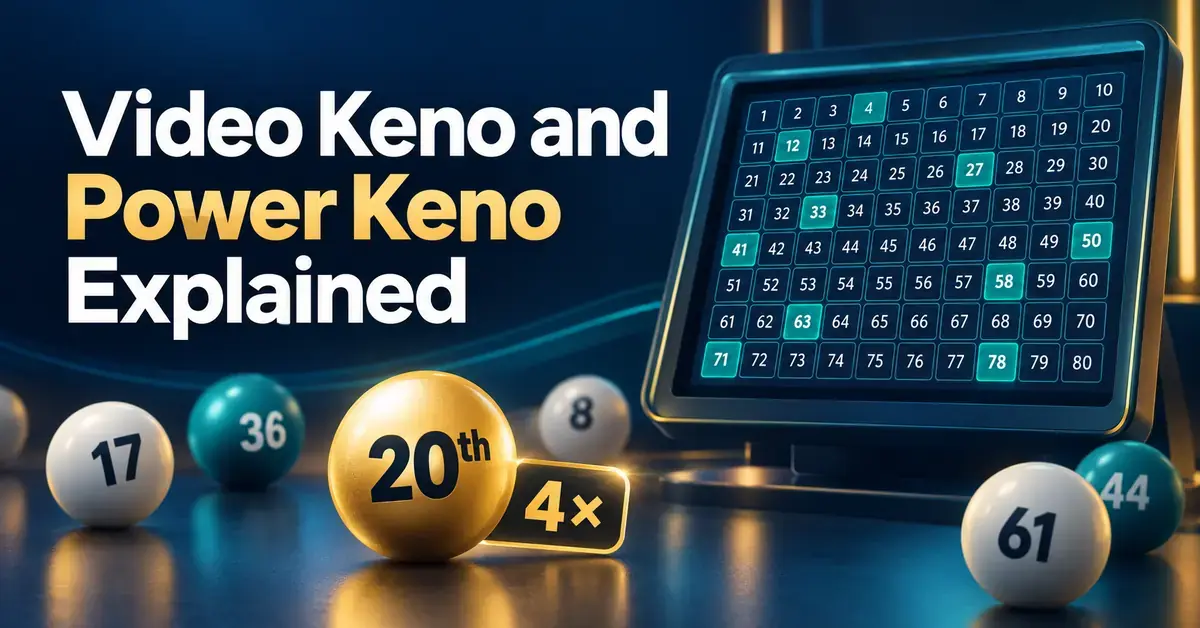
Video keno is the electronic, machine-based form of keno: instead of a live caller or a daily provincial draw, a computer picks the numbers and a touchscreen shows the result in seconds. It plays by the same core idea as any keno game — you choose a handful of numbers, the game draws 20, and matches pay — but the pace, the bonus features and the way the draw is produced all set it apart. This guide explains how video keno works, what Power Keno and Super Keno add on top, how the odds and speed compare with drawn keno, and what that faster pace means for your money.
Key Points
- Video keno is the electronic, RNG-based form of keno: pick up to 10 numbers from 1–80, the machine draws 20, and catches pay per the on-screen paytable.
- Power Keno multiplies your win (commonly 4x) when the last (20th) ball matches one of your spots.
- Super Keno applies a bonus when the first ball matches one of your spots.
- These bonuses change how a win is paid, not how often you win — the odds come from the paytable, not the feature.
- Video keno plays much faster than drawn keno (up to about 300 games per hour vs roughly 5–12), which is its main added risk.
- Typical casino video keno returns about 85–91% (house edge roughly 9–15%); always read the posted paytable first.
What is video keno?
Video keno is keno played against a machine that uses a random number generator (RNG) instead of a physical ball draw or a scheduled lottery draw. You see a grid of numbers from 1 to 80 on a screen, tap the ones you want, place a wager, and the machine instantly “draws” 20 numbers. Winnings are decided by how many of your picks it matched, following a payout table printed on the screen.
It is the same game you would recognise from a paper keno ticket — a touchscreen simply replaces the ticket and crayon. The important differences are mechanical: the draw is generated electronically, you play alone against the house rather than waiting for a shared draw, and you can start the next round the moment the last one ends. Video keno appears as a standalone machine on casino floors, as one game among many on multi-game cabinets, and as software on regulated online casino platforms. For a map of how it fits alongside other formats, see our overview of the different types of keno.
How does video keno work?
A round of video keno follows four steps, and every version — standard, Power, Super or themed — is built on this same loop.
Picking your spots
You select your numbers (called “spots”) from the 1–80 grid. Most machines let you pick between 1 and 10 spots, though some versions go up to 15 or 20. The number of spots you play changes the shape of the game: fewer spots hit more often for smaller amounts, while more spots hit rarely but can pay far more when they do. If the idea of spots and wagers is new to you, the full mechanic is covered step by step in our guide on how to play keno.
The RNG draw
Once you place your bet, the RNG selects 20 numbers from the pool of 80. An RNG is a computer algorithm, usually on a chip inside the machine, that produces numbers continuously; strictly it is a “pseudo-random” generator, but for a player each draw behaves as an independent random event. That independence matters: a number that has not appeared for several rounds is no more likely to come up next than any other. The belief that a cold number is “due” is one of the most common and costly misconceptions in any RNG game.
Catches and paytables
After the draw, the machine counts your “catches” — the spots that matched a drawn number — and pays according to its paytable. The paytable matters more than the rules themselves: two machines with identical rules can pay very differently for the same number of catches, which changes your long-run return. Before playing any video keno game, it is worth reading the posted paytable for the exact spot count and wager you intend to use, because that table is the single thing that defines what the game pays.
How is video keno different from drawn keno?
The biggest difference is speed. Drawn or “live” keno — the kind you find as a provincial lottery product or a lounge game — runs only a handful of draws per hour. Video keno lets you start a new round as fast as you can tap, so a single machine can run hundreds of games in the same hour.
Industry figures illustrate the gap: live keno is often described as running roughly 5 to 12 games per hour, while video keno can reach up to around 300 games per hour. Because the house keeps a fixed share of every wager, playing far more rounds per hour exposes far more money to that edge in the same amount of time, even if the edge per game is identical. Research on gambling speed is mostly about slot-style machines rather than keno specifically, but a 2018 review in the Journal of Gambling Studies found that faster games tend to encourage more wagers and longer sessions and are rated as more exciting — a correlation worth knowing before you sit down at a fast machine. That added pace is the main reason video keno deserves extra caution compared with a once- or twice-daily drawn game.
Comparison
| Feature | Drawn / live keno | Video keno (incl. Power & Super) |
|---|---|---|
| How numbers are drawn | Scheduled lottery or live ball draw | Random number generator (RNG) on the machine |
| Pace | Roughly 5–12 games per hour | Up to about 300 games per hour |
| You play against | A shared draw | The house, one round at a time |
| Bonus features | Usually none (sometimes a multiplier add-on) | Last-ball (Power), first-ball (Super) and themed multipliers |
| Odds set by | The game’s published prize structure | The machine’s posted paytable (varies by machine) |
| Main added risk | Lower, due to slow pace | Higher money exposure per hour from fast pace |
What is Power Keno?
Power Keno is standard video keno with one extra rule: if the last number drawn — the 20th ball — matches one of your spots, your winnings for that round are multiplied, most commonly by 4x. Everything else plays exactly like ordinary video keno; the bonus only applies when the final number of the draw lands on one of your picks and you already have a winning combination to multiply.
The practical effect is that Power Keno can turn an ordinary hit into a much larger one, but only on the rounds where that specific last-ball condition is met. It does not improve your underlying chance of catching numbers, and the multiplier is paid for by a paytable that is usually a little tighter elsewhere, so the long-run return is set by that table rather than by the bonus itself.
What is Super Keno?
Super Keno is the mirror image of Power Keno: the bonus triggers on the first number drawn. If the very first ball matches one of your spots, your winnings for that round are boosted. Some versions double the win and others multiply it by more (4x is common in casino versions), so the exact amount depends on the specific game.
Because the trigger is the first draw rather than the last, Super Keno tends to feel different in play — you know within the first ball whether the bonus is live — but the maths is the same in spirit. The bonus rewards one particular draw position, and the overall payback is still governed by the posted paytable. As with Power Keno, the feature changes the excitement, not the odds of the game being in your favour.
Power Keno vs Super Keno at a glance
The simplest way to keep them straight: Power Keno pays its bonus on the last (20th) ball; Super Keno pays its bonus on the first ball. Both are bonus-on-a-single-ball twists on the same base game, both leave your catching odds unchanged, and in both the real payout depends on the machine’s paytable. The exact trigger and multiplier can vary between manufacturers and between casino and app versions, so the in-game help screen or paytable is always the authority — never assume one game’s rule applies to another.
Other machine keno variants you may meet
Video keno has spawned many themed and bonus variants. They differ in presentation and bonus mechanics, but all sit on the same pick-spots / RNG-draw / paytable foundation:
- Caveman Keno: before the draw, the game marks a few extra “egg” numbers; if enough of them are drawn, a multiplier is added to your win.
- Cleopatra Keno: a themed version that can award free games with a multiplier when you catch enough spots in a round.
- Four Card / Multi-Card Keno: you play several keno cards at once from overlapping number selections, so a single draw is scored against multiple tickets.
- Extra Draw / Triple Power Keno: versions that add extra drawn balls or stack additional multipliers, again at the cost of a paytable adjusted elsewhere.
In every case the bonus is a feature layered on top of a fixed-edge game. None of them changes the fact that the draw is random and the house keeps a set percentage over time.
What are the odds and house edge on video keno?
Video keno carries a relatively high house edge compared with many casino games. Analysis of casino paytables by gambling mathematician Michael Shackleford (Wizard of Odds) puts average video keno payback at roughly 90% on the Las Vegas Strip and about 91% downtown — house edges of around 9% to 10% — with individual machines ranging from the mid-80s% up into the low-90s% depending on the paytable chosen by the operator. For comparison, video poker on the same floors often returns around 97%, so keno is clearly the weaker game of the two.
Two points follow from this. First, because each paytable sets its own return, the same game name can pay very differently from one machine to the next — the posted table is what counts, not the title on the screen. Second, Power Keno, Super Keno and the themed variants do not escape this: their eye-catching bonuses are funded by adjustments elsewhere in the table, so the headline multiplier does not mean a better long-run deal. For a fuller treatment of how matches translate into real returns, see our guide to keno odds and payouts.
Can you play video keno in Canada?
In Canada the keno products most people know are drawn games — such as OLG’s Daily Keno in Ontario and BCLC’s Keno in British Columbia — which run on a scheduled draw rather than a machine. Video, Power and Super Keno are the casino-floor and online RNG formats described above, and they appear through provincially run or provincially licensed channels: electronic gaming areas at regulated casinos and, in some provinces, the games libraries of government online platforms.
Gaming in Canada is regulated province by province, and the legal, regulated options are the provincial lottery and gaming corporations and operators licensed by them. We do not recommend or link to specific operators; for how keno is offered across the country and which channels are regulated where you live, see our overview of keno in Canada. Availability and exact rules change, so always confirm the current product and paytable with the official provincial source.
Common mistakes to avoid
Most video keno missteps come from misreading what the machine actually does:
- Chasing “due” numbers. The RNG makes each draw independent, so tracking cold or hot numbers has no effect on the next result.
- Ignoring the paytable. Playing without checking the posted returns for your spot count means you have no idea what edge you are accepting; two machines can differ by several percent.
- Assuming a bonus improves your odds. Power and Super Keno multipliers change how a win is paid, not how often you win, and they are funded by tighter pays elsewhere.
- Letting the speed set the spend. At up to hundreds of rounds per hour, a small per-game bet adds up quickly; the pace, not the stake, is what drains a bankroll on a fast machine.
- Treating it as a strategy game. No betting system beats a fixed house edge on a random draw. What you can control is spot choice, stake and time — the honest limits of keno “strategy” are covered in our guide to keno strategy and tips.
Who is video keno for?
Video keno suits a player who enjoys a simple, fast, self-paced number game and understands that it is entertainment with a built-in cost, not an earning opportunity. Its appeal is immediacy: no waiting for a shared draw, instant results, and themed bonuses that add variety. That same immediacy is its risk — the fast pace makes it easy to play far more rounds, and far more money, than a slower drawn game. If you value a cheap, low-frequency flutter, a daily drawn keno ticket exposes you to the house edge far more slowly than a machine running hundreds of games an hour.
A note on responsible gambling
Keno in every form, including video, Power and Super Keno, is a game of chance with a fixed house edge. Over time the game is designed to keep a share of what is wagered, no system or pattern changes that, and the faster a game is played the more money passes through that edge in a given hour. Nothing in this article is betting advice or a suggestion that any variant or feature improves your chances of winning.
You must be of legal gambling age in your province (18 or 19 depending on where you live) to play. If gambling is affecting you or someone you know, free, confidential help is available across Canada — in Ontario, ConnexOntario can be reached at 1-866-531-2600, and every province offers its own helpline and self-exclusion tools. For verified national and provincial support resources, see our responsible gambling help page. Please play only with money you can afford to lose, set time and spend limits before you start, and never chase losses.
Sources
- Wizard of Odds — Keno paytable analysis and house edge
- Las Vegas Advisor — Random number generator explained
- Las Vegas Advisor — Video keno speed and returns
- Harris & Griffiths (2018), Journal of Gambling Studies — Speed of play and gambling behaviour
- US Patent 11,636,738 — Keno games with bonus ball draws and bonus multipliers
- Casinos.com — Keno game variants and power features
Frequently asked questions (FAQ)
Is video keno the same as regular keno?
The core game is the same — you pick spots from 1 to 80, 20 numbers are drawn, and matches pay. The difference is that video keno uses a random number generator and a touchscreen, you play alone against the house, and you can start a new round immediately, so it runs far faster than a drawn or live keno game.
What does the bonus do in Power Keno and Super Keno?
Power Keno multiplies your winnings (commonly by 4x) when the last, or 20th, number drawn matches one of your spots. Super Keno applies a similar boost when the first number drawn matches a spot. Both only reward one specific draw position and do not change how often you catch numbers; the exact multiplier varies by version.
Does video keno have better odds than drawn keno?
Not inherently. The house edge of any keno game is set by its paytable, and casino video keno typically returns somewhere from the mid-80s% to the low-90s%. The bigger practical difference is speed: video keno’s fast pace exposes more of your money to the edge per hour than a slower drawn game.
Are the numbers in video keno really random?
Yes — a regulated machine’s RNG produces each draw independently, so no number is ever “due” and past results have no effect on the next round. Tracking hot or cold numbers does not improve your chances.
Can you play video keno legally in Canada?
Video keno and its variants are offered through provincially run or provincially licensed channels, such as regulated casinos and some government online platforms, and gaming is regulated province by province. Stick to your province’s official lottery and gaming operators, and confirm the current game and paytable with that official source.
