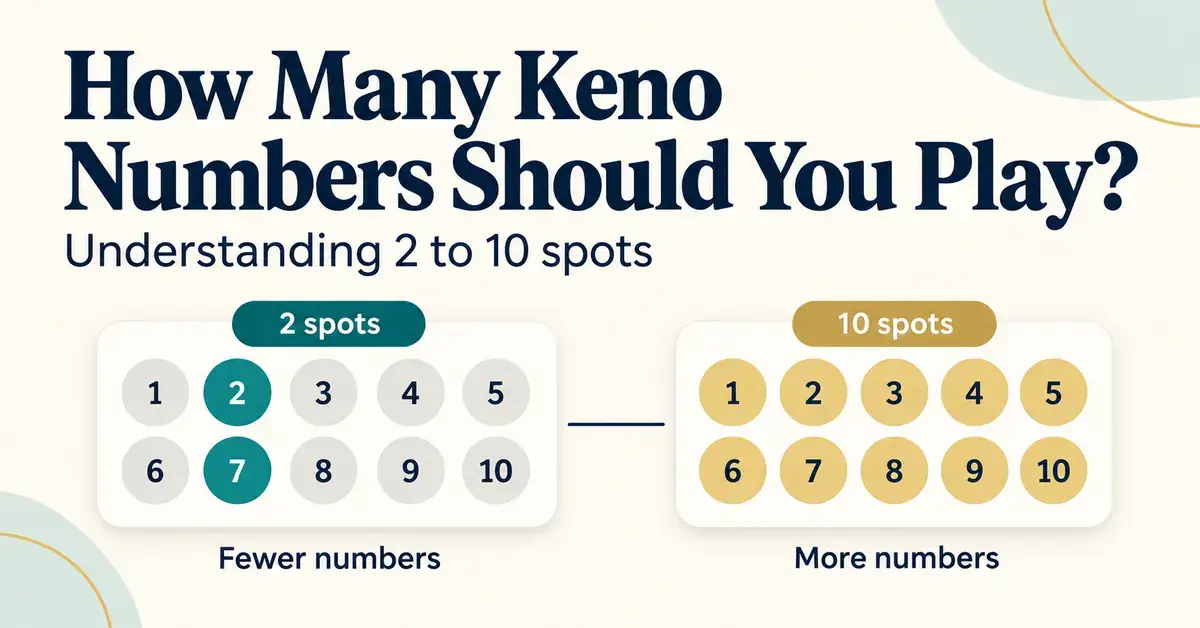
How many keno numbers you play — your “spots” — is the single real choice you make on a keno ticket, and it shapes your game far more than which numbers you circle. Picking fewer spots means you win more often for small amounts; picking more spots means you win rarely but chase a much larger top prize. Neither choice changes the house edge or improves your long-run odds. This guide explains what spots are, how the trade-off works across 2 to 10 spots, and how to match your spot count to what you actually want from the game — using the official prize tables for Canada’s main keno games.
Key Takeaways
- Spots = the numbers you pick. A 4-spot ticket has four numbers; a 10-spot has ten. In Canada you usually pick 2 to 10.
- Fewer spots win more often for less. On OLG Daily Keno a $1 2-pick pays $7 at about 1-in-13 odds.
- More spots win rarely for much more. A $1 10-pick pays $250,000 for all ten matches at about 1-in-2.1-million odds.
- More spots do not improve your odds. They lengthen the odds and raise the prize; the house edge stays broadly the same.
- Pools differ by game. OLG uses 70 numbers, BCLC and casino keno use 80, so the same spot count has different odds.
- Choose by goal, not by “system”: 2-4 spots for frequent small wins, 5-7 for a balance, 8-10 for a shot at the top prize.
What does “spots” mean in keno?
A “spot” is one number you choose to play on a keno ticket, so the terms “spot” and “number” mean the same thing. A “4-spot” ticket is simply one on which you picked four numbers; a “10-spot” ticket has ten. In every draw, the game randomly selects 20 numbers from a larger pool — 70 numbers in OLG Daily Keno and 80 numbers in BCLC Keno and most casino keno — and you win based on how many of your spots appear among those 20. If you want the full mechanic first, see our guide on how to play keno.
The number of spots you pick does two things at once: it sets how hard it is to match all your numbers, and it sets how big the prize can be when you do. Those two move in opposite directions, which is the whole story of this page.
How many keno numbers can you pick?
In Canada you can usually pick between 2 and 10 numbers, and that range is the practical choice for almost every keno player. OLG Daily Keno lets you play a “pick category” from 2 to 10 numbers. BCLC Keno lets you choose up to 10 numbers from the 80-number field, so you can play fewer if you prefer. Casino and video keno machines typically allow 1 to 10 spots, and a few let you pick more, but 2 to 10 is the standard range and the one these numbers describe.
The core trade-off: hit frequency versus top prize
The core trade-off is simple: fewer spots win more often for less, and more spots win far less often for much more. With only two spots, matching both is relatively easy, so small wins arrive frequently. With ten spots, matching all ten is extraordinarily rare, but the top prize is hundreds of times larger for the same stake.
The official OLG Daily Keno chart shows this clearly. On a $1 bet, matching both numbers on a 2-pick returns $7 at roughly 1-in-13 odds, while matching all ten numbers on a 10-pick returns $250,000 at roughly 1-in-2.1-million odds. Same ticket price, wildly different rhythm. Crucially, the house edge is broadly similar across spot counts — the game does not become more or less generous overall, it simply pays out in a different pattern. For the bigger picture of how chances and fixed prizes relate, see keno odds and payouts.
How the spots compare: odds and top prizes
The table below compares every spot count from 2 to 10 using OLG Daily Keno’s official game conditions: the top prize for matching all your numbers on a $1 bet, the published odds of doing so, the lowest number of matches that still pays, and the general character of each choice.
Spot-by-Spot Comparison
| Spots picked | Match all → top prize ($1 bet) | Odds of matching all | Lowest match that pays | Game character |
|---|---|---|---|---|
| 2 | $7 | 1 in 13 | 2 of 2 | Wins very often, smallest prize |
| 3 | $25 | 1 in 48 | 3 of 3 | Frequent wins, small prize |
| 4 | $100 | 1 in 189 | 4 of 4 | Fairly frequent, modest top prize |
| 5 | $250 | 1 in 781 | 4 of 5 | Balanced; a partial tier appears |
| 6 | $1,000 | 1 in 3,383 | 5 of 6 | Balanced; bigger top, rarer |
| 7 | $5,000 | 1 in 15,464 | 5 of 7 | Mid-range; several prize tiers |
| 8 | $25,000 | 1 in 74,941 | 6 of 8 | Large top prize, infrequent |
| 9 | $50,000 | 1 in 387,197 | 6 of 9 | Big top prize, rare |
| 10 | $250,000 | 1 in 2,147,181 | 7 of 10 (plus $2 for 0 of 10) | Largest top prize, very rare |
These figures come from OLG Daily Keno, which draws 20 numbers from a 70-number pool. BCLC Keno uses an 80-number pool with its own prize structure (a top prize of $200,000, rising to as much as $2,000,000 with the optional Keno Bonus multiplier), so its odds are longer and its prizes differ. Always read the official game conditions for the specific keno game you are playing before relying on any number.
How many keno numbers should you play?
There is no single best number of keno spots to play — the right answer depends on what you want from the game and what you can comfortably afford to lose. Because every spot count carries a similar house edge, the choice is about the style of play you enjoy, not about squeezing out an advantage. The three groups below map spot counts to common goals.
If you want to win more often: 2 to 4 spots
Two to four spots deliver the most frequent wins, which suits players who enjoy regular small results over long waits. On OLG Daily Keno, a 2-pick pays $7 for matching both numbers at about 1-in-13 odds, and a 4-pick pays $100 for matching all four at about 1-in-189 odds. The downside is a modest ceiling: no amount of luck on a low-spot ticket produces a life-changing prize.
If you want a shot at the biggest prize: 8 to 10 spots
Eight to ten spots offer the largest top prizes but the longest odds, so they suit players who accept frequent losing tickets in exchange for a small chance at a big payout. A 10-pick on OLG Daily Keno pays $250,000 for all ten matches, but the odds of matching all ten are roughly 1 in 2.1 million. Expect long dry spells. Some games soften this slightly — OLG’s 10-pick, for example, pays $2 on a $1 bet for matching none of the 20 drawn numbers — but that is a quirk of the paytable, not a reason to play.
A balanced middle ground: 5 to 7 spots
Five to seven spots sit between the two extremes, offering several prize tiers so partial matches can still pay. A 7-pick on OLG Daily Keno pays $5,000 for all seven at about 1-in-15,000 odds, plus smaller amounts for matching six or five of your numbers. This range appeals to players who want a meaningful top prize without the near-impossible odds of a full 10-spot match.
4-spot versus 7-spot keno: a closer look
A 4-spot ticket and a 7-spot ticket behave very differently, and comparing them is the clearest way to feel the trade-off. A 4-spot is a one-tier ticket: on OLG Daily Keno it pays only when you match all four numbers, returning $100 on a $1 bet at roughly 1-in-189 odds. It is simple and hits comparatively often, but $100 is the ceiling.
A 7-spot is a multi-tier ticket: matching all seven pays $5,000 (about 1 in 15,464), matching six pays $50, and matching five pays $5. So the 7-spot wins less often at the top but offers partial wins along the way and a top prize fifty times larger than the 4-spot. In short, the 4-spot gives steadier small hits, while the 7-spot trades frequency for a far higher ceiling and more prize tiers. Both carry the same underlying house edge, so neither is “better” in a mathematical sense — they are simply different experiences.
Does playing more spots improve your odds of winning?
No — playing more spots does not improve your odds; it lengthens them while raising the possible prize. Each of the 20 numbers is drawn at random and is completely independent of how many spots you picked, and the pool and the draw never change. Choosing more spots changes the distribution of outcomes — rarer wins, bigger prizes — but not the long-run return or the house edge built into the paytable. In keno, “strategy” means choosing a spot count and bet size that fit your budget and the kind of play you enjoy, not finding a system that beats the math, as our honest look at keno strategy explains.
Common mistakes when choosing how many spots to play
- Assuming more spots mean better odds. The opposite is true: the more spots you pick, the harder it is to match them all. The larger prize is compensation for the longer odds, not a sign of a better bet.
- Chasing the top prize on a small budget. Playing 9 or 10 spots means long runs of losing tickets. If your bankroll can’t absorb that comfortably, a lower spot count fits better.
- Ignoring the partial-match tiers. Some spot counts pay only on a full match — OLG’s 4-pick pays only for matching all four — while others pay for partial matches. Read the paytable so you know what actually wins.
- Reading the wrong paytable. Pools and prizes differ by game and province (70 numbers on OLG, 80 on BCLC and casino keno), so odds for “the same” spot count are not identical across games.
- Treating a zero-match prize as a plan. A small payout for matching none of the numbers is a paytable curiosity, not a reason to play 10 spots.
- Adding spots to recover losses. Increasing your spot count or stake to chase back a loss raises your exposure without improving your odds — a classic warning sign of problem play.
How keno spot rules differ across Canada
Spot counts work the same way everywhere, but pools and prizes differ by game, so the odds for a given spot count are not identical across the country. OLG Daily Keno (Ontario) uses a 70-number pool, lets you pick 2 to 10 numbers, draws twice daily, and pays up to $250,000 on a $1 10-pick. BCLC Keno on PlayNow (British Columbia) uses an 80-number pool, lets you pick up to 10 numbers, runs a new draw roughly every three and a half minutes, and offers a top prize of $200,000 — up to $2,000,000 with the optional Keno Bonus multiplier. Casino and video keno generally use the 80-number format as well. Because a 70-number pool makes matches easier than an 80-number pool, the same 10-spot ticket has meaningfully different odds depending on where you play. For a full province-by-province overview, see keno in Canada, and always confirm the current numbers in the official game conditions.
A note on responsible play
Keno is a game of chance with a fixed house edge, and this article is general information, not betting advice. No spot count, number pattern or system improves your long-run odds — every draw is random and independent. Prizes and odds vary by game and province and can change, so verify them in the official game conditions before you play. The minimum age to buy lottery products or play keno is 18 or 19 depending on the province. Only ever play with money you can afford to lose, and if gambling stops being fun, free and confidential help is available across Canada through responsible gambling help in Canada.
Sources
Frequently Asked Questions (FAQ)
What is the best number of keno spots to play?
There is no single best number of keno spots, because every spot count carries a similar house edge. Fewer spots (2 to 4) win more often for small prizes; more spots (8 to 10) win rarely but offer much larger top prizes. The best choice is the one that matches your budget and the kind of play you enjoy.
Is a 4-spot or 7-spot keno ticket better?
Neither is better in a mathematical sense; they play differently. A 4-spot hits comparatively often but pays only a modest prize for matching all four. A 7-spot wins the top prize far less often, but it has several partial-match tiers and a much higher ceiling. Both share the same underlying edge.
Do more keno numbers mean better odds?
No. The more numbers you pick, the lower your odds of matching them all. The bigger top prize on a high-spot ticket is compensation for those longer odds, not evidence of a better bet. Spot count changes the pattern of wins, not the overall return.
How many numbers are drawn in keno?
Twenty numbers are drawn in every keno game. They are selected at random from a pool of 70 numbers in OLG Daily Keno or 80 numbers in BCLC Keno and most casino keno. You win based on how many of your chosen spots appear among those 20 drawn numbers.
Can you win keno without matching any numbers?
In some games, yes. OLG Daily Keno pays $2 on a $1 10-pick for matching none of the 20 drawn numbers, for example. This applies only to certain high-spot tickets, however; most spot counts require you to match at least some of your numbers to win anything.
