

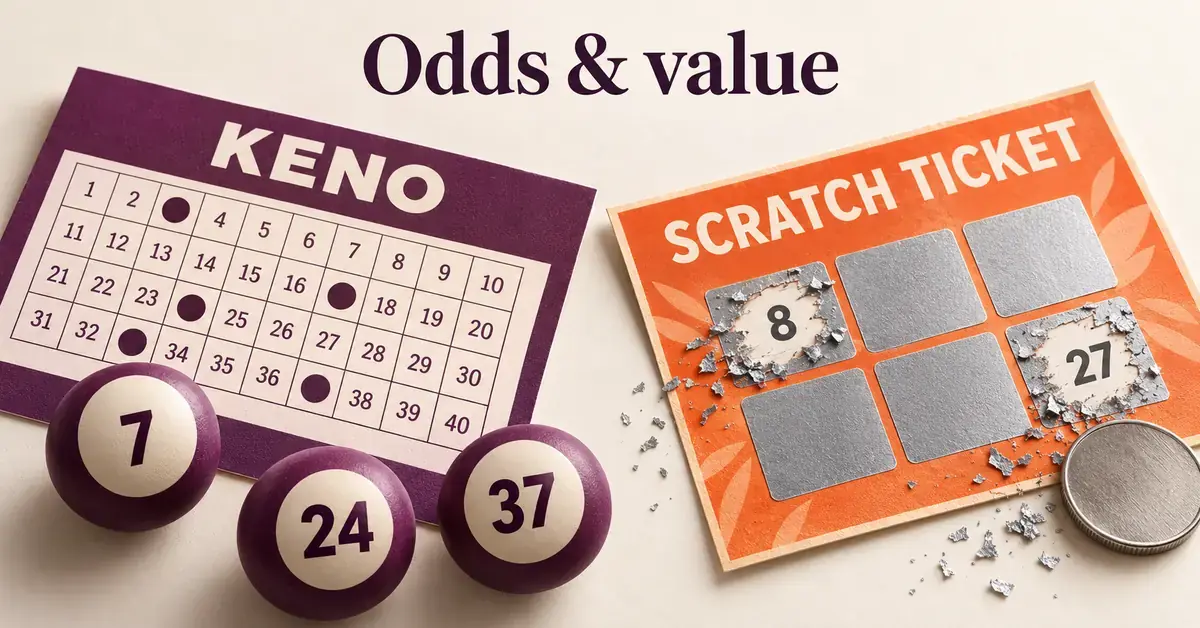
Keno and scratch tickets are two of the easiest lottery-style games to buy in Canada, and they often sit side by side at the same retailer. They feel similar — pick a game, pay a few dollars, hope for a win — but they work very differently under the hood. A scratch ticket (also called an instant or “scratch-and-win” ticket) decides your outcome the moment it is printed; keno is a drawn number game where 20 numbers are selected and you win on how many you match. This guide compares the two on the questions that actually matter: your odds of winning, the long-run value you get back, the size of the top prizes, and who each game suits. Every figure below is checked against official Canadian lottery sources.
Key Points
- Both are lottery games with a high house edge — over time you get back less than you stake, on keno and on scratch tickets alike.
- Scratch tickets have fixed overall odds of winning any prize (about 1 in 2.9 to 1 in 4 on OLG INSTANT games), but most of those wins are small or just your money back.
- Keno lets you choose your risk: fewer spots win small prizes more often; more spots chase a bigger prize that hits rarely.
- Value is similar: keno’s return on standard pay tables is often 65–80% (a 20–35% house edge); lottery scratch tickets typically return around 60–65% of sales as prizes.
- Top prizes reach the millions on both (OLG Daily Keno up to $2,500,000), but the odds of the jackpot are around 1 in a million or longer either way.
- No strategy beats either game. Scratch results are pre-set and keno draws are random — treat any spend as entertainment.
What are keno and scratch tickets?
Both are lottery products, but one is a drawn game and the other is pre-determined. Understanding that difference is the key to comparing them fairly.
What is keno?
Keno is a lottery-style number game: you choose how many numbers to play (called your spots), 20 numbers are then drawn from a larger pool, and you are paid based on how many of your numbers match. In Ontario, OLG Daily Keno uses a pool of 1 to 70 and lets you pick 2 to 10 spots, with wagers of $1, $2, $5 or $10 and two draws a day. In British Columbia, BCLC Keno draws from 1 to 80 every few minutes. The important feature is that you control how much risk you take by choosing how many spots to play.
What is a scratch ticket?
A scratch ticket is an instant-win lottery ticket: the result is already fixed inside the ticket when it is printed, and scratching the coating simply reveals whether that ticket is a winner. OLG sells these as INSTANT games, priced from $1 up to $100, with different themes and prize structures. There is no draw to wait for and nothing you can do to change the outcome — the ticket you buy is either a winner or it is not before you ever touch it. Each game publishes a single headline figure called the overall odds: your chance of winning any prize at all on that game.
How do the odds of winning compare?
Scratch tickets give you one fixed chance of winning something; keno lets you tune your chance up or down. That is the single biggest difference in odds between the two.
On a scratch ticket, the overall odds are set by the game and printed for you. Across recent OLG INSTANT games, the overall odds of winning any prize typically land between about 1 in 2.9 and 1 in 4 — for example, INSTANT PLINKO is listed at about 1 in 3.96 and MONEY MACHINE at about 1 in 3.75. That sounds generous, but there is an important catch explained below: many of those “wins” are small or simply return your stake.
Keno has no single overall figure because your odds depend on how many spots you play. Play few spots and you win small prizes often; play more spots and the top prize grows while your chance of hitting it all shrinks fast. On a 10-spot keno ticket, for instance, matching all 10 numbers happens only about once in 2.1 million tickets. Our guide to how many keno numbers to play breaks down that trade-off spot by spot.
Comparison
| Feature | Keno | Scratch tickets |
|---|---|---|
| Type of game | Drawn number game (20 numbers drawn) | Instant game, result fixed when printed |
| How you play | Pick 2–10 numbers (spots) from a pool (1–70 OLG; 1–80 BCLC) | Choose which game to buy, then scratch |
| Result speed | On a draw: twice daily (OLG) to every few minutes (BCLC) | Instant |
| Who controls the odds | You, by choosing the number of spots | Fixed by the game you buy |
| Odds of winning any prize | Varies by spot count; small prizes can be frequent | Fixed, about 1 in 2.9 to 1 in 4 on OLG INSTANT games |
| Odds of the top prize | Long — e.g. ~1 in 2.1 million to match all 10 on a 10-spot | Long — often around 1 in a million |
| Typical top prize (Canada) | Up to $2,500,000 (OLG Daily Keno) | Into the millions / “cash for life” on some games |
| Long-run return | Often ~65–80% (20–35% house edge) | Typically ~60–65% of sales returned as prizes |
| Price per play | Commonly $1–$10 per draw | $1 up to $100 per ticket |
Why “1 in 3 to win” on a scratch ticket is misleading
A scratch ticket’s overall odds count every prize, including the smallest ones and tickets that only win you your money back or a free play. So odds of “about 1 in 4” do not mean you keep money one time in four — a large share of those wins are break-even or near it. The odds of winning a top prize are far longer: INSTANT PLINKO’s top prize, for example, comes in at roughly 1 in a million. The frequent small wins are designed to keep the game feeling rewarding, not to return a profit.
Which gives better value over time?
Both keno and scratch tickets return less than you stake over the long run, so neither is a “good value” bet in the way a coin flip would be — but the way the loss is built in differs. The key concept is the house edge: the average share of every dollar wagered that the game keeps. Its mirror image is the return to player (RTP), the share paid back as prizes.
What is keno’s house edge?
Keno has one of the highest house edges of any common game. On standard pay tables, independent analysis (Wizard of Odds) puts live keno’s return at roughly 65% to 80%, which is a house edge of about 20% to 35%. In other words, for every $100 wagered, the game keeps about $20 to $35 on average over time. Provincial fixed-prize keno such as Daily Keno sets its own prize tables, but the principle is the same: it is a negative-expectation game. Our explainer on the keno house edge and RTP goes deeper on why the edge is so high.
What is a scratch ticket’s return?
Scratch tickets sit in a similar range. Lottery instant games in North America typically return somewhere around 60% to 65% of total sales as prizes across a full print run, with higher-priced tickets usually paying back a slightly larger share. OLG does not publish a fixed payout percentage for each game and notes that any payout figure is theoretical — it is based on the prizes offered at launch and assumes every ticket is bought, with the final figure only known once a game ends. The practical takeaway: a scratch ticket’s long-run return is broadly comparable to keno’s, and both leave a large margin with the lottery.
Which has the bigger top prize?
Both games can pay life-changing sums, but the headline numbers and the odds behind them differ. OLG Daily Keno advertises a top prize of up to $2,500,000 on a 10-spot play, and our comparison of which keno game pays the most in Canada shows how provincial top prizes stack up. Scratch tickets also offer top prizes into the millions, and some run “cash for life” style annuities, but the odds of hitting a scratch game’s top prize are usually around 1 in several hundred thousand to 1 in a few million — similar in scale to keno’s longest odds. In short, neither game gives you a realistic shot at the jackpot; the big prize is the hook, not the expectation.
How do speed, cost and experience differ?
Scratch tickets are instant and self-contained; keno is a paced, repeatable draw game. That changes how the two feel and how quickly money can move.
- Speed: A scratch ticket resolves the second you scratch it. Keno resolves on a draw — twice a day for OLG Daily Keno, or every few minutes for fast screen-based keno in bars and BCLC’s game.
- Cost per play: Keno wagers are commonly $1 to $10 per draw. Scratch tickets range from $1 to $100, so the per-ticket outlay can be much higher.
- Control: With keno you pick your numbers and your spot count; with a scratch ticket you choose only which game to buy.
- Pace risk: Fast, repeatable games — rapid keno or buying scratch tickets one after another — can make spending add up quickly, because a result (and the urge to play again) arrives almost immediately.
What are the most common mistakes players make?
The biggest errors come from misreading the odds, not from bad luck. Avoiding them will not make either game profitable, but it will keep your expectations honest.
- Treating “overall odds” as profit odds. A scratch ticket’s 1-in-3-to-4 figure includes tiny and break-even wins; it is not your chance of coming out ahead.
- Thinking expensive scratch tickets are “better value.” Higher-priced tickets often return a slightly larger share, but you also stake far more, so your average loss per ticket is usually larger, not smaller.
- Believing more keno spots means better odds. Adding spots raises the top prize but lowers your chance of catching them all. More spots is not “better,” just a different risk profile.
- Chasing losses. Buying another ticket or playing another draw to win back a loss does not change the fixed house edge on the next play.
- Looking for patterns. Scratch results are pre-set at random and keno draws are independent, so “hot” or “due” numbers do not exist. See keno vs lottery for how drawn games compare more broadly.
So which should you choose?
Choose based on the experience you want, not on a belief that one offers “better” odds — over time both cost you money. A scratch ticket suits someone who wants an instant result, a small fixed outlay, and no decisions to make. Keno suits someone who prefers to pick numbers, control their risk through the number of spots, and play along with a draw. If frequent small wins keep a game fun for you, low-spot keno and lower-priced scratch tickets both deliver that. If the appeal is a long-shot at a large prize, both can offer it, with similarly steep odds. Whatever you pick, the sensible approach is the same one covered in our keno strategy guide: set a budget you can afford to lose, treat the cost as entertainment, and stop when you reach your limit.
Disclaimer
This article is for general information only and is not gambling advice. Keno and scratch tickets are games of chance with a built-in house edge: over time, players lose more than they win, and no system, pattern or ticket price changes that. You must be of legal age to play (19+ in most provinces; 18+ in Alberta, Manitoba and Quebec). If gambling stops being fun or starts causing harm, free, confidential help is available — in Ontario, ConnexOntario is reachable 24/7 at 1-866-531-2600. See our responsible gambling resources for helplines and support across Canada.
Sources
Frequently Asked Questions (FAQ)
Which has better odds of winning, keno or scratch tickets?
It depends on what “winning” means. Scratch tickets give fixed overall odds of winning any prize — about 1 in 3 to 1 in 4 on many OLG games — but most of those are small or break-even. Keno lets you set your own odds by choosing fewer or more spots, so a low-spot keno ticket can win small prizes as often, or more often, than a scratch ticket.
Which pays back more over time?
They are broadly similar. Keno’s return on standard pay tables is often around 65% to 80% (a 20% to 35% house edge), and lottery scratch tickets typically return roughly 60% to 65% of sales as prizes. Both are negative-expectation games, so neither is a reliable way to make money.
Which has the bigger jackpot?
Both can reach the millions. OLG Daily Keno advertises a top prize of up to $2,500,000, and various scratch games offer top prizes in the millions or “cash for life” annuities. The odds of winning the top prize on either are extremely long — commonly around 1 in a million or worse.
Are scratch tickets a safer bet than keno?
Neither is a “safe” bet, but a scratch ticket caps your spend at the ticket price and resolves instantly, while keno is repeatable and can be played rapidly. That speed and repeatability is why fast keno can move money quicker than a single scratch ticket.
Can you improve your odds at either game?
No. A scratch ticket’s result is fixed when it is printed, and keno draws are random and independent. You can choose how much to stake and, in keno, how many spots to play, but nothing changes the underlying house edge on any single play.
