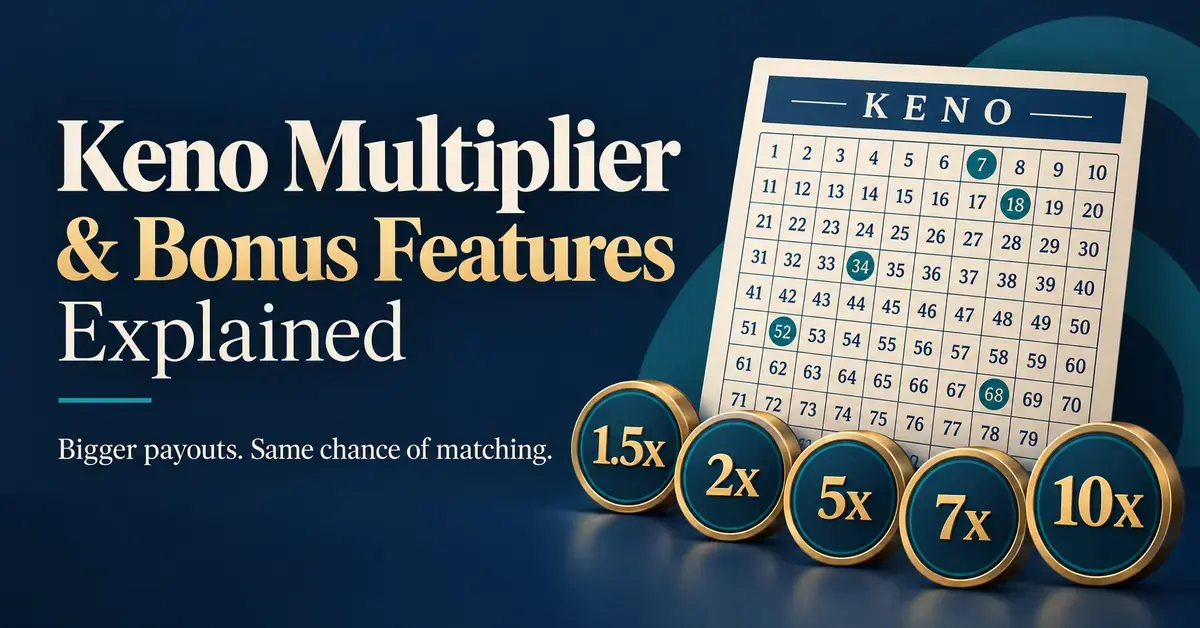
A keno multiplier is an optional add-on that multiplies any prize your keno ticket wins by a randomly drawn number, in exchange for a higher ticket price. In Canada the best-known example is the British Columbia Lottery Corporation (BCLC) Keno Bonus feature, which can multiply a win by 1.5x, 2x, 5x, 7x or 10x. The important thing to understand first is that a multiplier changes only how much a winning ticket pays — it never changes your chance of matching the numbers you picked. This guide explains how these bonus features work, what they really cost, and the common mistakes players make with them.
Key Points
- A keno multiplier (or “bonus” / “booster”) is an optional add-on that multiplies any prize your ticket wins by a randomly drawn number.
- The BCLC Keno Bonus multiplier values are 1.5x, 2x, 5x, 7x and 10x; one is drawn at random for each draw.
- Adding the bonus costs an extra amount equal to your base wager, so your ticket price roughly doubles (maximum wager $100).
- It does not change your odds of matching numbers — it only scales a win you already made. If the base ticket wins nothing, the multiplier pays nothing.
- BCLC does not publish how often each multiplier appears, so no one can prove the feature is good value. You must be 19+ to play in B.C.
What is a keno multiplier?
A keno multiplier is an extra bet you add to a normal keno ticket that multiplies any prize that ticket wins. You still pick your numbers and play the draw exactly as usual; the multiplier simply sits on top. When the draw happens, a multiplier value is selected at random, and if your base ticket wins anything, the prize is multiplied by that value.
Lottery operators market this feature under different names — “Bonus”, “Booster”, “Multiplier” or “Super” — but the mechanic is the same everywhere: you pay more per draw for the chance that a win is multiplied. The multiplier never creates a win on its own. If your base ticket matches nothing, multiplying nothing still gives you nothing.
Multiplier, bonus, booster — are they the same thing?
In everyday use, “keno multiplier”, “keno bonus”, “keno bonus multiplier” and “keno booster” all describe the same kind of add-on: an optional side bet that multiplies prizes. The exact brand name depends on the operator. On BCLC’s platform the feature is called Keno Bonus; other lotteries around the world use “Multiplier” or “Booster”. Because the name varies, always read the specific game rules for the keno product you are actually playing rather than assuming every “bonus” works the same way.
How the BCLC Keno Bonus works
BCLC Keno Bonus is an optional feature added to a standard BCLC keno ticket, which you play through PlayNow.com or at participating retailers in British Columbia. BCLC keno uses a pool of numbers from 1 to 80; you pick up to 10 numbers, 20 numbers are drawn each game, and a new draw runs roughly every three and a half minutes. Keno Bonus layers a random multiplier on top of that base game.
What multiplier values can you get?
BCLC lists five possible Keno Bonus multiplier values: 1.5x, 2x, 5x, 7x and 10x. One of these values is attached to each draw. If your base ticket wins and the draw’s multiplier is 5x, your prize is five times what the base ticket alone would have paid. BCLC advertises that Keno Bonus can lift the top potential payout to as much as $2,000,000 when the highest multiplier lands on a maximum win.
How is the multiplier chosen?
The multiplier is drawn at random, not chosen by you. According to BCLC’s official Keno game conditions, after each draw’s sales close, one Keno Bonus multiplier value is selected at random and applies to every Keno Bonus ticket in that draw. You cannot pick which multiplier you want, and you will not know the multiplier before you buy. BCLC does not publish how often each value appears, so there is no way for a player to know the exact long-run average multiplier.
What does Keno Bonus cost?
Adding Keno Bonus costs an extra amount equal to your base wager, so your ticket price effectively doubles. If you play a $1 keno wager and add Keno Bonus, you pay $2; a $5 wager plus Keno Bonus costs $10. BCLC’s game conditions set a maximum wager of $100. In other words, the feature is not a small top-up — it is a second bet the same size as your first.
Does the keno multiplier change your odds of winning?
No. A keno multiplier does not change the probability of matching your numbers at all. Your odds of hitting, say, 6 out of 6 chosen numbers are fixed by the base game and are identical whether or not you add the bonus. The multiplier only acts on a prize that the base ticket has already won.
This is the single most misunderstood point about bonus features. Marketing that shows a big multiplied jackpot can make it feel as though the add-on improves your chances. It does not. It raises the size of a possible win while leaving the likelihood of that win exactly where it was — and it does so at double the cost. For a fuller treatment of why no feature or system shifts the underlying math, see our guide to keno strategy and what actually works, and the breakdown of keno odds and payouts.
A worked example: what the multiplier does to a win
Imagine a base keno ticket that wins a $20 prize. The table below shows what that same $20 win becomes at each BCLC Keno Bonus multiplier, remembering that your ticket cost has already doubled because you added the feature.
| Multiplier drawn | A $20 base win becomes |
|---|---|
| 1.5x | $30 |
| 2x | $40 |
| 5x | $100 |
| 7x | $140 |
| 10x | $200 |
Two things stand out. First, the lowest multiplier (1.5x) adds only $10 to a $20 win, while you may have paid an extra dollar-for-dollar to play it — so a low multiplier can barely cover the extra cost. Second, if your base ticket wins nothing, every row above is $0: 10x times zero is still zero.
Standard keno versus keno with a bonus multiplier
The comparison below sets a plain keno ticket side by side with the same ticket plus a bonus multiplier, so you can see exactly what you are and are not buying.
Comparison
| Feature | Standard keno ticket | Keno ticket + bonus multiplier |
|---|---|---|
| Ticket cost | Your base wager (e.g. $2) | Roughly double (e.g. $4) |
| Chance of matching your numbers | Fixed by the base game | Identical — unchanged |
| What a win pays | The base prize | Base prize multiplied by the drawn value (1.5x-10x) |
| Top potential payout (BCLC) | Base top prize | Advertised up to $2,000,000 at 10x |
| Risk / reward | Lower stake, lower ceiling | Higher stake, higher ceiling (more variance) |
| Best suited to | Making a budget last across more draws | Wanting a bigger payout on a lucky draw |
Other BCLC keno add-ons
Keno Bonus is not BCLC’s only optional feature. Its official keno game conditions also list add-ons named Keno Doubler, Keno Tripler and Keno Pattern Play. As the names suggest, Doubler and Tripler apply fixed multipliers rather than a random one, and Pattern Play lets you base a ticket on a chosen pattern of numbers. Each has its own cost and rules, and availability can change, so check the current terms on PlayNow.com before adding any of them. Whichever add-on you use, the same principle holds: optional features change what a win pays or how a ticket is built, never the odds of the draw itself.
Is the keno multiplier worth it?
Whether a keno multiplier is “worth it” is a question about variance and cost, not about winning more often. Because the feature doubles your stake while leaving your hit odds unchanged, it makes your play higher-risk and higher-reward: most draws still return nothing, but the draws that do pay can pay several times more. It does not lower the house edge built into keno.
A few honest points to weigh:
- It costs double. Every dollar of multiplier is a dollar you are not keeping. Over many draws, doubling your spend roughly doubles your expected losses, because keno keeps a fixed share of every dollar wagered.
- The average multiplier is unknown. Since BCLC does not publish how often each value (1.5x to 10x) is drawn, no one outside the operator can calculate whether the feature is better or worse value than the base game. Treat any claim that it “pays for itself” with scepticism.
- Low multipliers are common-feeling but small. A 1.5x on a modest win adds very little, and that is a frequent outcome in multiplier-style games generally.
- It is entertainment, not income. The sensible way to view the add-on is as paying extra for a bigger thrill on the rare winning draw, within money you have already decided you can lose.
Common mistakes with keno multipliers and bonuses
The most common mistake is believing a multiplier improves your chance of winning. It does not — it only scales a win you already made. Watch for these errors too:
- Forgetting the cost doubled. Players often track their keno budget by the base wager and ignore that Keno Bonus added the same amount again. Count the full ticket price.
- Chasing the 10x. Because the multiplier is random, there is nothing you can do to make a high value appear. Buying more Keno Bonus tickets to “catch” a 10x just spends more money at the same odds.
- Assuming all provinces and sites are the same. BCLC Keno Bonus is a BC product. Other Canadian lottery keno games may offer different add-ons, or none; do not assume the 1.5x-to-10x structure exists elsewhere. Compare the actual products in our overview of keno in Canada.
- Mixing up multipliers with bonus draws or jackpots. Some keno variants have extra draws, progressive jackpots or side games; a prize multiplier is a different thing. If you are new to the format, start with how to play keno before adding features.
- Playing add-ons to recover losses. Doubling your stake to win back what you lost is loss-chasing, a classic warning sign of problem play, not a strategy.
Who is the keno multiplier for?
A keno multiplier suits a player who already enjoys keno, plays within a fixed entertainment budget, and specifically wants the chance of a larger payout on a lucky draw, accepting that it costs twice as much and does nothing for their odds. It does not suit anyone trying to improve their chances of winning, stretch a small budget across more draws, or recover previous losses — for those goals the add-on works against you, because it simply spends more at the same fixed house edge. If your aim is to make your money last longer, playing the base ticket without the multiplier is the cheaper choice. To understand the trade-offs between spot counts, wagers and payouts more broadly, our guide to keno variants puts the different game styles in context.
Responsible gambling
This article is for information only and is not betting advice or an encouragement to play. Keno is a game of chance with a fixed house edge, and optional features such as a multiplier or bonus increase how much you stake without improving your odds of winning. You must be 19 or older to buy lottery products in British Columbia. Set a budget before you play, treat any money wagered as spent, and never bet to recover losses. If gambling is causing harm to you or someone you know, free, confidential help is available in B.C. through the Responsible & Problem Gambling Program at 1-888-795-6111, and through provincial services across Canada. For helplines, self-exclusion and warning signs, see our responsible gambling help and support guide.
Sources
Vanliga frågor (FAQ)
Does a keno multiplier improve my chances of winning?
No. A multiplier only increases the size of a prize your ticket has already won. The probability of matching your chosen numbers is set by the base game and is exactly the same whether or not you add the bonus.
What are the BCLC Keno Bonus multiplier values?
BCLC lists five values: 1.5x, 2x, 5x, 7x and 10x. One value is drawn at random for each draw and applies to all Keno Bonus tickets in that draw. You cannot choose the value, and you do not know it before you buy.
How much does adding Keno Bonus cost?
Adding Keno Bonus costs an extra amount equal to your base wager, so the ticket price effectively doubles. A $2 keno wager plus Keno Bonus costs $4. BCLC sets a maximum wager of $100.
Is it worth adding the multiplier?
It depends on what you want. The feature makes play higher-risk and higher-reward at double the cost, without lowering the house edge. Because BCLC does not publish how often each multiplier is drawn, no one can prove it is good value; treat it as paying extra for a bigger possible win, not as a way to come out ahead.
Do all Canadian keno games have a multiplier or bonus?
No. The 1.5x-to-10x Keno Bonus described here is a BCLC product in British Columbia. Other provincial keno games may offer different optional features, or none at all, so always check the specific rules for the keno product you are playing.
