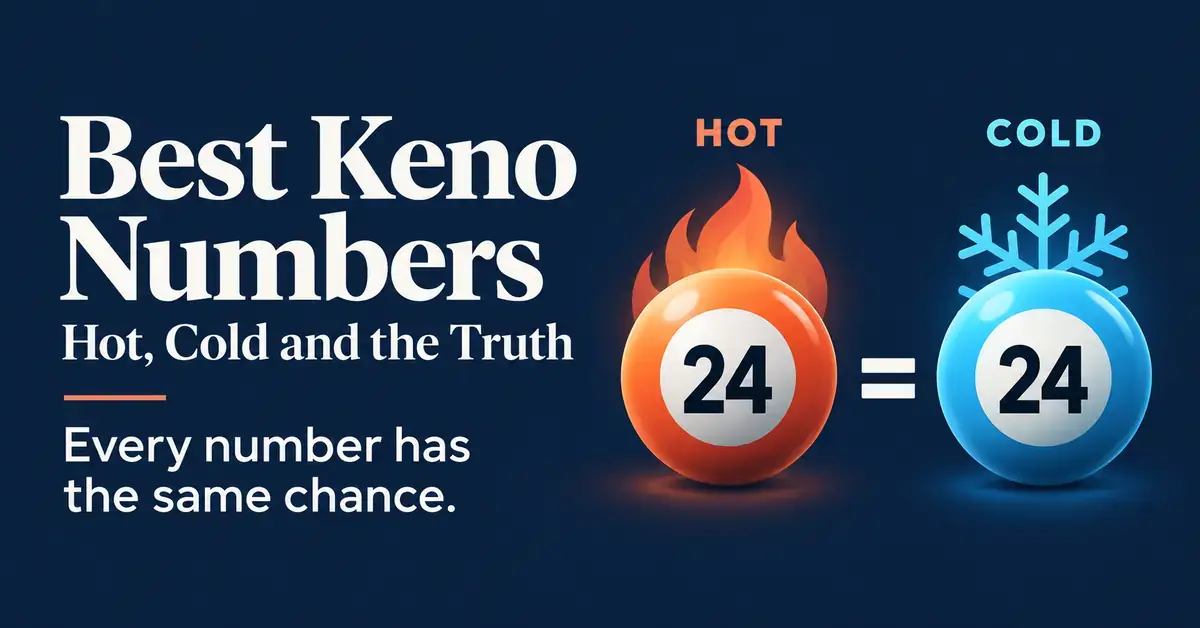
If you have searched for the best keno numbers, you were probably hoping for a short list of digits that win more often than the rest. The honest answer, backed by probability and by how Canadian keno games are actually run, is that no such list exists. Every number in a keno draw has exactly the same chance of being picked, each draw is independent of the last, and no “hot,” “cold,” “due” or “lucky” number is any better than another. This guide explains why, walks through the myths one by one, and shows the small number of things you genuinely do control.
Key Takeaways
- No keno number is “best” — every number has an identical chance of being drawn.
- Draws are independent: past results never change the next draw.
- “Hot,” “cold” and “due” numbers are the gambler’s fallacy, not a strategy.
- Canadian pools: OLG Daily Keno draws 20 from 1–70; BCLC Keno draws 20 from 1–80.
- Payouts are fixed, so your number choice changes neither your odds nor your prize.
- What you control: how many spots you play, your wager, your budget and your limits.
Are there really “best” keno numbers?
No — there is no number or set of numbers that is statistically better to play in keno. A keno draw selects 20 numbers at random from a fixed pool, and every number in that pool has an identical probability of being one of the 20. Because the game treats all numbers equally, picking 4, 17 and 23 is neither better nor worse than picking 1, 2 and 3, or a quick-pick chosen by the terminal.
The reason the phrase “best keno numbers” is so popular is marketing and wishful thinking, not mathematics. Humans look for patterns, and a game built on pure chance offers plenty of accidental patterns to find. But a pattern you spot in past results carries no information about the next draw. Understanding why starts with how the draw itself works.
How keno draws actually work
Keno is a random number game: you choose how many numbers to play, the game draws 20 numbers, and you win fixed prizes based on how many of yours match. The key detail for number-picking is that the draw mechanism gives no number an advantage.
What is the keno number pool in Canada?
The pool depends on the provincial game. With OLG Daily Keno in Ontario you pick between 2 and 10 numbers from a pool of 1 to 70, and 20 numbers are drawn twice a day (midday and evening). With BCLC Keno, played through PlayNow in British Columbia, you pick up to 10 numbers from a larger pool of 1 to 80, and a new set of 20 numbers is drawn roughly every three and a half minutes. In both cases, each of the numbers in the pool is equally likely to be drawn. For a full breakdown of the provincial games, see our guide to keno in Canada, and for the step-by-step rules read how to play keno.
Are keno draws random and independent?
Yes. Regulated keno draws are produced by certified random number generators or physical draw devices that are independently tested, and each draw is independent of every draw before it. “Independent” has a precise meaning here: the result of one draw has no effect whatsoever on the next. The game has no memory. It does not know which numbers came up yesterday, and it does not try to balance them out. That single fact dismantles almost every “best keno numbers” theory on the internet.
What are “hot” and “cold” keno numbers?
“Hot” and “cold” keno numbers are simply labels for how often a number has appeared in a recent block of draws — they describe the past and predict nothing about the future. The terms are everywhere, so it is worth defining them clearly before explaining why they do not help.
What are hot numbers?
Hot numbers are the numbers that have been drawn most frequently over some recent window — the last 50 or 100 draws, for example. Some operators even publish these lists: the Pennsylvania Lottery, for instance, shows which keno numbers have been hot or cold over the last 100 drawings. A number being “hot” is a true statement about the past and nothing more.
What are cold numbers?
Cold numbers are the opposite — numbers that have appeared least often recently, or that have not come up for a long stretch. Players who chase cold numbers usually believe such a number is “overdue” and must appear soon to even things out.
Do hot or cold numbers improve your chances?
No. Neither hot nor cold numbers are more likely to be drawn next, because each draw is independent and every number keeps the same probability every time. A number that has come up in eight of the last ten draws has exactly the same chance in the next draw as one that has been missing for two hundred draws. Short-term streaks are completely normal in random data — in any recent sample, some numbers will always look hot and others cold purely by chance. Those labels reset constantly and never carry forward.
The most drawn keno numbers — why the list changes nothing
A list of the most drawn keno numbers is a historical tally, not a forecast, so it cannot tell you what to play. Over a very large number of draws, every number in the pool trends toward being drawn about the same number of times. In any finite sample, small differences appear by chance, so one number will always sit at the top of the frequency chart and another at the bottom. That ranking is an artefact of sampling, not a property of the numbers.
This is why operators that publish frequency data present it as an information feature rather than a tip: the numbers are accurate, but they have no predictive power. Treating the most-drawn list as a shopping list for your next ticket is the single most common misunderstanding in keno number selection, and it rests entirely on a well-known thinking error.
The gambler’s fallacy: the math behind the myth
The belief that a number is “due” because it has not appeared in a while is the gambler’s fallacy — the mistaken idea that an independent random event becomes more or less likely based on recent history. Economists Charles Clotfelter and Philip Cook documented this directly in lottery players: studying a daily numbers game, they found that the money bet on a specific number dropped sharply right after that number was drawn, then slowly recovered over several months. Players behaved as though a freshly drawn number had been “used up” and needed time before it was worth betting on again. The draw, of course, did no such thing.
The math is simple. In a fair draw, the chance of any particular number appearing is set by the game and stays constant. History cannot change it, because the draw has no way of knowing or caring what came before. “Due” numbers, “balancing out” and “overdue” are all the same fallacy wearing different clothes. If you want to understand the broader odds picture behind these games, our explainer on keno odds and payouts lays out the real numbers.
Myth vs. Math
| Common belief | What the math says |
|---|---|
| “Some numbers are hot and keep hitting.” | Short streaks are normal randomness; the next draw ignores them. |
| “A cold number is due to appear.” | Each number has the same chance every draw, no matter how long it has been absent. |
| “Lucky numbers like 7 or birthdays win more.” | The draw has no memory or luck; all numbers are equally likely. |
| “A system or predictor improves my odds.” | No system changes a certified random game or its fixed house edge. |
| “Picking rare numbers means a bigger prize.” | Keno prizes are fixed by the pay table, not shared, so picks never change payouts. |
What about “lucky” keno numbers?
Lucky keno numbers — a birthday, the number 7, an anniversary, a diagonal pattern on the card — are meaningful to you but invisible to the draw, so they are exactly as likely as any other numbers. There is nothing wrong with playing numbers that are fun or sentimental; just be clear that they do not improve your odds.
There is one more point worth knowing, because it differs from some other lottery products. Canadian keno games pay fixed prizes set by a published pay table, based on how many numbers you match and your wager — prizes are not split among everyone who picked the same numbers. That means choosing “unpopular” or rare numbers to avoid sharing a prize, a tactic that can matter in pari-mutuel jackpot lotteries, does nothing in keno. Your number choice changes neither your chance of winning nor the size of the payout.
What you actually control in keno
You cannot influence which numbers are drawn, but you do control a few real decisions that shape your experience and your expected cost. These are the honest levers, and none of them involves a magic set of numbers:
- How many spots you play. Choosing to play, say, a 4-spot versus an 8-spot changes your odds profile and the pay table you are playing against. This is a genuine trade-off between how often you win and how large the top prize is.
- Your wager size. Betting more multiplies both potential prizes and potential losses; it does not improve your odds per dollar.
- Your budget and time. Deciding in advance how much money and how long you are willing to spend is the most effective control you have.
- Whether you play at all. Keno carries a built-in house edge on every bet, so the longer you play, the more the math works against you.
For a complete, honest look at these levers, read our keno strategy guide, which explains why no system beats the house edge and what “strategy” realistically means in a random game.
Common mistakes when choosing keno numbers
Most number-picking mistakes come from treating a random game as if it had patterns to exploit. Watch for these:
- Chasing “due” cold numbers. A long-absent number is not more likely to appear — this is the gambler’s fallacy in action.
- Piling onto “hot” numbers. Recent frequency says nothing about the next draw.
- Buying predictor systems, software or “winning number” lists. No product can predict a certified random draw; anything sold as such is taking your money for nothing.
- Increasing your bet after losses to “catch up.” Each draw is independent, so past losses do not make a win more likely — this just increases how much you can lose.
- Thinking quick picks are worse (or better). A terminal-generated set of numbers has identical odds to numbers you choose yourself.
- Believing rare numbers win bigger. With fixed keno payouts, your choice of numbers never changes the prize.
So how should you pick your keno numbers?
Pick whatever numbers you enjoy, because the choice has no effect on the outcome — the only sensible goal is that playing is fun and affordable. Use your favourite numbers, let the quick pick decide, or change them every draw; the odds are identical either way. Treat keno as paid entertainment with a known house edge rather than an investment or a puzzle to crack, set a budget before you start, and stop when you reach it. That mindset, not a number list, is the closest thing to a “best” approach that exists.
Responsible Gambling and Disclaimer
This article is for information only. It is not betting advice, and nothing here improves your chances of winning — keno is a game of chance with a fixed house edge, and no number choice or system changes the odds. Keno is legal-age gambling in Canada (generally 19+, and 18+ in Alberta, Manitoba and Quebec); play only with regulated provincial operators and only with money you can afford to lose.
If gambling is causing you stress or financial harm, free and confidential help is available. In Ontario, ConnexOntario offers 24/7 support at 1-866-531-2600 or by texting CONNEX to 247247. For helplines in every province and more on self-exclusion and warning signs, see our responsible gambling resources.
Sources
Frequently Asked Questions (FAQ)
What are the best numbers to play in keno?
There are no best numbers in keno. Every number in the pool has the same chance of being drawn, so any set of numbers is exactly as good as any other. Choose whatever you like; it does not change your odds.
Are hot and cold keno numbers real?
Hot and cold are real descriptions of past results, but they have no predictive value. Because each draw is independent, a hot number is no more likely to repeat and a cold number is no more likely to “catch up” on the next draw.
What are the most drawn keno numbers?
Over a short sample some numbers appear more than others by chance, but over the long run every number trends toward the same frequency. Whichever number currently tops a most-drawn list has no advantage in the next draw.
Do lucky numbers like 7 or birthdays win more in keno?
No. The draw has no idea which numbers are meaningful to you, so lucky numbers and birthdays are exactly as likely as any others. They are fine to play for fun, but they do not improve your odds or your payout.
Can a keno system or prediction tool improve my chances?
No. Keno draws come from certified random generators, and no system, pattern or paid prediction tool can forecast them. Any product promising winning keno numbers cannot deliver what it claims.
