

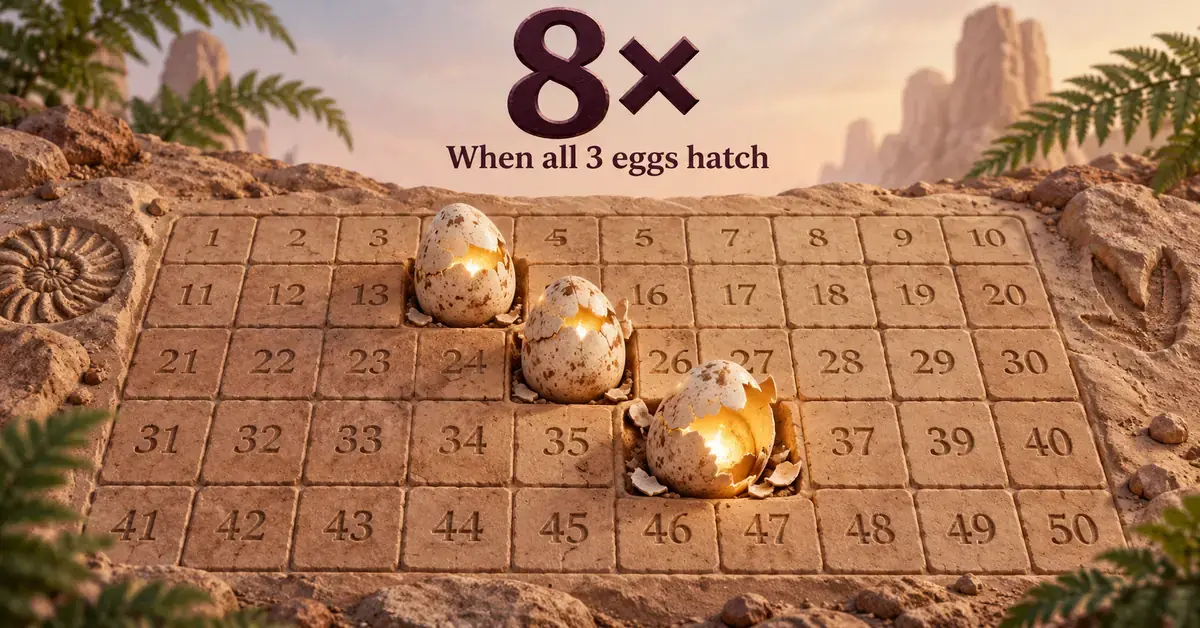
Caveman Keno is a video keno game made by IGT in which the machine hides three “bonus eggs” on your card; when the draw hatches them, any win you already have is multiplied by up to eight times. It plays like ordinary video keno on top, but the egg feature is what gives the game its name, its dinosaur-and-caveman theme, and its loyal following in bars and casinos. This guide explains exactly how the eggs work, how to play a ticket step by step, how the payouts and odds compare, and where the game stands for Canadian players.
Quick Facts
| Developer | IGT (International Game Technology) |
|---|---|
| Game type | Video keno variant (RNG, single-player) |
| Typical platform | Game King multi-game cabinets (US casinos and bars) |
| Number pool | 1 to 80 |
| Spots you pick | 2 to 10 |
| Bonus eggs | 3, placed randomly on numbers you did not pick |
| Multiplier | 4x if 2 eggs hatch, 8x if 3 eggs hatch |
| Typical RTP | Roughly 88%–95% (varies by paytable) |
| Available from Canadian lottery operators? | No — not offered by OLG, BCLC, WCLC, ALC or Loto-Québec |
What is Caveman Keno?
Caveman Keno is a branded version of video keno developed by the gaming manufacturer IGT (International Game Technology). Video keno is the single-player, screen-based form of keno: instead of waiting for a live draw, a random number generator (RNG) instantly picks 20 numbers each round, and you play as fast as you like. Caveman Keno has appeared for years on IGT’s Game King multi-game cabinets, the same machines that host video poker, and it is a familiar sight in Nevada casinos and in the gaming terminals found in bars, taverns and some convenience-store gaming areas in US states that allow them.
The underlying game is standard: a pool of numbers from 1 to 80, from which you choose between 2 and 10 “spots” (your numbers), and the machine draws 20. What sets Caveman Keno apart is the egg bonus layered on top — a multiplier feature themed around dinosaur eggs hatching. If you have never played the base game, our complete guide to how to play keno covers the fundamentals, and this page assumes you know them.
It is worth being clear from the start: Caveman Keno is an American casino and arcade-style game, not a lottery product. It is one of several machine-based keno styles covered in our overview of keno variants and game styles, and it is closely related to the family of games explained in our guide to video keno and Power Keno.
How the bonus eggs work
The egg bonus is the heart of Caveman Keno, and it is simpler than it first looks. The eggs are extra numbers the machine watches on your behalf, and hatching them turns a small win into a bigger one.
Where the eggs come from
After you lock in your picks, the machine randomly marks three numbers as dinosaur eggs. Crucially, the eggs are placed only on numbers you did not choose — they never overlap with your own spots. You do not select the eggs yourself and you cannot influence where they land; the game assigns them at random for each new ticket.
Hatching eggs and the multiplier
An egg “hatches” when one of the 20 numbers the machine draws happens to be an egg number. Because there are three eggs, you can hatch zero, one, two or all three in a single round. The number that hatch sets your multiplier:
- 0 or 1 egg hatches: no multiplier (your win pays at the normal rate).
- 2 eggs hatch: any win on that ticket is multiplied by 4.
- 3 eggs hatch: any win on that ticket is multiplied by 8.
Those 4x and 8x figures are the standard structure on IGT’s classic Caveman Keno. Be aware that imitation games and online clones sometimes use different values — some apps advertise a 2x, 4x and 10x ladder, for example — so always read the on-screen paytable of the exact machine or game you are sitting at before you assume the multipliers.
Why the multiplier only helps a winning ticket
The egg multiplier multiplies your base prize, so it only matters when you have already matched enough of your own numbers to win something. Eight times nothing is still nothing: if your spots do not hit a paying catch, hatching all three eggs changes your payout from zero to zero. This is the single most misunderstood point about the game, and it is why the eggs are a bonus on top of ordinary keno, not a shortcut around it. The multiplier idea is the same one we explain for provincial games in our guide to keno multiplier and bonus features.
How to play Caveman Keno step by step
Playing a round takes seconds once you know the sequence. Here is the full flow from an empty screen to a result.
- Load credits and set your bet. Choose how much to wager per round using the bet buttons. Higher bets raise every prize proportionally but also drain your balance faster.
- Pick your spots. Touch between 2 and 10 numbers on the 1–80 grid. The number you choose is your “spot count,” and it decides which paytable applies. Many machines also offer a quick-pick button that fills your spots at random, which has exactly the same odds as choosing by hand.
- Let the eggs appear. The machine marks three of the remaining numbers as eggs. There is nothing to do here — just note where they are.
- Start the draw. The RNG lights up 20 numbers. Matches on your spots build your base prize; matches on egg numbers hatch eggs.
- Collect the result. The game reads your base catch, applies the 4x or 8x multiplier if two or three eggs hatched, and credits any win. Then you can repeat the same ticket or change it.
A quick example: say you play 7 spots and catch 5 of them for a base prize of 20 credits. If two of your three eggs hatch, that win becomes 80 credits (20 x 4). If all three hatch, it becomes 160 credits (20 x 8). Catch only 3 spots for no base prize, though, and the eggs pay you nothing regardless.
Caveman Keno Plus: the extra-ball twist
Caveman Keno Plus is a popular follow-up version with one added mechanic. When you have a winning ticket and at least two of your eggs have hatched, the machine draws three extra balls. Those extra numbers can land on your spots and increase your base prize, and they can also hatch your third egg. If exactly two eggs had hatched in the main draw and an extra ball then hatches the third, your multiplier is upgraded from 4x to 8x on the spot.
The extra balls only ever appear when you are already in a winning position, so Plus never turns a losing ticket into a winner — it only sweetens tickets that have already paid. Published return figures for Caveman Keno Plus paytables sit roughly between 88% and 94%, depending on the spot count and the specific paytable the operator has set.
Payouts, odds and RTP: what to expect
The odds of catching your numbers in Caveman Keno are identical to ordinary keno, because the base game is ordinary keno — the eggs do not change your chance of hitting a single spot. What the eggs add is variance: most rounds you hatch fewer than two eggs and get no boost, and occasionally a modest win is multiplied into something memorable.
Return to player (RTP) is the share of money the game pays back over the very long run. Video keno in general returns somewhere between about 85% and 94%, and the Caveman Keno family lands in a similar band — commonly quoted figures run from roughly 88% up to about 95% for certain online six-spot paytables. The exact number depends entirely on the paytable the operator chooses, which can differ from one machine or site to the next.
Flip RTP around and you get the house edge: even a generous 95% return means the house keeps about 5% of every dollar wagered on average, and a tighter 88% paytable keeps 12%. That is a steep edge compared with games like blackjack or baccarat, and it is the reason keno is best treated as entertainment rather than a way to make money. Our guide to the keno house edge and RTP explains why keno sits at the high-edge end of the casino floor and what that means over time.
Can you play Caveman Keno in Canada?
Caveman Keno is not sold by any Canadian provincial lottery operator. The keno games offered through OLG in Ontario, BCLC in British Columbia, WCLC across the Prairie provinces, Atlantic Lottery and Loto-Québec are their own branded draw games — Daily Keno, BCLC Keno, Keno Atlantic and the rest — and none of them is IGT’s Caveman Keno. Canada’s regulated online lottery sites carry themed keno products of their own (BCLC’s PlayNow.com, for instance, has added licensed titles such as a Deal or No Deal keno game), but Caveman Keno is not among them.
In practice, a Canadian is most likely to meet Caveman Keno in person at a land-based casino in the United States, where it runs on Game King cabinets. It also turns up on various offshore online casinos and free-to-play apps, but those sites are not licensed by a Canadian provincial regulator, so the usual cautions about unregulated operators apply. For the full picture of what is legal and where, see our guide to online keno in Canada.
Caveman Keno vs regular video keno and the Plus version
The quickest way to understand Caveman Keno is to line it up against the plain video keno it is built on and against its own Plus sequel. The table below compares the three on the points that actually affect how a round plays out.
Comparison
| Feature | Regular video keno | Caveman Keno | Caveman Keno Plus |
|---|---|---|---|
| Numbers you pick | 2–10 of 1–80 | 2–10 of 1–80 | 2–10 of 1–80 |
| Bonus eggs | None | 3 random eggs | 3 random eggs |
| Multiplier | None | 4x (2 eggs), 8x (3 eggs) | 4x (2 eggs), 8x (3 eggs) |
| Extra balls | No | No | Yes — 3 extra balls when you win with 2+ eggs |
| Odds of catching your spots | Standard keno odds | Same as standard | Same as standard |
| Multiplier can only help if… | n/a | you already have a paying catch | you already have a paying catch |
The takeaway is that all three share the same core odds of catching numbers. The eggs and extra balls change the size and shape of wins — adding multipliers and, in Plus, extra chances to build a prize — not your underlying chance of hitting your spots.
Common mistakes players make
A few misunderstandings cost Caveman Keno players money or enjoyment. Knowing them up front helps you play with clear eyes.
- Thinking the eggs improve your odds of winning. They do not. Eggs only multiply a prize you have already earned; they cannot create a win out of a losing ticket.
- Chasing “due” eggs or numbers. Every round is independent and random. Numbers and egg positions that missed last time are no more likely to hit next time, as we explain in our piece on hot, cold and lucky keno numbers.
- Ignoring the paytable. Two machines labelled Caveman Keno can have very different RTPs. Checking the paytable before you play is the only way to know what you are actually being paid.
- Over-betting for the 8x dream. Hatching all three eggs is rare, and betting more per round to “be ready” for it just increases how fast you lose on the vast majority of rounds where it does not happen.
- Treating free-play apps as the real thing. Social or demo versions often use looser paytables and never pay real money, so they are a poor guide to what a real machine returns.
Who Caveman Keno suits
Caveman Keno fits players who already enjoy video keno and want a bit of extra suspense from the egg multiplier, and who treat the money they put through it as the cost of entertainment. The game rewards patience and small, steady bets more than big swings, because the multiplier is occasional rather than reliable. It is a poor fit for anyone hoping to find an edge or a system — the high house edge means no pattern of picks or bets changes the long-run result. If you like the idea of multipliers but want a game you can actually play through a Canadian provincial operator, the keno variants guide points you to the regulated options.
Responsible Gambling
Keno, including Caveman Keno, is a game of chance with a built-in house edge, which means the game is designed for the operator to profit over time. No strategy, egg count or betting pattern can overcome that edge, and fast machine play can run through a bankroll quickly. Play only with money you can afford to lose, set a limit before you start, and never try to win back losses. The legal age to gamble in Canada is 18 or 19 depending on the province.
If gambling is causing you or someone you know harm, free, confidential help is available. In Ontario you can reach ConnexOntario any time at 1-866-531-2600 or by texting CONNEX to 247247; other provinces have their own helplines. See our responsible gambling help and support page for verified resources across Canada. This article is informational only and is not gambling, financial or legal advice.
Sources
Frequently Asked Questions (FAQ)
What are the eggs in Caveman Keno?
The eggs are three numbers the machine randomly marks on spots you did not pick. When the 20-ball draw lands on an egg number, that egg hatches. Hatching two eggs multiplies any win by 4, and hatching all three multiplies it by 8.
Do the bonus eggs make you more likely to win?
No. The eggs do not change your odds of matching your own numbers at all. They only multiply a prize you have already won, so a ticket that catches nothing still pays nothing even if all three eggs hatch.
What is the difference between Caveman Keno and Caveman Keno Plus?
Caveman Keno Plus adds three extra balls when you have a winning ticket and at least two eggs have hatched. Those extra balls can raise your base prize and can hatch the third egg, upgrading a 4x multiplier to 8x. Regular Caveman Keno has no extra balls.
Can I play Caveman Keno in Canada?
Not through a Canadian provincial lottery operator — OLG, BCLC, WCLC, Atlantic Lottery and Loto-Québec all offer their own keno games, not IGT’s Caveman Keno. Canadians usually encounter it at land-based casinos in the United States or on unlicensed offshore sites and free apps.
What is the return to player on Caveman Keno?
It depends on the paytable the operator sets, but figures commonly run from about 88% to 95%. That leaves a house edge of roughly 5% to 12%, which is high compared with most casino games, so keno is best treated as entertainment.
