

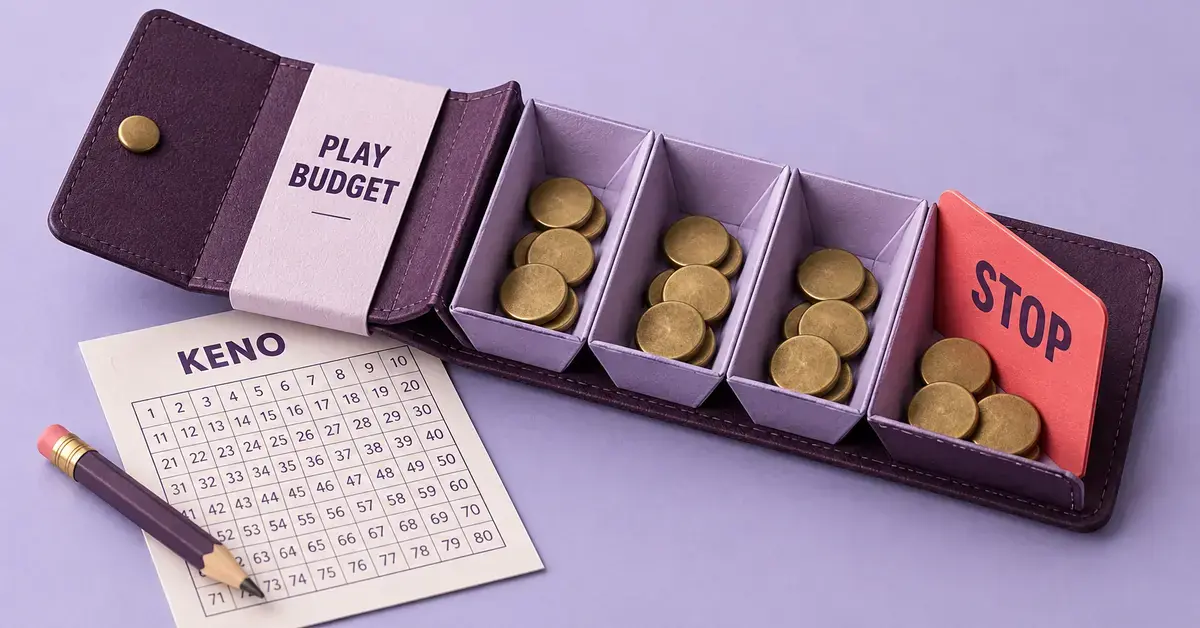
Keno bankroll management is the practice of deciding — before you play — how much money you will spend on keno, how you will split it across draws, and exactly when you will stop. Because keno is a game of pure chance with one of the highest house edges of any lottery or casino game, you cannot improve your odds of winning. What you can control is how much you risk and how long your money lasts. This guide explains, in plain terms, how much to bet, how to make a keno budget stretch, and the mistakes that drain a bankroll fastest — using real figures from Canada’s provincial keno games and national lower-risk gambling guidance.
Key Points
- Bankroll first: decide how much you can afford to lose before you place a single bet — it is entertainment spending, not an investment.
- No plan changes the odds: keno is random with a high house edge; money management controls cost and duration, not whether you win.
- Canada’s guideline: spend no more than 1% of pre-tax household income per month on all gambling combined, on no more than 4 days a month.
- Size bets small: keep each wager to about 5–10% of your session budget so a cold run does not wipe you out.
- Pace is everything: the same budget lasts days on a twice-daily draw but about an hour on a 3.5-minute game.
- Set hard stops: a loss limit, a win goal and a time limit decided in advance protect you from in-the-moment decisions.
What is a keno bankroll?
Your keno bankroll is the fixed sum of money you set aside specifically for playing keno — money you have already decided you can afford to lose. It is entertainment spending, like the cost of a movie or a night out, not an investment and not money you expect to get back. The whole point of a bankroll is that it is a boundary: once it is gone, you are done, and the rest of your money is never in play.
A bankroll works best when it is physically or mentally separate from the money you need for rent, bills, groceries, debt and savings. Many players keep a small cash amount for retail keno, or set a deposit limit on a provincial online account, so the ceiling is built in rather than left to willpower in the moment.
Why bankroll management is the only keno “strategy” that works
Bankroll management matters in keno precisely because nothing else you do changes the result. Keno draws are random and independent, so no number pattern, betting system or “due” number gives you an edge. Over time the game is built to pay back less than it takes in — that gap is the house edge, and in keno it is among the steepest in gambling. You can read a fuller, honest version of this in our guide to keno strategy.
What follows from that is simple: since you cannot out-play the odds, the only decisions with real consequences are financial ones — how big your budget is, how large each bet is, how fast you play, and when you walk away. Those decisions do not make keno profitable (it is not), but they decide whether a set amount of money buys you ten minutes or a month of entertainment, and whether a losing run ever touches money you actually need.
How much should you bet on keno?
The honest answer is that you should bet only what you have already budgeted to lose — and you should decide that budget before you ever look at a bet slip. Work from the top down: first set a monthly limit, then break it into sessions, then size each individual bet. Doing it in that order stops the common trap of picking a bet amount first and letting the total quietly run away from you.
Start with a monthly limit, not a bet size
Canada has national guidance built for exactly this question. The Canadian Centre on Substance Use and Addiction’s Lower-Risk Gambling Guidelines recommend three limits for anyone who chooses to gamble:
- Spend no more than 1% of your pre-tax household income per month on gambling.
- Gamble on no more than 4 days per month (roughly once a week).
- Play no more than 2 types of gambling if you gamble regularly.
Two points matter for keno players. First, the 1% figure is a ceiling across all your gambling combined — lottery, scratch tickets, casino and keno together — not a separate allowance for keno. Second, the guidelines only lower your risk if you follow all three at once. The table below turns the 1% rule into a monthly dollar figure.
Monthly Spending Guide
| Pre-tax household income (per year) | Suggested monthly gambling ceiling (1%) |
|---|---|
| $10,000 | about $8 |
| $40,000 | about $33 |
| $70,000 | about $58 |
| $100,000 | about $83 |
| $130,000 | about $108 |
Turn the monthly limit into a per-session budget
Once you know your monthly ceiling, divide it across the number of times you plan to play. If your monthly keno budget is $40 and you play about four times a month, that is roughly $10 a session. The session amount is the number that actually protects you, because it is the figure you physically bring (or load onto an account) and the point at which you stop for the day.
Keep the session budget small enough that a bad run does not tempt you to “top up.” A good test: if losing the whole session amount in one sitting would bother you beyond mild disappointment, the amount is too high.
Size each bet to your session bankroll
Your individual bet should be a small fraction of your session budget so that variance — the natural swing of wins and losses — cannot wipe you out in a few draws. On Canada’s keno games the wager is set per board. OLG’s Daily Keno, for example, lets you pick 2 to 10 numbers and bet $1, $2, $5 or $10 per board. With a $10 session budget, a $1 bet gives you ten plays and room to ride out a cold streak; a $10 bet is your entire session on a single draw.
As a rule of thumb, keeping each bet to around 5–10% of your session bankroll lets your money survive long enough to enjoy the game. Betting your whole session on one or two draws is not a strategy — it is just a faster way to reach zero.
Do more spots or bigger bets change the cost?
Yes — both raise what you pay, and neither lowers the house edge. The number of spots you pick changes the shape of the prize (more spots means rarer but larger top payouts), while the wager amount and the number of boards and draws decide your total outlay. How many spots you choose affects your odds and payouts, but not the house edge. The key bankroll point: your cost is bet size × boards × number of draws, so every one of those levers spends your money faster.
How to make a keno bankroll last
Making a bankroll last is mostly about controlling pace and setting hard stops. The single biggest factor is how quickly draws happen, because that decides how many bets you can place per hour — and keno’s draw speed varies dramatically across Canada.
Match your budget to the draw pace
Draw frequency is the hidden multiplier on your spending. As our guide to how often keno is drawn explains, OLG’s Daily Keno in Ontario draws twice a day, so a budget naturally stretches over days. BCLC Keno in British Columbia, and the fast screen-based keno in bars and lounges, can draw roughly every 3.5 minutes. The same $20 played at $1 per draw lasts 20 draws either way — but on a twice-daily game that is more than a week, while on a 3.5-minute game it is gone in about 70 minutes. On fast games, set a strict time or draw-count limit before you start.
Set a loss limit (stop-loss)
A stop-loss is the amount of loss that ends your session, no exceptions. For most players the stop-loss simply equals the session budget: when it is gone, you stop. Deciding this in advance removes the in-the-moment judgement call that losing streaks are designed to exploit. Write it down, or set it as a deposit limit, so it is not negotiable later.
Set a win goal and lock it away
A win goal is a point at which you pocket winnings rather than feed them back into the game. If you double a $20 budget to $40, you might bank the original $20 and play on only with the $20 of “house money,” or simply cash out and stop. Keno’s edge means winnings tend to return to the game if you keep playing, so the only reliable way to leave ahead is to physically stop while you are.
Set a time limit
Time limits protect you even when the money is lasting. Decide before you sit down how long you will play, set a phone alarm, and treat it as firmly as the loss limit. This matters most on fast-draw and online keno, where there is no natural end to a session and “just one more” draws can run for hours.
A worked example: making a $40 budget last
Suppose your pre-tax household income is about $48,000, giving a monthly all-gambling ceiling near $40 under the 1% guideline, and you decide to spend all of it on keno across four sessions.
- Monthly budget: $40 total, split into four $10 sessions.
- Bet size: $1 per board, so each session is up to 10 plays.
- Stop-loss: the $10 session amount — when it is gone, stop for the day.
- Win goal: if a session reaches $20, bank the first $10 and play on only with winnings, or cash out.
- Pace: on a twice-daily draw game, 10 plays can span several days; on a 3.5-minute game, add a 30-minute time limit so a single sitting does not burn the week’s budget.
Nothing here improves the odds. What it does is guarantee that one month of keno costs exactly $40, never touches essential money, and cannot spiral during a losing run.
Common keno bankroll mistakes
Most bankrolls are not lost to bad luck alone — they are lost to a handful of predictable habits. Watch for these:
- Chasing losses. Betting more to “win back” a loss is the fastest way to turn a small loss into a large one. Past draws do not make a win more likely.
- Raising stakes after a cold run. Each draw is independent, so increasing your bet does not correct earlier losses — it only increases how much you can lose.
- Betting on “hot,” “cold” or “due” numbers. These patterns do not exist in a random draw; chasing them often means playing more and spending more. See our guide to best keno numbers for why.
- Adding the multiplier to catch up. A multiplier add-on typically doubles your ticket cost while leaving your odds of matching unchanged, so using it to recover losses just doubles the money at risk.
- Playing many consecutive draws with no limit. Buying long strings of draws commits your budget before you have seen a single result and removes natural stopping points.
- Using money meant for something else. Rent, bills, savings and debt payments are never a bankroll. If keno money comes from those, the budget has already failed.
Tools that help you stick to your limit
You do not have to rely on willpower alone. Canada’s regulated provincial platforms build limit tools directly into play. On provincial online sites you can usually set deposit limits, time-on-site limits, loss limits and reminders, and you can use self-exclusion to block your own access for a set period. These are the same tools responsible gambling programs recommend, and they turn your plan into a hard boundary the system enforces. For the full list of help lines, self-exclusion programs and support services, see our responsible gambling resources.
Who keno bankroll discipline is for
Bankroll discipline is for everyone who plays keno, because the house edge applies to every player equally. It matters most, though, for anyone drawn to the fast screen-based games in bars or online, where draws come every few minutes and spending can accelerate without you noticing. If you treat keno strictly as paid entertainment with a fixed cost, a bankroll plan simply guarantees the price. If you ever find yourself unable to stop at your limit, that is a signal to step back and reach out for support.
A note on responsible gambling
Keno is a game of chance with a built-in house edge: over time it pays out less than players put in, and no budget or betting plan changes that. It should only ever be played with money you can afford to lose, and never to earn income or recover debt. The legal age to play is 18 or 19 depending on your province. If gambling is causing you stress or financial harm, free and confidential help is available 24/7: in Ontario, call ConnexOntario at 1-866-531-2600 or text 247247; in British Columbia, call the Problem Gambling Help Line at 1-888-795-6111; in Quebec, call Gambling: Help and Referral at 1-800-461-0140. Our responsible gambling page lists the full set of provincial help lines and support services.
Sources
Frequently Asked Questions (FAQ)
How much money should I bring to play keno?
Bring only a fixed amount you have decided in advance you can afford to lose, and leave the rest at home or off your gambling account. A practical approach is to set a monthly gambling budget — Canada’s lower-risk guidelines suggest no more than 1% of pre-tax household income — then split it into small session amounts, such as $10 at a time.
What is a good bet size for keno?
A good bet is a small fraction of your session budget, roughly 5–10%, so a cold streak cannot wipe you out in a few draws. On OLG Daily Keno, for example, a $1 bet from a $10 session gives you ten plays, while a $10 bet puts the whole session on one draw.
Does bankroll management improve my chances of winning keno?
No. Keno draws are random and carry a fixed house edge, so no amount of money management changes your odds of matching numbers. Bankroll management controls how much you spend and how long your money lasts — not whether you win.
How do I stop losing more than I planned at keno?
Set a loss limit equal to your session budget and stop the moment it is gone, set a time limit and a win goal, and never bet more to chase a loss. On provincial online platforms you can enforce this automatically with deposit, loss and time limits.
Why does my keno money disappear so fast on bar or online games?
Fast keno can draw roughly every 3.5 minutes, so you place far more bets per hour than on a twice-daily lottery draw. The same budget that lasts over a week on Daily Keno can be gone in about an hour on a 3.5-minute game, which is why a strict time limit matters most on fast games.
