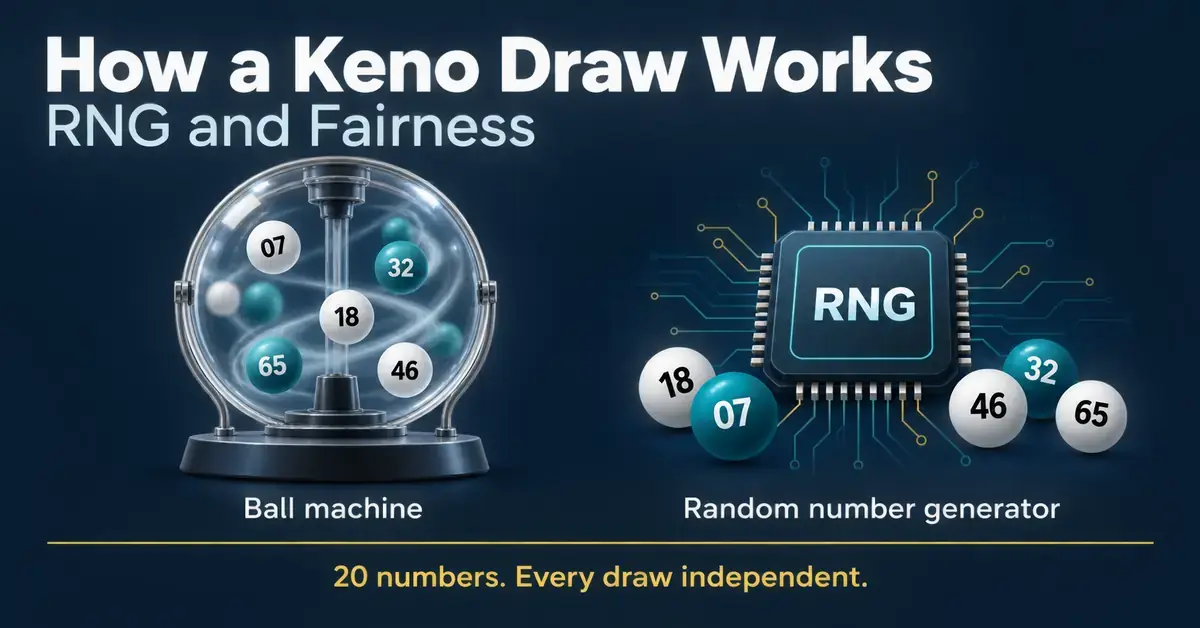
A keno draw is the moment the game picks its 20 winning numbers. In every version of keno sold in Canada, exactly 20 numbers are selected from a fixed pool, and you win based on how many of them match the spots you chose. What changes from game to game is how those 20 numbers are produced and how often a new draw happens. This guide explains the two draw methods keno uses — a physical ball machine and a computerised random number generator — how Canada’s provincial games run their draws, and why every draw is independent and random.
Key Facts
- Numbers drawn per draw: 20
- Number pool: 1–70 (OLG Daily Keno) or 1–80 (BCLC, WCLC and most casino/video keno)
- Draw method: certified random number generator (video, online and fast lottery keno) or an air-blown ball machine (live casino keno)
- Draw frequency: OLG twice daily (~2:00 p.m. & ~10:30 p.m. ET); BCLC every ~3.5 minutes (~400 draws/day); WCLC about every 5 minutes
- Independence: each draw is independent and random — past results do not affect future draws
- Fairness: provincial games are regulated (e.g. AGCO, GPEB) and draw systems are independently tested
What is a keno draw?
A keno draw is a single round in which 20 numbers are selected at random from the game’s number pool. That pool is either 1–70 or 1–80 depending on the game. Before the draw, you choose between a handful of your own numbers — called “spots” — and place your wager. After the draw closes, the 20 numbers are revealed, and the game compares them to your spots to decide your prize.
The draw is the engine of the whole game. You do not play against other people or against a dealer; you play against a fresh set of 20 randomly chosen numbers. If you are new to the game itself, our guide on how to play keno walks through picking spots and wagers first; this page focuses only on the draw.
Ball blower vs. random number generator: the two draw methods
Keno draws its numbers in one of two ways: a mechanical ball machine or a computerised random number generator. Both are designed so that every number has an equal chance of being drawn, and both produce the same kind of result — 20 numbers from the pool. The method depends on where and how you are playing.
Live keno and the ball blower
Live keno in a casino or gaming lounge uses a physical ball machine, often called a blower or bubble. Eighty numbered balls — one for each number from 1 to 80 — are mixed by forced air inside a clear chamber, and 20 are blown out one at a time until the draw is complete. This is the oldest and most visible form of keno: players can watch the balls being drawn, which is part of its appeal. It is slower than a computer draw because the balls have to be physically mixed and selected each round.
Video and lottery keno and the random number generator
Most keno you encounter today — video keno machines, online keno and the fast provincial lottery games — uses a random number generator (RNG). An RNG is a computer program that produces unpredictable numbers; for a keno draw it selects 20 numbers from the pool with no human involvement. A sound RNG gives every number the same chance on every draw and keeps no “memory” of earlier draws. RNG draws are used whenever games must run quickly or around the clock, because a computer can complete a draw in seconds. The different ways keno is packaged — live, video, online and lottery — are compared in our guide to types of keno and game variants.
How Canada’s lottery keno draws actually work
Canada’s provincial lottery keno games are drawn by certified random number generators, not public ball machines. This is a practical necessity: a game that draws new numbers every few minutes, hundreds of times a day, cannot be run with a physical blower. The provincial lottery corporations — OLG in Ontario, BCLC in British Columbia, WCLC across the Prairies and the North, ALC in Atlantic Canada and Loto-Québec in Quebec — each run their own keno product with its own pool size and draw schedule. You can see how the provincial products line up in our overview of keno in Canada.
Where physical balls are still used — mainly live casino keno — the draw is a mechanical process. Where speed or constant availability matters, the draw is an RNG. Quebec’s casino by-law captures the point plainly: in keno, the winning numbers come “either from a draw machine or a computer which chooses them at random.” Either way, the goal is the same — an unbiased selection of 20 numbers.
How often does keno draw in Canada?
Draw frequency is the biggest practical difference between Canada’s keno games. Some draw just twice a day; others draw every few minutes. Here is how the main provincial products compare.
OLG Daily Keno (Ontario)
OLG’s Daily Keno draws 20 numbers from a pool of 1–70, twice a day. The midday draw is held at about 2:00 p.m. Eastern and the evening draw at about 10:30 p.m. Eastern. You pick between 2 and 10 numbers and choose a $1, $2, $5 or $10 wager, and you can play the same numbers across 1 to 10 consecutive draws. Because there are only two draws a day, Daily Keno feels more like a traditional lottery than a rapid casino game. OLG reports the overall odds of winning any prize at about 1 in 9.17.
BCLC Keno (British Columbia)
BCLC’s Keno, played through PlayNow and at retail, draws 20 numbers from a larger pool of 1–80, with a new draw roughly every 3.5 minutes — close to 400 draws a day. You pick from 1 to 10 spots. BCLC’s game conditions state that draws occur at intervals determined by BCLC, starting on or after 4:30 a.m., so the operator controls the exact timing rather than it being fixed by law. A ticket can cover up to 99 draws, and an optional Keno Bonus multiplier is selected at random just before each draw.
WCLC, ALC and Loto-Québec
The Western Canada Lottery Corporation (WCLC), serving the Prairie provinces and the territories, runs a fast keno drawn from a 1–80 pool with a new draw about every five minutes and a pick range of 1 to 10 spots — similar in format to BCLC’s game. Atlantic Canada (ALC) and Quebec (Loto-Québec) offer their own keno products; pool size, spot limits and draw frequency vary, so always check the current game conditions published by the operator in your province.
Keno Draw Comparison
| Game (operator) | Number pool | Numbers drawn | Spots you can pick | Draw frequency |
|---|---|---|---|---|
| Daily Keno (OLG, Ontario) | 1–70 | 20 | 2–10 | Twice daily (~2:00 p.m. & ~10:30 p.m. ET) |
| Keno (BCLC, British Columbia) | 1–80 | 20 | 1–10 | About every 3.5 minutes (~400/day) |
| Keno (WCLC, Prairies & North) | 1–80 | 20 | 1–10 | About every 5 minutes |
Is each keno draw independent and random?
Yes — each keno draw is independent, meaning the result of one draw has no effect on the next. A properly built draw, whether a ball blower or an RNG, treats every round as a clean slate. The 20 numbers are selected fresh each time, every number has the same chance, and nothing carries over from the previous draw.
What “independent draws” means
Independence is a mathematical property, not a marketing claim. It means the odds of any particular number appearing are exactly the same on every draw, regardless of what came before. If the number 17 was drawn in the last five rounds, it is neither more nor less likely to appear in the next one. The draw has no memory. This is why past results cannot be used to predict future numbers, and why the odds printed on a keno game stay constant draw after draw. For the actual odds by spot, see our guide to keno odds and payouts.
The gambler’s fallacy: a common mistake
The most common mistake people make about keno draws is the gambler’s fallacy — the belief that a number is “due” because it has not appeared recently, or “hot” because it keeps appearing. Because draws are independent, neither idea holds. Tracking which numbers are overdue or hot does not change your odds on the next draw by even a fraction. Any system built on past draw results is tracking noise, not a pattern. Our honest look at keno strategy and what actually works explains why no number-picking system can beat the game’s fixed house edge.
Is keno random, or is it rigged?
Keno sold by Canada’s provincial lottery corporations is random and regulated, not rigged. The draw is designed to be unbiased, and the games do not need to cheat to make money — the built-in house edge, set through the payout table, already guarantees the operator a long-run margin whether or not any individual draws go the player’s way. In other words, a fair random draw and a profitable game are not in conflict; the math of the payouts does the work.
That does not mean every keno-style game online is trustworthy. The assurance of fairness comes from regulation and independent testing (below), which apply to licensed provincial games and not to unlicensed offshore sites. If you want the full fairness-versus-rigged discussion, that is the natural next topic after understanding the draw itself.
Who makes sure keno draws are fair in Canada?
Keno draw fairness in Canada is overseen by provincial regulators and verified by independent test laboratories. In Ontario, gaming is regulated by the Alcohol and Gaming Commission of Ontario (AGCO); in British Columbia, oversight sits with the Gaming Policy and Enforcement Branch (GPEB). The lottery corporations themselves publish game conditions and prize structures, and specialised testing labs such as Gaming Laboratories International (GLI) audit the random number generators and draw systems used in regulated environments. Transparency practices — published winning numbers, published odds and named major-prize winners — add a further check that the games behave as advertised.
Common mistakes people make about keno draws
- Assuming a number is “due.” Draws are independent, so an overdue number is no more likely to appear next time.
- Chasing “hot” numbers. A number appearing often in recent draws does not raise its future chance; the pattern is random.
- Confusing pool sizes. OLG’s Daily Keno uses 1–70, while BCLC and WCLC use 1–80. The pool affects the odds, so do not assume all keno is the same.
- Thinking more draws improve your odds. Playing the same numbers over 10 draws gives you more chances to play, but the odds on each individual draw are unchanged.
- Trusting unlicensed sites. Fairness guarantees apply to regulated provincial games. An offshore “keno” site may not use an audited draw at all.
Disclaimer
This article is informational only and is not gambling advice. Keno is a game of chance with a built-in house edge; no understanding of how the draw works, and no system based on past results, can improve your odds or guarantee a win. Play only with money you can afford to lose, and know the legal age in your province. If gambling is affecting you or someone you know, free, confidential help is available — see our guide to responsible gambling help and support in Canada.
Sources
Frequently Asked Questions (FAQ)
How many numbers are drawn in a keno draw?
Exactly 20 numbers are drawn in every standard keno draw. They are selected from a pool of 1–70 (OLG Daily Keno) or 1–80 (BCLC, WCLC and most casino and video keno). You win based on how many of those 20 match the spots you picked.
Does keno use real balls or a computer?
It depends on the game. Live casino keno typically uses a physical air-blown ball machine, while video keno, online keno and the fast provincial lottery games use a certified random number generator. Both methods are built to give every number an equal chance.
How often does keno draw?
Draw frequency varies by game. OLG’s Daily Keno draws twice a day, at about 2:00 p.m. and 10:30 p.m. Eastern. BCLC’s Keno draws roughly every 3.5 minutes — close to 400 times a day — and WCLC’s keno draws about every five minutes.
Is each keno draw independent?
Yes. Every keno draw is independent, so the result of one draw has no effect on the next. Each number has the same chance on every draw, and the game keeps no memory of previous results. That is why past numbers cannot predict future ones.
Can you predict keno numbers from past draws?
No. Because draws are random and independent, no pattern in past results can predict future numbers. Tracking “hot” or “overdue” numbers does not change your odds, and no system can overcome the game’s fixed house edge.
