

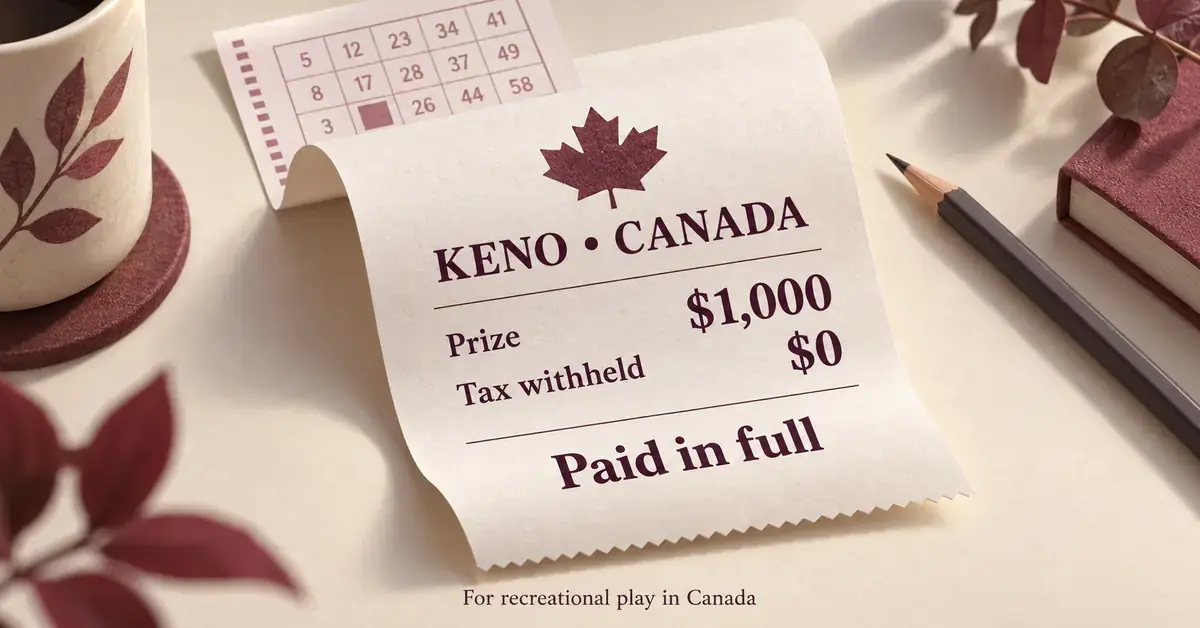
If you hit a keno prize in Canada, the money is almost always yours to keep in full. The Canada Revenue Agency (CRA) does not treat ordinary keno, lottery or casual gambling winnings as income, so a recreational player who matches their numbers does not pay income tax on the prize. There are a few real exceptions, though, and they trip people up: money you later earn from your winnings, gambling as a business, and prizes won in the United States. This guide explains the general rule, the law behind it, and exactly when a keno win can become taxable.
Key Points
- Generally not taxable: Recreational keno winnings are a tax-free windfall in Canada — no federal or provincial income tax on the prize.
- No amount threshold: The rule is the same whether you win $10 or a six-figure jackpot, and nothing is withheld from a Canadian prize.
- The law: Winnings fall outside “income,” and Income Tax Act paragraph 40(2)(f) exempts lottery gains; the CRA’s position is in Income Tax Folio S3-F9-C1.
- Taxable exceptions: Gambling run as a business, investment income earned on the winnings, and prizes won in the United States.
- Not tax advice: Confirm your own situation with the CRA or a qualified tax professional.
The short answer: are keno winnings taxable in Canada?
No — for a recreational player, keno winnings are not taxable in Canada. The CRA classifies lottery and gambling prizes as a “windfall,” which is unexpected money rather than income from a job, a business or an investment. Because Canada’s income tax system taxes income and not windfalls, there is no federal or provincial tax on the prize itself, and no amount is too large to change that on its own.
This applies to the keno products offered across the country, from OLG Daily Keno in Ontario to BCLC Keno in British Columbia and the games run by the other provincial lottery corporations. You can read more about those games on our overview of keno in Canada.
Why Canada does not tax keno winnings
Canada does not tax keno winnings because the law does not count a gambling prize as income. Two pieces of the tax rules work together here.
First, the general concept of a “windfall.” The CRA considers a payment a windfall when the person had no enforceable right to it, made no organized effort to get it, did not expect it to recur and did not provide goods or services in return. A keno prize fits that description: you bought a ticket hoping to get lucky, not as a service rendered. Windfalls fall outside the definition of income, so they are not taxed.
Second, the capital gains rules. Paragraph 40(2)(f) of the Income Tax Act specifically states that a gain from betting on a lottery scheme is not a taxable capital gain. In other words, even the “growth” angle is closed off. The CRA sets out its full position in Income Tax Folio S3-F9-C1, Lottery Winnings, Miscellaneous Receipts, and Income (and Losses) from Crime, which replaced the older Interpretation Bulletin IT-213R.
Do you have to report keno winnings to the CRA?
Generally, no. Because a keno prize is not income, there is no line on your T1 personal tax return for it, and the provincial lottery corporations do not issue a tax slip for the win itself. You simply keep the money. The reporting obligations only begin once the winnings start to earn income — more on that below.
Does the amount, format or province change anything?
The tax treatment of a recreational keno win does not change with the size of the prize, how you played, or where in Canada you live. The windfall rule is national. Here is how the common “what if” questions actually play out.
Does it matter how much you win?
No. A $10 keno catch and a six-figure jackpot are treated identically — both are tax-free windfalls for a recreational player. Unlike the United States, Canada has no withholding tax taken off the top of a domestic lottery or keno prize, so the advertised amount is what you receive.
Does it matter whether you play in person or online?
No. Whether you buy a ticket at a retailer, play at a bar terminal, or play through a provincial website, a win is still a windfall and still tax-free. What matters for legality is that you are playing a regulated Canadian product; our guide to online keno in Canada explains which provincial platforms are licensed to offer it.
Does it matter which province you are in?
No. The windfall treatment comes from federal tax law and applies in every province and territory, so a keno win is tax-free in Ontario, British Columbia, Quebec, the Atlantic provinces and the Prairies alike. Provinces differ on things like the minimum playing age — see the legal age to play keno by province — but not on whether a prize is taxed.
When keno winnings can be taxed
Keno winnings become taxable in three situations: when gambling is run as a business, when you earn investment income on the money, and when the prize is won in a country that taxes it. Each is worth understanding on its own.
If you gamble as a business (the professional-gambler exception)
Winnings are taxable as business income if the CRA decides you are carrying on gambling as a business rather than playing recreationally. There is no fixed dollar threshold for this; it is a fact-based test looking at whether your activity is organized, systematic and pursued as a genuine source of livelihood. A professional would report the income on Form T2125 (Statement of Business or Professional Activities).
In practice this is a high bar and it rarely applies to lottery-style games such as keno, where outcomes are random and there is no skill that produces a reliable income. The issue arises far more often with skill-adjacent gambling. Notably, the Supreme Court of Canada declined to hear an appeal by high-stakes poker players who argued their winnings should be tax-free like a lottery, leaving in place the principle that genuinely business-like gambling can be taxed. For a game of pure chance like keno, a one-off or occasional win stays a windfall.
Investment income earned on your winnings
Any income your winnings generate after you receive them is taxable, even though the prize itself was not. This is the exception that catches the most winners. Examples include:
- Interest paid on the winnings sitting in a savings account or GIC.
- Dividends from shares you buy with the money.
- Capital gains when you sell an investment bought with the winnings for more than you paid.
- Rental income from a property purchased with the prize.
Your bank or investment firm will issue the usual tax slips (such as a T5 for interest and dividends), and you report that income normally. Sheltering some of the money inside a Tax-Free Savings Account (TFSA) or a Registered Retirement Savings Plan (RRSP), within your available contribution room, is one way to reduce tax on that future income — but that is a personal financial-planning decision, not something the keno rules require.
Keno or gambling winnings won in the United States
Winnings from gambling in the United States are taxed differently because the U.S. taxes them at source. The U.S. Internal Revenue Service (IRS) generally applies a 30% withholding tax to gambling and lottery winnings paid to non-residents, so a Canadian can have nearly a third of a U.S. prize held back immediately.
The Canada–United States tax treaty provides relief. It lets a Canadian resident offset U.S. gambling losses against U.S. gambling winnings and reclaim some or all of the withheld tax by filing a U.S. non-resident return (Form 1040-NR), attaching the Form 1042-S that shows the tax withheld. The refund is limited to the extent of documented losses, so keeping records matters. This is a cross-border filing, and most people in this situation use a tax professional who handles U.S. non-resident returns.
Tax Treatment Comparison
| Situation | Taxable in Canada? | Notes |
|---|---|---|
| Recreational keno win (any amount) | No | Treated as a tax-free windfall; nothing to report. |
| Online vs. in-person keno win | No | Format does not change the windfall treatment. |
| Interest or dividends earned on the winnings | Yes | Investment income is taxable and reported (e.g. T5 slip). |
| Capital gain on an investment bought with winnings | Yes | Taxed when you sell for a profit. |
| Gambling carried on as a business (professional) | Yes | Business income on Form T2125; a high, fact-based bar. |
| Keno or lottery won in the United States | Taxed by the U.S. | ~30% IRS withholding; partly recoverable under the Canada–U.S. treaty. |
| Giving winnings to family | No gift tax | But attribution rules can tax income from gifts to a spouse or minor child. |
Giving keno winnings to family: is there a gift tax?
Canada has no gift tax, so you can give keno winnings to family or friends without the recipient paying tax on the gift itself. If you share a jackpot with relatives, the cash handed over is not income to them.
The catch is the CRA’s “attribution rules.” If you give money to your spouse or common-law partner, or to a minor child, and they invest it, the investment income it earns can be attributed back to you and taxed in your hands. Gifts to adult children generally are not caught by these rules. The gift is still tax-free; it is only the ongoing investment income that the attribution rules can follow. For a large or shared prize, this is a point worth reviewing with a tax advisor before moving money around.
Common mistakes and misconceptions
Most tax confusion around keno comes from a handful of recurring myths. Clearing them up:
- “A big enough jackpot gets taxed.” False. There is no size threshold in Canada; a recreational win is tax-free regardless of amount.
- “I can deduct my keno losses.” No. Because winnings are not taxable income for recreational players, losses are not deductible either. The two go together.
- “I should hide or not declare my win.” There is nothing to declare on the prize itself, so there is nothing to hide — but you must report the interest, dividends or other income the money later earns.
- “Online wins are taxed but retail wins aren’t” (or vice versa). False. The format does not change the windfall treatment.
- “Winnings in Vegas are tax-free because they’re tax-free at home.” No. U.S. winnings face U.S. withholding; the Canadian windfall rule does not override U.S. tax law.
- “Playing more or using a system changes my tax or my odds.” No. Keno is a game of chance with a fixed house edge, and no pattern of play makes you a taxable professional or improves your chances.
If you want to confirm an actual prize before thinking about any of this, our guide on how to check keno results in Canada explains the official way to verify a winning ticket.
Friskrivning
This article is general information about Canadian tax rules as they apply to keno, not tax, legal or financial advice. Tax outcomes depend on your personal circumstances, and rules can change — confirm your situation with the Canada Revenue Agency or a qualified tax professional before acting.
Keno is a game of chance with a built-in house edge; it is a form of entertainment, not a way to make money. You must be of legal age to play in your province. If gambling is causing you or someone you know harm, free, confidential help is available across Canada — for example ConnexOntario at 1-866-531-2600 — and our responsible gambling page lists provincial support lines and resources.
Sources
- Canada Revenue Agency — Income Tax Folio S3-F9-C1, Lottery Winnings, Miscellaneous Receipts, and Income (and Losses) from Crime
- Income Tax Act, section 40(2)(f) — Justice Laws Website
- Legal Line — Do you pay tax on lottery winnings?
- H&R Block Canada — Are lottery winnings taxed?
- TaxTips.ca — U.S. gambling taxes and recovering withholding under the treaty
- MoneySense — Unexpected money: what Canada taxes and what it doesn’t
Vanliga frågor (FAQ)
Are keno winnings taxable in Canada?
No. For a recreational player, keno winnings are a tax-free windfall under Canadian tax law. You keep the full prize and do not report it as income on your tax return.
Do I have to pay tax if I win a large keno jackpot?
No. Canada does not tax lottery or keno prizes based on size. A large jackpot is treated the same as a small win — tax-free for a recreational player, with no amount withheld from a domestic prize.
Is the interest I earn on my keno winnings taxable?
Yes. The prize itself is tax-free, but any interest, dividends or capital gains you earn after investing the money are taxable and must be reported, usually through slips such as a T5 from your bank.
Can keno winnings ever be taxed as income?
Yes, if the CRA considers you to be gambling as a business rather than recreationally. This is a fact-based test and rarely applies to a game of pure chance like keno, but genuine business-like gambling income is taxable and reported on Form T2125.
What happens if I win keno or a lottery in the United States?
The U.S. generally withholds about 30% from a non-resident’s gambling winnings. Under the Canada–U.S. tax treaty you may recover some or all of it by filing a U.S. non-resident return and offsetting documented U.S. gambling losses.
