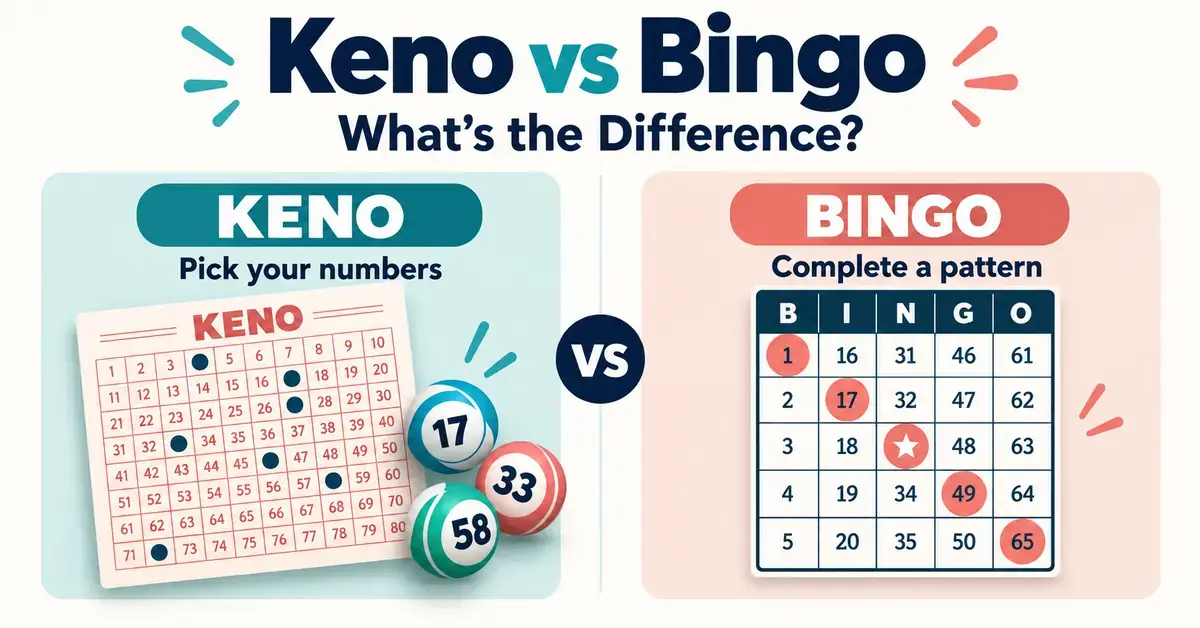
Keno and bingo are both lottery-style games of chance built on numbered balls and matching, which is why they are so often confused. The difference comes down to two things: in keno you pick your own numbers and get paid on how many of the 20 drawn you match, while in bingo you play pre-printed cards and win by completing a pattern before anyone else. This guide breaks down how each game works, how they compare on speed and prizes, where they came from, and how both are offered in Canada.
Key Points
- Keno is a numbers game: you choose your own numbers and are paid on how many of the 20 drawn you match.
- Bingo is a pattern game: you play pre-printed cards and win by completing a shape before other players.
- Pace differs: keno rounds are fast and usually solo, while bingo is caller-paced and social.
- Prizes differ: keno offers large fixed payouts on long odds; bingo prizes are usually pooled and shared, so wins are smaller but more frequent.
- Both are games of chance with a built-in house edge, and no system changes the result.
What are keno and bingo?
Keno and bingo are both draw-based number games, but they belong to different families. Keno is closer to a fast lottery you play on your own, while bingo is a communal pattern game run by a caller. Understanding each one on its own makes the comparison much clearer.
What is keno?
Keno is a number-matching game where you choose a set of numbers, called spots, and the game then draws 20 numbers at random. The more of your chosen numbers that appear among the 20 drawn, the more you win, according to a fixed paytable. In the classic casino and lottery format, numbers run from 1 to 80, and players typically mark between 1 and 10 spots (some versions allow up to 15). In Ontario, OLG’s Daily Keno uses a smaller 1-to-70 pool but still draws 20 numbers. If you are new to the mechanics, our full walkthrough on how to play keno covers spots, wagers and draws step by step.
What is bingo?
Bingo is a game played on pre-printed cards covered with numbers, where a caller (or a random number generator online) announces numbers one at a time and you mark any that appear on your card. You win by being the first to cover a required pattern. The two most common formats are 75-ball bingo, popular across North America, which uses a 5×5 card with a free centre square and columns headed B-I-N-G-O, and 90-ball bingo, common in the UK and Europe, which uses a three-row, nine-column ticket numbered 1 to 90. Speed variants such as 80-ball and 30-ball also exist. The key point is that you do not choose your numbers in bingo; the card decides them for you.
Keno vs bingo: the core differences
The clearest way to tell the two games apart is to line them up feature by feature. The table below summarises the differences that matter most to a player; the sections after it explain each one in plain language.
Comparison
| Feature | Keno | Bingo |
|---|---|---|
| Number pool | You pick from a fixed pool (1–80 in the classic format; 1–70 for OLG Daily Keno) | Numbers come pre-printed on cards (1–75 in 75-ball, 1–90 in 90-ball) |
| Who picks the numbers | You choose your own spots | The card is pre-filled for you |
| How you win | Match as many of your numbers as possible to the 20 drawn | Complete a required pattern (line, four corners, full house, etc.) |
| When a round ends | After 20 numbers are drawn | When a player completes the pattern and calls it |
| Pace | Fast, often one draw after another | Slower, set by the caller |
| Prize structure | Fixed paytable; large top prizes on long odds | Usually pooled; smaller, more frequent, sometimes shared |
| Social element | Typically played solo | Communal and social by design |
| Origin | China | 16th-century Italian lottery |
Who picks the numbers?
You pick your own numbers in keno, but your numbers are decided for you in bingo. In keno you actively mark the spots you want on a blank grid, which gives you control over how many numbers you play. In bingo, every card arrives pre-printed, so your only real choices are how many cards to buy and which game to join. This single difference drives almost everything else about how the two games feel.
Matching numbers vs completing patterns
Keno pays you for matching individual numbers, while bingo pays you for completing a shape. In keno, each number you match against the 20 drawn moves you up a fixed paytable, and the draw always stops at 20 numbers. In bingo, individual numbers do not pay on their own; what counts is covering a specific pattern, such as a single line, two lines, four corners, a set shape, or a full card (often called a full house or blackout). The caller keeps drawing numbers until a player completes the target pattern and claims the win.
Game speed and pace
Keno is fast and self-paced, while bingo moves at the caller’s speed. A keno round can resolve in well under a minute, and lottery and online versions let you play draw after draw with little waiting, which is why keno is often described as a rapid game. Bingo is slower by design: numbers are read out one at a time, and a single game runs until someone completes the pattern. That slower rhythm is part of the appeal, because it leaves room for conversation.
Prize structure and payouts
Keno offers fixed payouts on long odds, while bingo prizes are usually pooled and shared. In keno, the paytable is set in advance: match a certain number of spots and you win a stated amount or multiple of your wager, with large top prizes attached to very long odds. In most bingo games, the money collected from cards is pooled and awarded to whoever completes each pattern, so prizes tend to be smaller but land more often, and a prize may be split if several players finish on the same number. To understand how fixed keno paytables translate into real chances, see our guide to keno odds and payouts.
The social element
Bingo is a social, shared experience, while keno is typically solo. Bingo halls and online bingo rooms are built around playing together in real time, often with chat, hosts and a communal rhythm. Keno is usually played individually against the paytable, whether on a lottery terminal, a video machine or an app, with no need to interact with other players. Neither approach is better; they simply suit different moods.
How do the odds compare?
Both games are pure chance with a built-in house edge, and no system changes the outcome of either. In an 80-number keno game, any single number you pick has a 20-in-80 chance, or 1 in 4, of being among the 20 drawn, but the odds of matching all of your spots grow astronomically long as you add more numbers. Keno is known for a relatively high house edge that varies with the paytable. Bingo’s odds depend on how many cards are in play: the more cards other people hold, the lower your chance of winning any single game, since only one card completes the pattern first. In short, keno dangles large fixed prizes on long odds, while bingo spreads smaller prizes among players more frequently. Treating either as entertainment rather than income is the only realistic approach; our honest look at keno strategy explains why no betting pattern beats the math.
History: where each game came from
Keno and bingo have completely separate origins, despite looking like cousins today. Knowing where each came from helps explain why they play so differently.
The origins of keno
Keno traces back to China, where lottery-style number games were played using sheets of written characters rather than numbers. Popular legend links the game to the Han dynasty and even to funding the Great Wall, though that story is folklore rather than documented history; licensed Chinese lotteries are reliably recorded from the 19th century. Chinese immigrants carried the game to North America in the 1800s, where characters were swapped for numbers and the modern name “keno” took hold.
The origins of bingo
Bingo descends from a 16th-century Italian lottery known as “Lo Giuoco del Lotto d’Italia”, which spread to France as “Le Lotto” and was later used by German educators as a teaching tool. In the United States it circulated as a carnival game called “Beano”, played with dried beans on numbered cards. The modern name reportedly stuck in 1929 after a player excitedly shouted “Bingo!” instead of “Beano”, and toy entrepreneur Edwin Lowe commercialised the game that followed.
Keno and bingo in Canada
Both games are legal and regulated in Canada, but they are overseen province by province rather than nationally. Keno is sold as a lottery product by provincial operators, with OLG’s Daily Keno in Ontario being one well-known example and other provincial lottery corporations running their own versions; you can see how the games differ across the country in our overview of keno in Canada. Bingo in Canada takes two main forms: licensed charitable bingo, run by charities and religious organisations under a provincial regulator such as Ontario’s Alcohol and Gaming Commission, and electronic or online bingo, which under federal law may only be conducted and managed by a provincial government or its lottery corporation. The minimum legal age to play is either 18 or 19 depending on the province and the product. Keno is one of several lottery-style formats you will meet in Canada; our guide to the main types of keno puts it alongside video, live and online versions.
Which game suits you?
Choose keno if you want fast, solo play with the chance of a large fixed prize; choose bingo if you prefer a slower, social game with more frequent, shared wins. Keno rewards players who like control over their numbers and quick, repeatable rounds, and who do not mind long odds on the biggest payouts. Bingo suits players who enjoy a communal atmosphere, a steady pace and the feeling of regular small wins, and who are happy to let the card choose their numbers. Many people enjoy both for different reasons, and neither requires any special skill beyond understanding how the prizes work.
Common mistakes players make
The most common mistake is assuming the two games play the same way because they both use numbered balls. A few specific misunderstandings trip up newcomers:
- Expecting to pick numbers in bingo. Bingo cards are pre-printed; you cannot choose your numbers the way you do in keno.
- Thinking matching more numbers always wins in bingo. Bingo is about completing the required pattern first, not about total matches, so a card with many marks can still lose to one that finishes the pattern.
- Believing a “system” improves the odds. Both games are random. Choosing certain numbers, cards or spot counts does not change the house edge.
- Chasing the keno top prize with many spots. Adding spots lengthens the odds of a full match dramatically; it does not make a big win likely.
- Ignoring the paytable or house rules. Keno payouts and bingo patterns vary by operator and venue, so the exact rules in front of you decide what you can win.
A note on playing responsibly
Keno and bingo are forms of gambling and should be treated as entertainment, not a way to make money. Both carry a house edge, outcomes are random, and no strategy changes that. Set a budget before you play, never chase losses, and remember that the legal minimum age is 18 or 19 depending on your province. If gambling stops being fun or starts causing harm, free, confidential help is available through the resources listed on our responsible gambling page.
Sources
Frequently Asked Questions (FAQ)
What is the main difference between keno and bingo?
In keno you choose your own numbers and are paid on how many of the 20 drawn you match, while in bingo you play pre-printed cards and win by being the first to complete a required pattern. Keno is a fast, solo matching game; bingo is a slower, social pattern game.
Is keno or bingo easier to win?
Neither is “easier” in a way you can control, because both are games of chance with a built-in house edge. Bingo tends to produce smaller wins more often since prizes are pooled among players, while keno offers larger fixed prizes on much longer odds.
Do you pick your own numbers in bingo?
No. Bingo cards come pre-printed with their numbers already set, so you cannot choose them. Your only choices are how many cards to play and which game to join, which is a key difference from keno.
Why is keno faster than bingo?
A keno round ends as soon as 20 numbers are drawn, and lottery and online versions let you play one draw after another with little waiting. Bingo runs at the caller’s pace, reading numbers one at a time until a player completes the pattern, so each game takes longer.
Are keno and bingo legal in Canada?
Yes. Both are legal and regulated province by province. Keno is sold as a lottery product by provincial operators, and bingo is offered as licensed charitable bingo and as government-run electronic or online bingo. The minimum age is 18 or 19 depending on the province.
