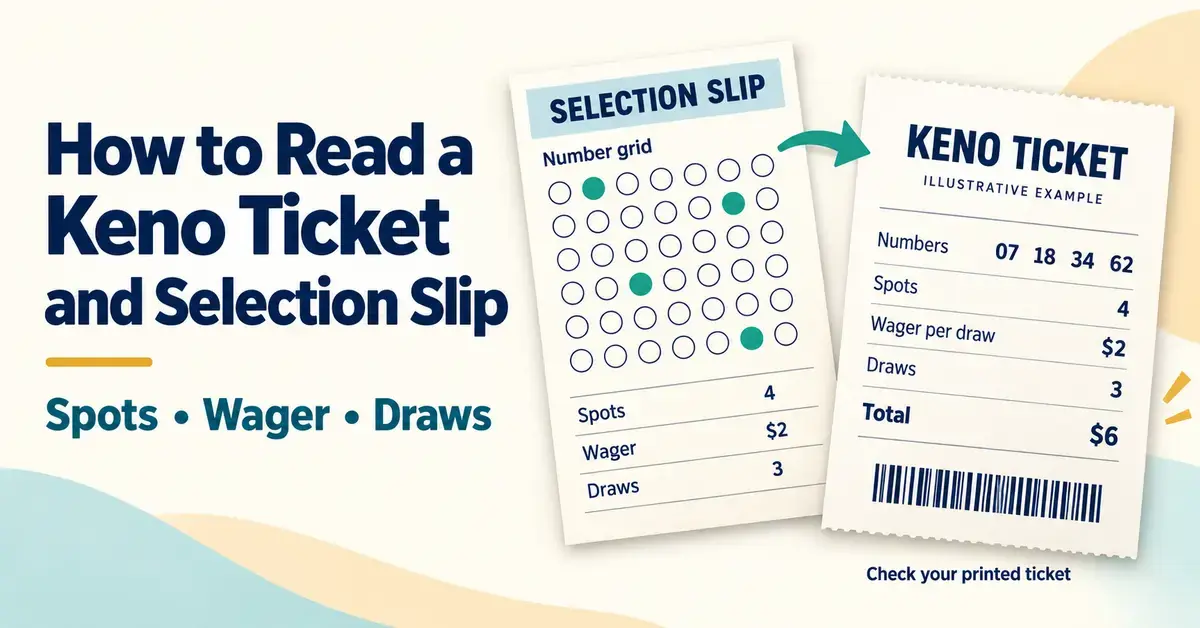
A keno ticket really has two parts to understand: the selection slip you fill in before a draw, and the printed ticket the lottery terminal hands back to you. Reading both correctly tells you how many numbers you picked, how much you bet on each draw, how many draws you paid for, and how to confirm whether you won. This guide walks through a Canadian keno slip field by field — including why some slips use the numbers 1 to 70 and others 1 to 80 — and then explains how to read the printed receipt and check your results.
Key Points
- A keno slip asks for four things: how many numbers (spots), which numbers, your wager per draw, and how many draws.
- Canadian slips use one of two grids: 1–70 (OLG Daily Keno in Ontario) or 1–80 (most other provincial keno games).
- Twenty numbers are drawn from the pool; you win based on how many of your spots match.
- The printed ticket — not the slip — is the valid record. Check the spots, wager and draw count before leaving, and sign the back.
- Keno is random with a fixed house edge; no way of filling in or reading a ticket changes the odds.
What is a keno selection slip?
A keno selection slip is the paper card you use to tell a lottery retailer which numbers you want to play. You fill in a few small boxes with a pen or pencil, hand it to the clerk, and the terminal reads your marks and prints your ticket. The slip itself is not proof of anything — only the printed ticket is valid — so the slip is simply a fast, standard way to communicate your choices.
Every Canadian keno slip asks for the same four things, even though the exact layout changes by province: how many numbers you are playing (your spots), which numbers those are, how much you are betting on each draw (your wager), and how many draws you want to enter. Most provincial keno games are sold both ways — you can hand in a completed slip, or ask the clerk for a computer-picked set of numbers. For the full mechanics of the game behind the slip, see our guide on how to play keno.
The number grid: 70-number and 80-number keno slips
The first thing to check on any keno slip is how large the number grid is, because Canada uses two different number pools. The size of the grid tells you which game you are playing and which numbers are even allowed. Marking a number that is not on the grid will void that selection.
The 1 to 70 grid (OLG Daily Keno in Ontario)
Ontario’s Daily Keno slip shows a grid of numbers from 1 to 70. You choose a pick category from 2 to 10 (how many numbers you want to play), mark that many numbers, and choose a wager of $1, $2, $5 or $10. At each draw, 20 numbers are drawn from the 70, and you win based on how many of yours match. Daily Keno holds two draws every day — a Midday draw at 2:00 p.m. Eastern Time and an Evening draw at 10:30 p.m. Eastern Time — and the advertised top prize is up to $2,500,000. You can also add the ENCORE game to your purchase for an extra $1, which prints a separate 7-digit number with its own draw and a top prize of $1,000,000.
The 1 to 80 grid (most other provincial keno games)
Outside Ontario, the common keno slip shows a larger grid of numbers from 1 to 80. On the Western Canada Lottery Corporation (WCLC) Keno slip, for example, you pick from 1 to 10 numbers, choose a wager of $1, $2, $5 or $10 per draw, and 20 numbers are drawn from the 80. This version runs as a rapid game, with a new draw roughly every five minutes rather than twice a day. Matching all 10 numbers on a 10-spot play pays $100,000 for each $1 wagered, at odds of about 1 in 8,911,712.
Because both the pool and the payouts differ by province, always read the slip for the game that is actually sold where you are. Our overview of keno in Canada compares the provincial games side by side so you know which grid and rules to expect.
How many numbers (spots) should you mark?
A “spot” is simply one of the numbers you choose, so a 4-spot play means you picked four numbers. The slip has a box or column where you mark how many spots you are playing, and the number of spots you mark must match the number of grid squares you fill in. If the two do not agree — for example you mark a 5-spot play but circle six numbers — the terminal will reject the slip or treat it as overmarked.
Ontario’s Daily Keno allows pick categories from 2 to 10 spots, while the 1–80 WCLC game allows 1 to 10 spots. More spots do not improve your overall odds; they change the prize structure, because you need to match more numbers to hit the top prize but there are also more ways to win smaller amounts. If you are unsure how many spots suit you, our page on keno odds and payouts shows how the chances shift from a 2-spot to a 10-spot play.
The wager box: your bet per draw
The wager box is where you choose how much to stake on each draw, and in Canadian keno that is typically $1, $2, $5 or $10. Your wager is multiplied by the number of draws to give the total cost, and it also scales your prize: betting $2 instead of $1 doubles both the cost and the amount each prize line pays. On the WCLC slip, if you leave the wager box blank the terminal defaults to a $1 wager, so it is worth marking it deliberately rather than relying on a default you did not intend.
The number of draws box
The draws box controls how many consecutive draws your numbers are entered into. If you leave it blank, your numbers normally play a single, next-available draw. If you want the same numbers to ride for several draws, you mark the draws box: the WCLC slip accepts anywhere from 1 to 99 consecutive draws, marked in columns, while Ontario’s Daily Keno offers Advance Play to cover a run of upcoming draws.
Your total cost is the wager per draw multiplied by the number of draws. A $2 wager played over 5 draws costs $10, for instance. This is one of the easiest fields to misread, so confirm the draw count before you pay — it is the difference between one quick game and a dozen.
Quick Pick and slipless options
If you do not want to fill in the grid by hand, you can mark the Quick Pick box (sometimes called Easy Pick) so the terminal chooses your numbers at random. You still decide how many spots, your wager and the number of draws; only the specific numbers are left to the computer. You can also just tell the clerk your spots, wager and draw count and ask for a Quick Pick without a slip at all. Computer-chosen numbers have exactly the same chance as hand-picked ones — the draw is random either way.
Comparison
| Slip field | OLG Daily Keno (Ontario) | WCLC Keno (Western Canada) |
|---|---|---|
| Number grid | 1 to 70 | 1 to 80 |
| Spots you can mark | 2 to 10 | 1 to 10 |
| Wager per draw | $1, $2, $5, $10 | $1, $2, $5, $10 (defaults to $1 if blank) |
| Numbers drawn | 20 | 20 |
| Draw frequency | Twice daily (2:00 p.m. & 10:30 p.m. ET) | About every 5 minutes |
| Draws per ticket | Advance Play for upcoming draws | 1 to 99 consecutive draws |
| Add-on / extras | ENCORE for +$1 | Quick Pick available |
How to read a printed keno ticket
Once you pay, the terminal prints a ticket that is the only valid record of your play — keep it safe and sign the back. The printed ticket restates everything you marked, so your main job is to confirm it matches what you intended before you leave the counter. Keno sold as a video or live-screen game in some venues shows the same information on screen instead of a paper slip; our guide to types of keno explains how those formats differ.
The fields on your printed ticket
Layouts vary by operator, but a Canadian keno ticket generally shows: the game name, the numbers you selected, the number of spots, your wager per draw, the number of draws and the draw date or draw numbers covered, the total amount paid, and a barcode or serial number used to validate the ticket. If you added a side game such as ENCORE, its separate numbers print on the same ticket. Check the spots and numbers first, then the wager and the draw count — those are the fields that change what you actually bought.
Checking your numbers against the draw results
To see if you won, compare the numbers on your ticket to the 20 numbers drawn for the matching draw, then look up how that number of matches pays for your spot level. You do not have to total this by hand: a retailer’s self-serve ticket checker, the operator’s mobile app, or the official winning-numbers page will validate the ticket for you. Keno prizes are fixed by how many numbers you match and how many spots you played, and generally only one prize is paid per selection per draw. Never discard a ticket until it has been checked.
How way tickets change the slip
A standard keno slip plays one group of numbers as a single set. A way ticket lets you split your chosen numbers into groups and play several combinations on one ticket, so a single slip can cover many plays at once. That also multiplies the cost, because you pay your wager for every “way” you create. Reading a way ticket means understanding how the groups are bracketed and how many ways are in play — a step up from the basic slip covered here. Our guide to keno strategy and tips explains way tickets and the spot-and-payout trade-offs in more detail.
Common mistakes when filling out a keno slip
- Spot count does not match the numbers marked. Marking a 5-spot play but filling in four or six numbers gets the slip rejected or voided.
- Leaving the wager box blank. Some slips default to $1, which may not be the stake you wanted.
- Misreading the draws box. It is easy to buy a single draw when you meant several, or to buy many draws by accident and multiply your spend.
- Using the wrong number grid. On a 1–70 Ontario slip there is no number above 70; marks outside the grid do not count.
- Not checking the printed ticket. The printout, not the slip, is the valid record — confirm it before leaving and sign the back.
- Expecting a “system” to help. How you fill in or read a ticket does not change the odds; keno draws are random with a fixed house edge.
Responsible play and compliance
Keno is a game of chance, not a source of income. The draw is random and every provincial keno game carries a built-in house edge, so no method of choosing, marking or reading a ticket improves your chances of winning. Prizes, pools and rules are set by the official operator in each province, and the figures above reflect published game information at the time of writing — always confirm the current conditions for the game sold where you play.
You must be of legal gambling age to buy a ticket — 18 or 19 depending on your province — and you should only play games run by a licensed provincial lottery. Set a budget before you play and treat any money spent as the cost of entertainment. If gambling is no longer fun, or if it is affecting you or someone close to you, free, confidential help is available; see our guide to responsible gambling help and support in Canada for provincial helplines and self-exclusion options.
Sources
Frequently Asked Questions (FAQ)
What does the number of spots on a keno ticket mean?
A spot is one number you choose, so a 6-spot ticket means you picked six numbers. The spot count tells you how many numbers must match the draw for each prize and must equal the number of grid squares you filled in.
Why do some Canadian keno slips go up to 70 and others to 80?
Different operators use different number pools. Ontario’s Daily Keno uses a 1–70 grid, while the Western Canada keno game uses a 1–80 grid. Twenty numbers are drawn either way, but the pool size affects the odds and payouts, so always read the slip for the game sold in your province.
What is the wager box on a keno slip?
The wager box is where you set your bet per draw, usually $1, $2, $5 or $10. Your wager multiplies both the total cost and the size of each prize. If you leave it blank, some slips default to $1.
How do I check if my keno ticket won?
Compare your numbers to the 20 drawn for the matching draw, or use a retailer’s self-serve ticket checker, the operator’s app, or the official winning-numbers page to validate it. Keep the signed ticket until it has been checked.
Can I play more than one draw on the same ticket?
Yes. Mark the number of draws (or advance-play) box to enter the same numbers into several consecutive draws on one ticket. The total cost is your wager multiplied by the number of draws.
