

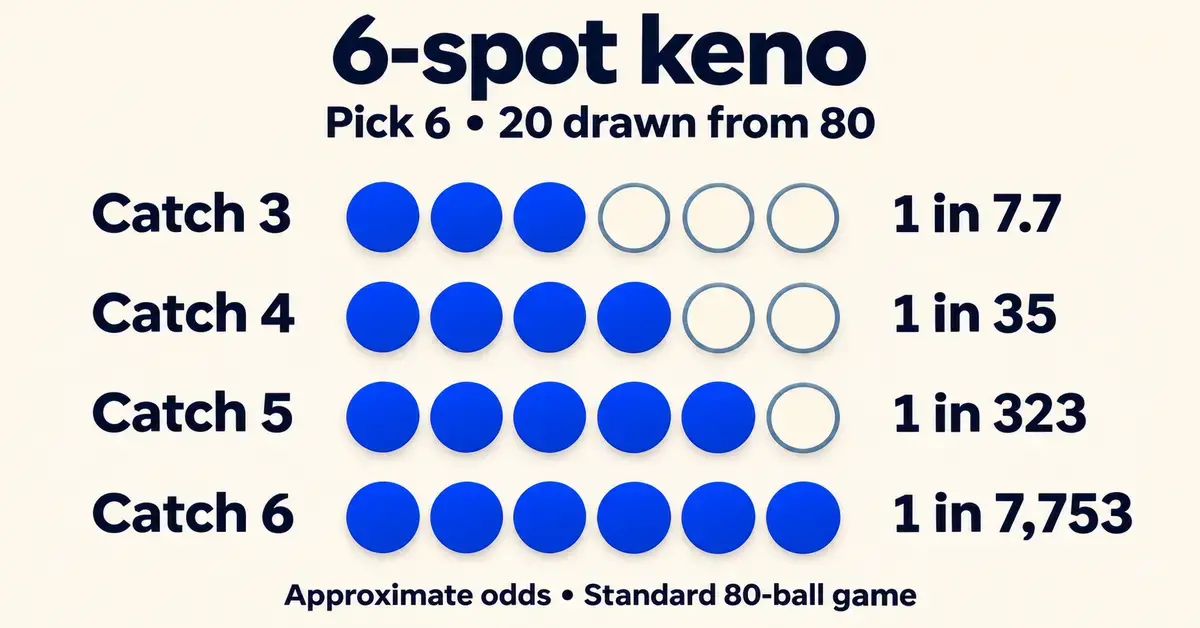
The odds of catching all 6 numbers on a 6-spot keno ticket are about 1 in 7,753 in a standard 80-ball game. Catching 5 of 6 is roughly 1 in 323, catching 4 is about 1 in 35, and catching 3 lands around 1 in 7.7. A 6-spot – where you pick six numbers and the game draws 20 – is one of the most commonly played bets because it offers a four-figure top prize while still paying on partial matches far more often than an 8- or 10-spot. One Canadian quirk matters before you start: Ontario’s OLG Daily Keno 6-Pick pays nothing unless you catch five or six, while an 80-ball game pays down to a three-catch.
Key Points
- Catch 6 of 6: about 1 in 7,753 on an 80-ball game; roughly 1 in 3,383 on OLG Daily Keno (70 numbers).
- Catch 5: ~1 in 323. Catch 4: ~1 in 35. Catch 3: ~1 in 7.7 (80-ball figures).
- Where it pays: an 80-ball 6-spot (BCLC, casino, video) pays from three catches up; OLG Daily Keno’s 6-Pick pays only on five or six – nothing for three or four.
- Top prize: about $1,500 on a $1 BCLC Keno play, or $1,000 on a $1 OLG Daily Keno 6-Pick ($10,000 on a $10 play).
- Win anything: roughly 1 in 6 draws on an 80-ball paytable that pays from three, but only about 1 in 161 on OLG’s 6-Pick.
- Odds are fixed: no number choice, Quick Pick or bonus multiplier changes them.
What a 6-spot keno ticket is
A 6-spot keno ticket means you choose six numbers – each chosen number is called a “spot” – and the game then draws 20 numbers at random. Every one of your spots that appears among the 20 drawn numbers is a “catch”. Your prize depends only on how many of your six you catch, not on which numbers they are.
The size of the number pool is set by the game, and that is where Canadian keno gets confusing. Classic 80-ball keno – the version offered through BCLC Keno in British Columbia, at casinos and bar monitors, and in most video and online keno – draws 20 numbers from a pool of 1 to 80. Ontario’s OLG Daily Keno instead uses a smaller pool of 1 to 70 and also draws 20. A smaller pool means a larger share of the board is drawn, so your odds of catching numbers are slightly better on the 70-number game – but, as you will see, the paytable is tighter. For the bigger picture of how matches turn into money across every bet size, see our overview of keno odds and payouts.
The odds of catching 3, 4, 5 and 6 numbers
On a standard 80-ball game, the chance of catching all six is about 1 in 7,753, and the odds improve sharply for each smaller catch. The table below gives the exact figures for a 6-spot, calculated from the hypergeometric probabilities of drawing 20 numbers from 80.
| Catch (of 6) | Odds (80-ball keno) | Chance per draw |
|---|---|---|
| 6 of 6 | 1 in 7,753 | 0.013% |
| 5 of 6 | 1 in 323 | 0.31% |
| 4 of 6 | 1 in 35 | 2.85% |
| 3 of 6 | 1 in 7.7 | 12.98% |
| 2 of 6 | 1 in 3.2 | 30.83% |
What are the odds of catching 6 out of 6?
Catching all six numbers is the jackpot result on a 6-spot, and on an 80-ball game it happens about once in 7,753 draws, or 0.013% of the time. On Ontario’s 70-number Daily Keno the same perfect catch is more likely – roughly 1 in 3,383 – because 20 of 70 numbers are drawn rather than 20 of 80.
What are the odds of catching 5 of 6?
Catching five of your six is far more frequent than a full catch: about 1 in 323 on an 80-ball game (0.31%), or roughly 1 in 169 on OLG Daily Keno. This is the second-highest prize tier on most 6-spot paytables.
What are the odds of catching 4 of 6?
Catching four of six comes up about 1 in 35 draws on an 80-ball game – around 2.85% of the time. On the 70-number game it is closer to 1 in 22. Whether four catches wins anything depends entirely on the game’s paytable: an 80-ball 6-spot usually pays a small prize for four.
What are the odds of catching 3 of 6?
Catching three of your six is the most common paying result on an 80-ball 6-spot, landing about 1 in 7.7 draws, or roughly 13% of the time. The catch is that this tier often pays only your stake back, so a frequent 3-catch does not mean you are ahead.
Why 6-spot odds differ between Canadian games
The number pool is the reason the same 6-spot bet has two different odds. OLG Daily Keno draws 20 of 70, so about 29% of the board is drawn each time; classic 80-ball keno draws 20 of 80, or 25%. The larger drawn share on the 70-number game makes every catch count slightly more likely, which is why the Ontario odds in the table below are shorter.
| Catch (of 6) | 80-ball keno (BCLC, casino, video) | OLG Daily Keno (70 numbers) |
|---|---|---|
| 6 of 6 | 1 in 7,753 | 1 in 3,383 |
| 5 of 6 | 1 in 323 | 1 in 169 |
| 4 of 6 | 1 in 35 | 1 in 22 (no OLG prize) |
| 3 of 6 | 1 in 7.7 | 1 in 5.9 (no OLG prize) |
Better match odds do not automatically mean a better bet, because OLG’s shorter odds come with a much tighter paytable than the 80-ball game. Which game suits you is really a question of how many spots and what paytable you want, covered in our guide to how many keno spots to play.
What does a 6-spot keno ticket pay?
Prizes are set by each operator and scale with your wager – a $2 bet pays double a $1 bet, and so on. The figures below are per $1 played; always confirm current amounts on the official game conditions, because operators can revise them.
BCLC Keno 6-spot prizes (80-ball, per $1)
In British Columbia, BCLC Keno pays a 6-spot down to three catches:
| Catch | Odds | Prize on $1 |
|---|---|---|
| 6 of 6 | 1 in 7,753 | $1,500 |
| 5 of 6 | 1 in 323 | $50 |
| 4 of 6 | 1 in 35 | $5 |
| 3 of 6 | 1 in 7.7 | $1 |
| 2 or fewer | — | No prize |
The most a single BCLC Keno ticket can win on one draw is $200,000, regardless of how much you wager, before the optional add-on. The Keno Bonus multiplier (a random 1.5x, 2x, 5x, 7x or 10x revealed before the draw) can lift winnings to as much as $2,000,000, but it doubles the ticket cost and does not change your odds of catching numbers – it only multiplies the prize you already won.
OLG Daily Keno 6-Pick prizes (70-ball, per $1)
Ontario’s OLG Daily Keno runs a 6-Pick on its 70-number pool, and its paytable is noticeably tighter – only the top two catches pay:
| Catch | Odds | Prize on $1 |
|---|---|---|
| 6 of 6 | 1 in 3,383 | $1,000 |
| 5 of 6 | 1 in 169 | $25 |
| 4 or fewer | — | No prize |
On a 6-Pick, the top prize is $1,000 on a $1 bet and scales up to $10,000 on a $10 bet. Catch four or three and you win nothing, even though those catches happen often – a crucial difference from the 80-ball game.
How often you actually win on a 6-spot
On an 80-ball paytable that pays from three catches, you win something roughly 1 in 6 draws – the catch-3-or-better rate is about 16%. That sounds frequent, but most of those wins are the $1 three-catch that simply returns your stake, so winning “often” is not the same as coming out ahead. On OLG’s 6-Pick, where only five or six catches pay, you win a prize only about 1 in 161 draws.
Over many tickets, keno keeps one of the higher house edges of any lottery-style game, meaning the total prizes paid out are well below the total staked. No bet size, number choice or multiplier changes that long-run math; a 6-spot is entertainment with a negative expected return, not a way to profit.
How a 6-spot compares with other spot counts
A 6-spot sits in the middle of the board. Compared with a 4-spot, it catches a paying result less often but offers a bigger top prize; compared with an 8- or 10-spot, it pays far more frequently but the jackpot is smaller. If you want the long-shot headline prizes, the 8-spot keno odds and the odds on a 10-spot and its jackpot show how steeply the top catch gets rarer as you add spots – a 10-spot perfect catch is about 1 in 8.9 million on an 80-ball game, versus 1 in 7,753 for a 6-spot. More spots stretch the top prize and the odds together; fewer spots do the reverse.
Common mistakes 6-spot players make
- Chasing “hot,” “cold” or lucky numbers. Every number has the same chance every draw, and draws are independent. No pattern or system shifts the odds.
- Believing Quick Pick is luckier than hand-picking. Randomly generated spots and hand-chosen spots carry identical odds.
Responsible Gambling Disclaimer
This article is for general information only and is not gambling advice or encouragement to play. Keno is a game of chance with a fixed, built-in house edge, so over time it returns less than is wagered, and no strategy, number choice or bet size changes the odds. You must be of legal age in your province (18 or 19) to play. Prizes and odds are set by each provincial operator and can change – always confirm current figures with the official game conditions. If gambling is affecting you or someone you know in Ontario, ConnexOntario offers free, confidential 24/7 support at 1-866-531-2600 or by texting CONNEX to 247247; see our responsible gambling page for help lines across Canada.
Sources
Frequently Asked Questions (FAQ)
How many numbers do you need to match to win on a 6-spot keno ticket?
It depends on the game. On a standard 80-ball 6-spot, such as BCLC Keno, catching three or more pays – though three often just returns your stake. On OLG Daily Keno’s 6-Pick, you must catch five or six; four or fewer wins nothing.
Does a 6-spot keno ticket pay for matching zero numbers?
No. Unlike some higher-spot tickets that pay a small prize for catching none, both the 80-ball 6-spot and OLG’s 6-Pick pay nothing for zero catches.
Is a 6-spot better than a 4-spot or an 8-spot?
Neither is “better” – they trade frequency for prize size. A 4-spot catches a paying result more often but tops out lower; an 8-spot pays rarely but offers a much bigger jackpot. A 6-spot is a middle ground. All carry a house edge, so none is a winning bet over time.
