

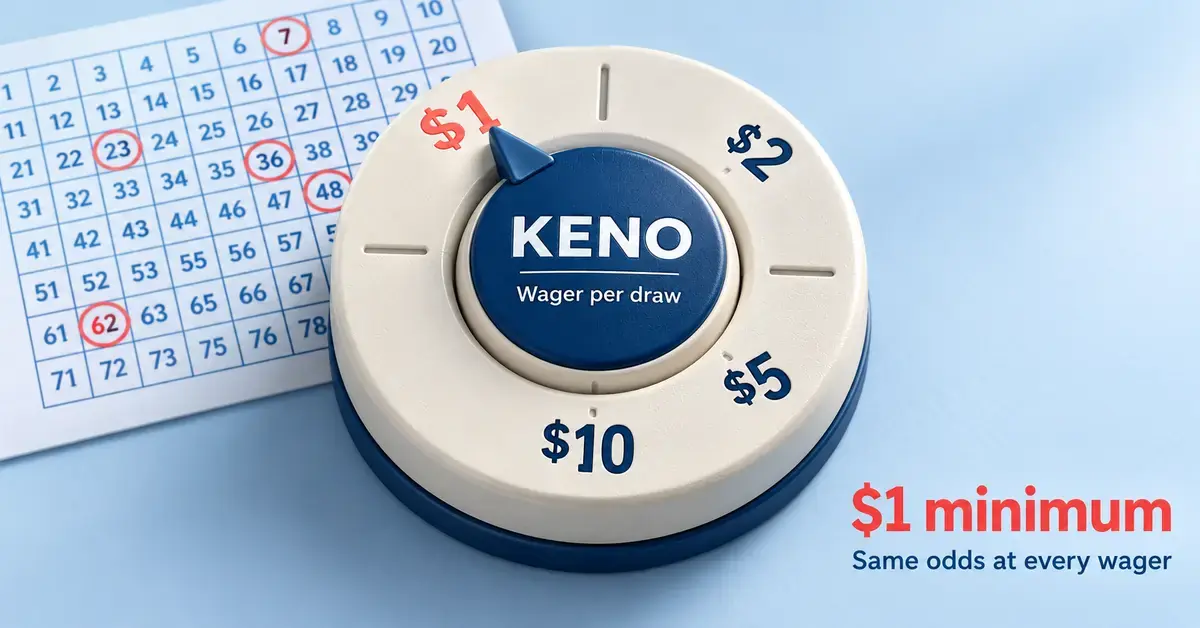
The minimum cost to play keno in Canada is $1 for one set of numbers in a single draw. From there the price is entirely in your hands: every provincial keno game uses the same four wager levels — $1, $2, $5 and $10 per play — and your total depends on how much you stake, how many draws you buy and whether you add an optional feature. This guide breaks down the wagers and minimums for each Canadian keno game, shows how a ticket’s total cost is calculated, and clears up the single biggest misunderstanding about paying more.
Key Points
- The minimum cost to play keno anywhere in Canada is $1 — one set of numbers in one draw.
- Every provincial keno game offers the same four wagers: $1, $2, $5 and $10 per play, with $1 as the default.
- Your wager multiplies the prize, not the odds: a $10 bet pays 10x a $1 bet on the same catch, but your chance of matching is identical.
- Total ticket cost = wager per draw x number of draws, plus any optional add-ons.
- Add-ons raise the price: BCLC’s Keno Bonus doubles the wager, while ENCORE (Ontario) and TAG (Atlantic) add $1 per play.
- Way, combination and king tickets stack several bets on one slip, so the cost can climb far beyond the base wager.
How much does it cost to play keno in Canada?
You can play keno in Canada for as little as $1. That $1 buys one set of chosen numbers (your “spots”) entered into one draw. There is no cheaper entry — $1 is the floor across Ontario’s OLG Daily Keno, BCLC Keno in British Columbia, WCLC Keno in the Prairie provinces, Keno Atlantic in the Atlantic provinces and Loto-Québec’s Banco in Quebec.
Where the cost grows is the choices you layer on top. Staking more per play, entering the same numbers into several draws at once, or adding a bonus feature all raise the price. None of those choices is required, so the cheapest honest answer to “how much does keno cost” is simply $1 — and you decide whether to spend more. If you are new to the mechanics, our full guide to how to play keno walks through spots, draws and wagers step by step.
What are the keno wager amounts and minimum bets?
Every regulated Canadian keno game offers the same four wager amounts: $1, $2, $5 and $10 per play. The $1 wager is both the default and the minimum — on most selection slips, if you do not mark a wager box at all, the terminal charges $1 automatically.
The wager does two things. First, it sets your minimum spend. Second, it acts as a multiplier on any prize: a $10 wager pays ten times what a $1 wager pays for the exact same numbers and the exact same matches. A $2 wager pays double a $1 wager, a $5 wager pays five times, and so on. What the wager does not do is change your chance of matching — more on that below. The published prize tables are usually shown “per $1 wagered,” so you multiply the listed prize by your stake.
Keno wagers and minimums by province
The wager ladder is identical nationwide, but the number pool, the draw schedule, how many draws you can load onto one ticket and the optional add-ons differ by operator. The table below summarises the price side of each game, and the sections that follow add the detail. For the full map of games, see our hub on provincial keno games across Canada.
Cost by Province
| Game (operator) | Province(s) | Wager per play | Minimum | Draws per ticket | Main optional add-on |
|---|---|---|---|---|---|
| OLG Daily Keno | Ontario | $1 / $2 / $5 / $10 | $1 | Two daily draws; Advance Play for upcoming draws | ENCORE (+$1) |
| BCLC Keno | British Columbia | $1 / $2 / $5 / $10 | $1 | Up to 99 consecutive draws | Keno Bonus (doubles the wager) |
| WCLC Keno | Alberta, Saskatchewan, Manitoba | $1 / $2 / $5 / $10 | $1 | Up to 99 consecutive draws | — |
| Keno Atlantic (ALC) | New Brunswick, Nova Scotia, PEI, Newfoundland & Labrador | $1 / $2 / $5 / $10 | $1 | One nightly draw | TAG (+$1) |
| Banco (Loto-Québec) | Quebec | $1 / $2 / $5 / $10 | $1 | Nightly draws | Optional Turbo feature |
Ontario: OLG Daily Keno
OLG Daily Keno costs $1 to $10 per play. You select a wager of $1, $2, $5 or $10, pick between 2 and 10 numbers from a pool of 1 to 70, and match them against the 20 numbers drawn. There are two draws a day, and you can enter the same numbers into upcoming draws with Advance Play. For an extra $1 you can add ENCORE at checkout, a separate add-on game with its own draw and prizes. Full rules and prize tiers are covered in our guide to OLG Daily Keno.
British Columbia: BCLC Keno
BCLC Keno costs $1 to $10 per draw, and the pace is far quicker than Ontario’s. You pick up to 10 numbers from 1 to 80, choose a wager of $1, $2, $5 or $10, and decide how many consecutive draws to play — up to 99 on a single ticket, with a draw roughly every 3.5 minutes. Your total is the per-draw wager multiplied by the number of draws, capped at $100 for a plain ticket. The optional Keno Bonus multiplier costs an extra $1 for every $1 wagered, so it doubles your ticket price (raising the maximum wager to $200) in exchange for a random multiplier of 1.5x, 2x, 5x, 7x or 10x on wins. See our dedicated guide to BCLC Keno for the full picture.
Alberta, Saskatchewan and Manitoba: WCLC Keno
WCLC Keno costs $1 to $10 per draw across the Prairie provinces. You pick 1 to 10 numbers from a pool of 1 to 80, and the wager options are $1, $2, $5 and $10 — defaulting to $1 if you leave the wager box blank. A single ticket can cover from 1 up to 99 consecutive draws, with draws held roughly every five minutes, so the same wager-times-draws maths applies. Prizes are limited to $100,000 per ticket per draw regardless of how much you wager.
Atlantic Canada: Keno Atlantic (ALC)
Keno Atlantic costs $1 to $10 per play in New Brunswick, Nova Scotia, Prince Edward Island and Newfoundland and Labrador. You choose 2 to 10 spots from a pool of 1 to 70 and a wager of $1, $2, $5 or $10, with one draw held each night. For an extra $1 you can add TAG, a bonus feature that gives an additional chance at a prize. Because the wager scales the prize, a $1 play matching all 10 spots pays a different amount than a $10 play, with the game’s top prize reaching $2.5 million on a $10 wager.
Quebec: Banco (Loto-Québec)
In Quebec, the keno-style draw game is Banco from Loto-Québec, and it uses the same $1, $2, $5 and $10 stake levels, with $1 as the minimum. As with every other keno game, the stake you choose multiplies the prize rather than your odds. Banco is sold only in Quebec, where the legal age to play is 18.
How is the total cost of a keno ticket calculated?
The total cost of a keno ticket is your wager per draw multiplied by the number of draws, plus any optional add-ons. In plain terms:
Total cost = (wager per draw) x (number of draws) + (add-ons)
So a $2 wager played over 5 draws costs $10 before any extras. Understanding each part keeps the final price from surprising you at the counter.
Playing several draws at once
Buying multiple draws is the most common reason a ticket costs more than $1. Instead of returning to buy a fresh ticket each time, you can enter the same numbers into a run of upcoming draws on one slip — 2 to 99 draws depending on the game. The wager is charged per draw, so a $1 ticket set to 20 draws costs $20, not $1. This is convenient but front-loads your spending, so it is worth doing the multiplication first. Our guide to playing keno for multiple draws with Advance Play covers the limits and the trade-offs.
Add-ons that raise the price
Optional add-ons are the second way a keno ticket gets more expensive. Each is genuinely optional and never required to play:
- Keno Bonus (BCLC): doubles your wager — an extra $1 for every $1 bet — for a random win multiplier up to 10x.
- ENCORE (OLG, Ontario): a flat extra $1 per play for a separate add-on game with its own draw.
- TAG (Keno Atlantic): an extra $1 per play for an added chance at a bonus prize.
These features change the price and the prize structure, but none of them changes your odds of matching your chosen numbers.
Way, combination and king tickets
Way, combination and king tickets can multiply the cost of a single slip dramatically. These let you group your numbers so that one ticket contains several bets at once — for example, splitting eight numbers into overlapping groups that each count as their own wager. The catch is that each of those internal bets carries the full wager, so a slip you expect to cost a few dollars can run to $20, $30 or more. If you plan to use them, read our breakdown of way, combination and king tickets so the total does not catch you off guard.
Does paying more change your odds of winning?
No — a bigger wager scales your potential prize, not your chance of winning. This is the single most important cost fact in keno. Whether you stake $1 or $10, your probability of matching any given number of spots is exactly the same; the draw does not know or care what you wagered. A $10 bet simply pays ten times a $1 bet when you do win.
The same is true of add-ons and ticket types. The Keno Bonus multiplier, ENCORE and TAG all add cost and can raise what you take home, but they do not improve your hit rate. Spending more buys a larger prize if luck lands your way — it never buys better luck.
Worked examples: what a keno ticket really costs
A few concrete examples show how the formula plays out:
- The cheapest play: $1 wager, one set of numbers, one draw = $1.
- A single bigger bet: $5 wager, one draw = $5 (prizes pay five times the $1 table).
- A week of the same numbers: $1 wager over 14 draws = $14.
- BCLC Keno with the bonus: $2 wager x 10 draws = $20, then doubled by the Keno Bonus = $40.
- Ontario with ENCORE: $2 Daily Keno wager + $1 ENCORE = $3 per play.
In each case the price is predictable the moment you know your wager, your number of draws and your add-ons.
Common mistakes when budgeting for keno
The most common costing mistake is assuming the per-draw price is the ticket price. Multi-draw tickets charge the wager for every draw, so a $5 wager over 20 draws is $100, not $5. Watch for these other traps:
- Thinking a larger wager improves your chances. It only multiplies the prize; the odds are fixed.
- Forgetting that add-ons stack on top. The Keno Bonus doubles the whole ticket, while ENCORE and TAG add $1 per play.
- Underestimating way and combination tickets. Each grouped bet carries the full wager, so the slip total can be many times the base price.
- Buying a long run of advance draws on impulse. Committing to 50 or 99 draws at once locks in a far bigger spend than a single play.
- Confusing the prize cap with the payout. Per-draw prize limits (for example $100,000 on WCLC Keno or $200,000 on a plain BCLC Keno ticket) cap what you can win regardless of how much you bet.
How to keep your keno spending predictable
Decide your total budget before you reach the terminal, then work backwards to a wager and draw count that fit it. Because keno carries one of the higher house edges in gambling, the realistic way to control cost is to treat your stake as the price of entertainment, not an investment, and to stick to the amount you set. Setting a firm limit and sizing each bet to it is the core of sensible keno bankroll management. Skipping optional add-ons and keeping draw counts short are the two simplest ways to keep the price at or near the $1 minimum.
Disclaimer
This article is for information only and is not gambling advice or encouragement to play. Keno is a game of chance with a fixed house edge; no wager size, add-on or ticket type improves your odds, and over time the game is designed to return less than it takes in. You must be of legal age to play — 19 in most provinces, and 18 in Alberta, Manitoba and Quebec. If gambling is affecting you or someone you know, free, confidential help is available; see our responsible gambling resources for Canada for provincial helplines and support.
Sources
Frequently Asked Questions (FAQ)
What is the cheapest way to play keno in Canada?
The cheapest keno play is $1: one set of numbers entered into a single draw, with no add-ons. This $1 minimum applies to every provincial keno game in Canada.
Can you play keno for less than $1?
No. The lowest wager offered on Canadian keno games is $1 per play, and it is the default if you do not mark a wager box. There is no sub-$1 option.
Does a $10 keno bet have better odds than a $1 bet?
No. A $10 wager pays ten times the prize of a $1 wager on the same numbers and matches, but your chance of matching is identical. The wager scales the prize, never the odds.
Why did my keno ticket cost more than I expected?
Almost always because it covered multiple draws or included an add-on. The wager is charged for every draw, so a $2 ticket over 10 draws is $20, and features like the Keno Bonus double the total.
How much does the Keno Bonus or a multiplier add to the cost?
Multiplier add-ons such as BCLC’s Keno Bonus cost an extra $1 for every $1 wagered, which doubles your ticket price. In return, wins are multiplied by a random factor of up to 10 times.
