

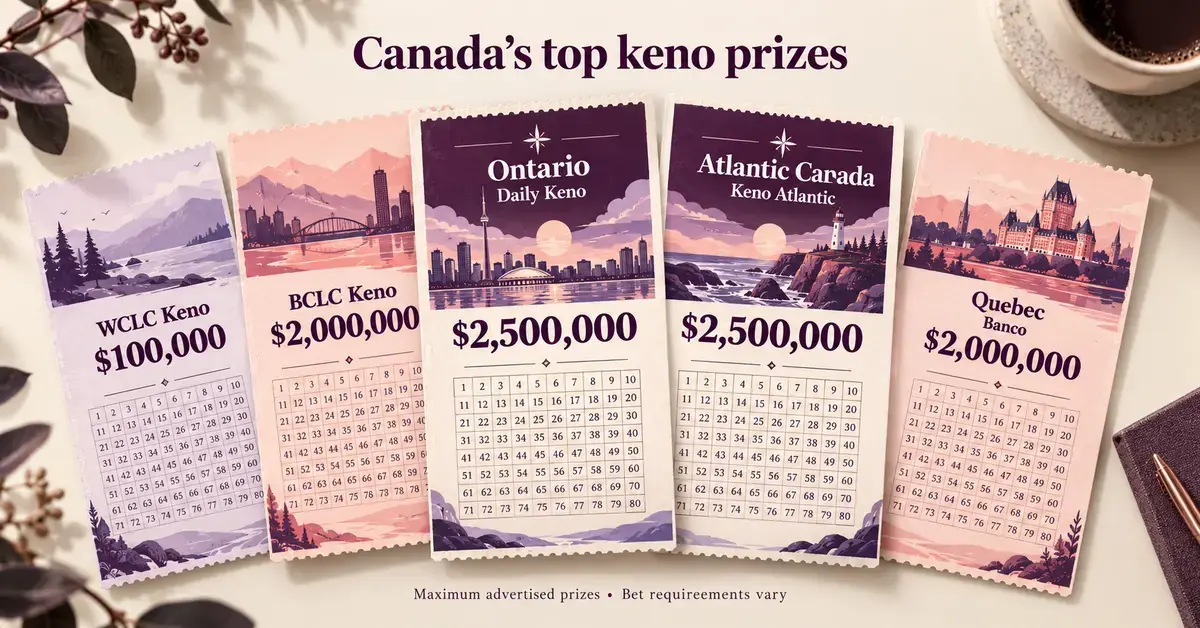
If you are asking which keno game pays the most in Canada, the short answer is Ontario’s Daily Keno and Atlantic Canada’s Keno Atlantic: both advertise a top prize of up to $2,500,000 on a single play. But “pays the most” can mean the biggest possible cheque, the best return for a $1 bet, or the best value once the odds are taken into account — and those three questions do not all point to the same game. This guide compares the five provincial keno products side by side so you can see exactly where each one stands.
Key Points
- The highest keno top prize in Canada is $2,500,000, offered by OLG Daily Keno (Ontario) and Keno Atlantic (Atlantic Canada) on a $10 play that matches 10 of 10 numbers.
- BCLC Keno (British Columbia) and Loto-Québec’s Banco (Quebec) top out at $2,000,000.
- WCLC Keno (Alberta, Saskatchewan, Manitoba) pays the least at the top, with a $100,000 cap per ticket per draw.
- For the same $1 bet, Ontario and Atlantic Canada pay $250,000 for 10 of 10 — and at shorter odds (1 in 2,147,181) than the 80-number BC and Prairie games (about 1 in 8,911,711).
- Bonus features and bigger wagers raise the prize, never the odds. Every keno game carries a high house edge and returns less than players wager.
The short answer: which keno game pays the most?
Ontario’s Daily Keno (run by OLG) and Keno Atlantic (run by the Atlantic Lottery Corporation) pay the most of any keno game in Canada, with a maximum prize of $2,500,000. That figure applies to a $10 wager on a 10-number selection where all 10 numbers match the draw.
The other provincial games sit below that ceiling. British Columbia’s BCLC Keno and Quebec’s Banco both cap out at $2,000,000, and the Western Canada Lottery Corporation (WCLC) Keno game played in Alberta, Saskatchewan and Manitoba pays the least at the very top, with a hard limit of $100,000 per ticket per draw.
Keep in mind that these are the maximum jackpots, not what a typical ticket returns. Hitting them means matching all 10 of your numbers against the 20 drawn — an outcome with odds in the millions-to-one range. The rest of this comparison breaks the numbers down so the headline figure makes sense.
What “pays the most” actually means
There are three fair ways to measure how much a keno game pays, and it helps to keep them separate.
- Highest possible prize. The single largest amount one ticket can win in one draw. This favours the games that let the prize scale up with a bigger wager.
- Most paid for the same bet. What a standard $1 play returns for the same result (for example, matching 10 of 10). This strips out the wager size so you compare like for like.
- Best value for the odds. Whether a game pays more relative to how hard the result is to hit, and how much of each dollar wagered is returned to players over time (the return to player, or RTP).
A game can lead on one measure and trail on another. BCLC Keno can reach $2,000,000, but only by paying double for a bonus feature; WCLC Keno never pays more than $100,000 no matter how much you stake. The sections below rank the games on each measure.
Top prize by province: the payout comparison
The table below compares the headline numbers for each regulated provincial keno game. All figures are the maximum top prize for matching 10 of 10 numbers, taken from each operator’s current game information.
Payout Comparison
| Province / operator | Game | Number pool | Spots | Draw frequency | Max top prize |
|---|---|---|---|---|---|
| Ontario — OLG | Daily Keno | 1–70 | 2–10 | Twice daily | $2,500,000 ($10 play, 10/10) |
| Atlantic Canada — ALC | Keno Atlantic | 1–70 | 2–10 | Nightly | $2,500,000 ($10 play, 10/10) |
| British Columbia — BCLC | Keno | 1–80 | 1–10 | Every ~3.5 min | $2,000,000 (with 10x Keno Bonus) |
| Quebec — Loto-Québec | Banco | 1–70 | 2–10 | Nightly | $2,000,000 ($10 play, 10/10) |
| Alberta / Sask. / Manitoba — WCLC | Keno | 1–80 | 1–10 | Every ~5 min | $100,000 (cap per ticket per draw) |
Ontario — OLG Daily Keno: up to $2,500,000
OLG Daily Keno is one of the two highest-paying keno games in the country. You pick 2 to 10 numbers from a pool of 1 to 70, choose a wager of $1, $2, $5 or $10, and match against the 20 numbers drawn. Matching all 10 on a 10-number play pays $250,000 for every $1 wagered, so a $10 play that catches 10 of 10 returns the maximum $2,500,000. There are two draws a day, at roughly 2:00 p.m. and 10:30 p.m. Eastern. (The separate ENCORE add-on has its own $1,000,000 top prize, but that is a different game, not a keno payout.) Our full breakdown of OLG Daily Keno rules, prizes and odds covers every pick level.
Atlantic Canada — Keno Atlantic: up to $2,500,000
Keno Atlantic matches Ontario at the top. Offered across New Brunswick, Nova Scotia, Prince Edward Island and Newfoundland and Labrador, it also uses a 1-to-70 number pool, a 2-to-10 selection and $1 to $10 wagers. A 10-of-10 catch pays $250,000 per $1, reaching $2,500,000 on a $10 play. The game draws once nightly. An optional add-on called TAG adds a separate six-digit game worth up to $100,000, which is not part of the keno prize itself. See how Keno Atlantic works across the Atlantic provinces for the full prize table.
British Columbia — BCLC Keno: up to $2,000,000
BCLC Keno pays a base top prize of $200,000, but it is the only Canadian keno game with a built-in multiplier that can push a win into seven figures. You pick up to 10 numbers from a pool of 1 to 80, and a new draw runs about every three and a half minutes. The optional Keno Bonus multiplies any prize by 1.5x, 2x, 5x, 7x or 10x, so a 10x bonus on the $200,000 base reaches the $2,000,000 maximum. The catch: adding Keno Bonus doubles the cost of your ticket, and it does not improve your chance of matching numbers. Read how BCLC Keno and the Keno Bonus work before adding it.
Quebec — Loto-Québec Banco: up to $2,000,000
Quebec has no game called Keno; its keno-style draw game is Banco. You pick 2 to 10 numbers from 1 to 70 and wager $1 to $10, with a nightly draw. Matching 10 of 10 pays a grand prize of $200,000 per $1, so a $10 play reaches $2,000,000. Banco also offers an optional Turbo feature that multiplies prizes by up to 10x (Turbo is not available on the $10, 10-number play). The full Banco prize schedule is explained in our guide to Loto-Québec’s keno-style games.
Alberta, Saskatchewan and Manitoba — WCLC Keno: up to $100,000
WCLC Keno pays the least at the top. The game uses a 1-to-80 pool, lets you pick 1 to 10 numbers, and draws about every five minutes. Its published rules cap the prize at $100,000 per ticket per draw — regardless of how much you wager and regardless of the bonus structure. If two or more tickets hit the top prize in the same draw, the combined payout is shared, with no single ticket exceeding the cap.
Same bet, different payout: why the 70-number games pay more
For the same $1 bet, the Ontario and Atlantic games pay the most — and they do it at shorter odds. This is the detail most payout comparisons miss. The games split into two groups by the size of their number pool, and that changes both the prize and the odds.
- 70-number games (OLG Daily Keno, Keno Atlantic, Banco) draw 20 numbers from 1 to 70. The chance of matching all 10 of a 10-number pick is about 1 in 2,147,181.
- 80-number games (BCLC Keno, WCLC Keno) draw 20 numbers from 1 to 80. The same 10-of-10 result is far rarer, about 1 in 8,911,711.
The table below lines up the top 10-of-10 prize against the odds of hitting it.
| Game (number pool) | Odds of matching 10 of 10 | 10-of-10 prize per $1 |
|---|---|---|
| OLG Daily Keno (1–70) | 1 in 2,147,181 | $250,000 |
| Keno Atlantic (1–70) | 1 in 2,147,181 | $250,000 |
| Banco (1–70) | 1 in 2,147,181 | $200,000 |
| BCLC Keno (1–80) | ~1 in 8,911,711 | up to $200,000 (prize cap) |
| WCLC Keno (1–80) | ~1 in 8,911,711 | $100,000 (prize cap) |
Read across the table and the pattern is clear: OLG Daily Keno and Keno Atlantic pay the biggest 10-of-10 prize and give you the best chance of hitting it, because the 70-number pool makes the jackpot roughly four times more likely than on an 80-number game. Banco uses the same favourable odds but pays $200,000 for a $1 result rather than $250,000. BCLC and WCLC face the longest odds and, in WCLC’s case, the smallest ceiling.
Do bonus features change which keno pays the most?
Bonus add-ons can raise your maximum prize, but they also raise your cost and never improve your odds. Two provincial games offer them:
- BCLC Keno Bonus multiplies any win by 1.5x to 10x and roughly doubles the price of the ticket. A 10x bonus is what lets BCLC reach $2,000,000 from its $200,000 base.
- Banco Turbo multiplies prizes by up to 10x on eligible plays, with its own added cost.
Even with a 10x bonus, BCLC’s $2,000,000 maximum still falls short of the $2,500,000 that OLG Daily Keno and Keno Atlantic pay with no bonus purchase at all. So bonus features do not change the overall answer: the two 70-number games at the top still pay the most, and they do it without asking you to double your stake. A multiplier only ever scales a win you were going to get anyway — it does nothing to the chance of getting it.
Why the biggest top prize is not the best value
A larger top prize does not make a game a better bet, because every keno game returns less than it takes in. This is the single most important point in any honest payout comparison. Keno carries one of the highest house edges in regulated gambling — commonly in the 25% to 35% range depending on the game and pick level — which means the long-run return to player sits well below 100%. Over many tickets, the game is designed to keep a large share of every dollar wagered.
That edge is the same whether the headline prize is $100,000 or $2,500,000. A bigger jackpot is funded by longer odds, not by the house giving up its margin. For a deeper look at how this works, see our explainer on the keno house edge and return to player. The practical takeaway: choose a game because the format, draw pace and price suit you, not because its top number is the largest.
Common mistakes when comparing keno payouts
Readers comparing keno games often reach the wrong conclusion for one of these reasons:
- Comparing the $10 maximum to a $1 prize. OLG’s $2,500,000 is a $10-wager figure; its $1 figure is $250,000. Always compare the same wager.
- Ignoring the odds behind the prize. BCLC and WCLC’s 80-number pool makes the jackpot about four times harder to hit than the 70-number games, so a similar prize is worth less.
- Assuming a multiplier improves your chances. Keno Bonus and Turbo scale the prize but never the odds, and they cost extra.
- Treating the top prize as a likely outcome. Matching all 10 numbers is a millions-to-one event; most tickets win a small prize or nothing.
- Confusing add-on games with keno. OLG’s ENCORE and ALC’s TAG are separate games bolted onto the ticket, not part of the keno prize.
Which provincial keno is right for you?
The best game depends on where you live and what you value, since each provincial lottery sells only its own product. A few plain comparisons:
- Biggest possible prize: OLG Daily Keno (Ontario) or Keno Atlantic (Atlantic Canada), at up to $2,500,000.
- Most for a $1 bet: again OLG Daily Keno and Keno Atlantic, at $250,000 for 10 of 10.
- Fastest action: BCLC Keno, with a draw roughly every 3.5 minutes, or WCLC Keno every 5 minutes.
- Built-in multiplier: BCLC Keno (Keno Bonus) or Banco (Turbo), if you want the option to scale a win — at extra cost.
For a broader look at every regulated game and where it is sold, see our overview of keno in Canada and its provincial games. And if you are curious about real payouts people have actually collected rather than advertised maximums, our round-up of the biggest keno wins in Canada covers the record cheques.
Responsible gambling and disclaimer
This article is for information only and is not advice to play or a prediction of any outcome. Keno is a game of chance with a high house edge; the prize figures above are maximums that are extremely unlikely to be won on any given ticket, and over time keno returns less than players wager. No game, wager size, bonus or number choice improves your odds of winning. You must meet your province’s minimum legal age to play (18 or 19, depending on the province).
If gambling is affecting you or someone you know, free, confidential help is available in Canada. ConnexOntario offers support 24/7 at 1-866-531-2600 (or text CONNEX to 247247). In British Columbia, call 1-888-795-6111; in Alberta, 1-866-461-1259; in Quebec, 1-800-461-0140. You can also find provincial helplines and self-exclusion options through our responsible gambling resources for Canada.
Sources
Frequently asked questions (FAQ)
Which keno game has the highest jackpot in Canada?
OLG Daily Keno in Ontario and Keno Atlantic in the Atlantic provinces share the highest top prize, at $2,500,000. Both pay $250,000 per $1 for matching all 10 numbers on a 10-number play, so a $10 play reaches the maximum.
Does a bigger wager really increase the keno prize?
Yes, in most provincial games the prize scales with the wager. OLG Daily Keno, Keno Atlantic and Banco pay the listed amount for each $1 staked, so a $10 play pays ten times the $1 prize. WCLC Keno is the exception: it caps every prize at $100,000 per ticket per draw no matter how much you wager.
Why does BCLC Keno pay less than Ontario even with the 10x bonus?
BCLC Keno starts from a $200,000 base, and a 10x Keno Bonus lifts that to $2,000,000 — still below Ontario’s $2,500,000. On top of that, BCLC uses an 80-number pool, so the jackpot is about four times harder to hit than Ontario’s 70-number game, and the bonus doubles the ticket cost.
Which keno game gives the best value for money?
No keno game offers good long-run value, because all of them carry a house edge that is commonly 25% to 35%. The 70-number games (OLG Daily Keno, Keno Atlantic, Banco) pay larger prizes at shorter jackpot odds than the 80-number games, but every version returns less than players wager over time.
Can I play another province’s keno for the bigger prize?
Provincial lotteries generally sell their keno games only within their own region, and online play is restricted to residents of the operating province. In practice you play the keno game offered where you live, so compare the one available to you rather than trying to buy across provinces.
